How Early Radio Receivers Worked

If you’ve ever built a crystal radio, there’s something magical about being able to pull voices and music from far away out of thin air. If you haven’t built one, maybe you should while there’s still something on the AM band. Of course, nowadays the equivalent might be an SDR. But barring a computer solution, there are not many ways to convert radio waves into intelligence. From a pocket radio to advanced RADAR to a satellite in orbit, receiving a radio wave is accomplished in pretty much the same way.

There are, however, many ways to modulate and demodulate that radio wave. Of course, an AM radio works differently than an FM radio. A satellite data downlink works differently, too. But the process of capturing the radio wave from the air and getting them into a form ready for further processing hasn’t changed much over the years.

In this article, I’ll talk about the most common radio receiver architectures you may have seen in years past, and next week I’ll talk about modern architectures. Either way, understanding receiver architectures will help you design new radios or troubleshoot them.

Continue reading “How Early Radio Receivers Worked”

This Week In Security: F5, Novel Ransomware, Freta, And Database Woes

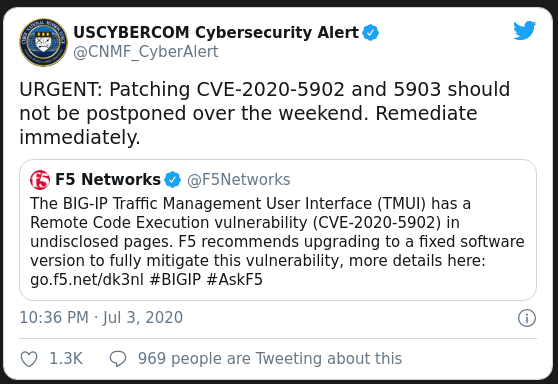
The big story of the last week is a problem in F5’s BIG-IP devices. A rather trivial path traversal vulnerability allows an unauthenticated user to call endpoints that are intended to be restricted to authenticated. That attack can apparently be as simple as:

'https://[F5 Host]/tmui/login.jsp/..;/tmui/locallb/workspace/tmshCmd.jsp?command=list+auth+user+admin'

A full exploit has been added to the metasploit framework. The timeline on this bug is frighteningly quick, as it’s apparently being actively exploited in the wild. F5 devices are used all over the world, and this vulnerability requires no special configuration, just access to the opened management port. Thankfully F5 devices don’t expose the vulnerable interface to the internet by default, but there are still plenty of ways this can be a problem.

Freta

Microsoft has made a new tool publicly available, Freta. This tool searches for rootkits in uploaded memory snapshots from a Linux VM. The name, appropriately, is taken from the street where Marie Curie was born.

The project’s namesake, Warsaw’s Freta Street, was the birthplace of Marie Curie, a pioneer of battlefield imaging.

The impetus behind the project is the realization that once a malicious actor has compromised a machine, it’s possible to compromise any security software running on that machine. If, instead, one could perform a security x-ray of sorts, then a more reliable conclusion could be reached. Freta takes advantage of the VM model, and the snapshot capability built into modern hypervisors.

Continue reading “This Week In Security: F5, Novel Ransomware, Freta, And Database Woes”

Art of 3D printer in the middle of printing a Hackaday Jolly Wrencher logo

3D Printering: Selling Prints, And Solving The Pickup Problem

After getting a 3D printer up and running, it’s not uncommon for an enterprising hacker to dabble in 3D printing to make a little money on the side. Offering local pickup of orders is a common startup choice since it’s simple and avoids shipping entirely. It’s virtually tailor-made to make a great bootstrapping experiment, but anyone who tries it sooner or later bumps up against a critical but simple-seeming problem: how to get finished prints into a customer’s hands in a sustainable way that is not a hassle for either the provider, or the customer?

It’s very easy to accept a 3D file and get paid online, but the part about actually getting the print into the customer’s hands does not have a one-size-fits-all solution. This is what I call The Pickup Problem, and left unsolved, it can become unsustainable. Let’s look at why local pickup doesn’t always measure up, then examine possible solutions.

The Problems with Local Pickup

Local pickup for delivery of print jobs is great because there is no mucking about with shipping supplies or carriers. Also, many 3D prints when starting out will be relatively low-value jobs that no one is interested in stacking shipping fees onto, anyway.

“Your order is complete. Come to this address to pick up your order.” It is straightforward and hits all the bases, so what’s the problem?

Continue reading “3D Printering: Selling Prints, And Solving The Pickup Problem”

Bridge Over Trebled Water: How The Golden Gate Bridge Started To Sing

Throughout the spring, some Bay Area residents from Marin County to the Presidio noticed a sustained, unplaceable high-pitched tone. In early June, the sound reached a new peak volume, and recordings of the eerie noise spread across Twitter and Facebook. Soon after, The Golden Gate Bridge, Highway, & Transportation District, the agency responsible for the iconic suspension bridge’s maintenance, solved the mystery: The sound was due to high winds blowing through the slats of the bridge’s newly-installed sidewalk railing. Though a more specific explanation was not provided, the sound is most likely an Aeolian tone, a noise produced when wind blows over a sharp edge, resulting in tiny harmonic vortices in the air.

The modification of the Golden Gate Bridge railing is the most recent and most audible element of a multi-phase retrofit that has been underway since 1997. Following the magnitude 6.9 Loma Prieta Earthquake in 1989, The Golden Gate Bridge, Highway, & Transportation District (The District) began to prepare the iconic bridge for the wind and earthquake loads that it may encounter in its hopefully long life. Though the bridge had already withstood the beating of the Bay’s strong easterly winds and had been rattled by minor earthquakes, new analysis technology and construction methods could help the span hold strong against any future lateral loading. The first and second phases of the retrofit targeted the Marin Viaduct (the bridge’s north approach) and the Fort Point Arch respectively. The third and current phase addresses the main span.

Continue reading “Bridge Over Trebled Water: How The Golden Gate Bridge Started To Sing”

Marian Croak Is The MVP Of VoIP Adoption

If you’ve ever used FaceTime, Skype, own a Magic Jack, or have donated money after a disaster by sending a text message, then you have Marian Croak to thank. Her leadership and forward thinking changed how Ma Bell used its reach and made all of these things possible.

Marian Croak is a soft-spoken woman and a self-described non-talker, but her actions spoke loudly in support of Internet Protocol (IP) as the future of communication. Humans are always looking for the next best communication medium, the fastest path to understanding each other clearly. We are still making phone calls today, but voice has been joined by text and video as the next best thing to being there. All of it is riding on a versatile network strongly rooted in Marian’s work.

Continue reading “Marian Croak Is The MVP Of VoIP Adoption”

Not Just GPS: New Options For Global Positioning

A few weeks ago, China launched the final satellite in its BeiDou-3 satellite positioning system. Didn’t know that China had its own GPS? How about Europe’s Galileo, Russia’s GLONASS, or Japan’s QZSS? There’s a whole world of GPS-alikes out there. Let’s take a look.

Continue reading “Not Just GPS: New Options For Global Positioning”

The WIMP Is Dead, Long Live The Solar Axion!

For decades scientists have been building detectors deep underground to search for dark matter. Now one of these experiments, the XENON1T detector, has found an unexpected signal in their data. Although the signal does not stem from dark matter it may still revolutionize physics.

Since the 1980s the majority of scientists believe that the most likely explanation for the missing mass problem is some yet undiscovered Weakly Interacting Massive Particle (WIMP). They also figured that if you build a large and sensitive enough detector we should be able to catch these particles which are constantly streaming through Earth. So since the early 1990s, we have been putting detectors made from ultrapure materials in tunnels and mines where they are shielded from cosmic radiation and natural radioactivity.

Over the decades these detectors have increased their sensitivity by a factor of about 10 million due to ever more sophisticated techniques of shielding and discriminating against before mentioned backgrounds. So far they haven’t found dark matter, but that doesn’t mean the high-end sensing installations will go unused.

Continue reading “The WIMP Is Dead, Long Live The Solar Axion!”