Grind Your Welds With Pride, If That’s The Way You Do It

To grind or not to grind? What a question! It all depends on what you’re really trying to show, and in the case of welded joints, I often want to prove the integrity of the weld.

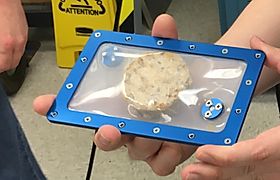
My ground-back piece of welded tube. Eagle-eyed readers will spot that the grinding reveals a weld that isn't perfect.
My ground-back piece of welded tube. Eagle-eyed readers will spot that the grinding reveals a weld that isn’t perfect.

Recently, I wrote a piece in which I talked about my cheap inverter welder and others like it. As part of it I did a lower-current weld on a piece of thin tube and before snapping a picture of the weld I ground it back flat. It turns out that some people prefer to see a picture of the weld bead instead — the neatness of the external appearance of the weld — to allow judgment on its quality. Oddly I believe the exact opposite, that the quality of my weld can only be judged by a closer look inside it, and it’s this point I’d like to explore.

Continue reading “Grind Your Welds With Pride, If That’s The Way You Do It”

Developing Guidelines For Sustainable Spaceflight

In the early days of spaceflight, when only the governments of the United States and the Soviet Union had the ability to put an object into orbit, even the most fanciful of futurists would have had a hard time believing that commercial entities would one day be launching sixty satellites at a time. What once seemed like an infinite expanse above our heads is now starting to look quite a bit smaller, and it’s only going to get more crowded as time goes on. SpaceX is gearing up to launch nearly 12,000 individual satellites for their Starlink network by the mid-2020s, and that’s just one of the “mega constellations” currently in the works.

Just some of the objects in orbit around the Earth

It might seem like overcrowding of Earth orbit is a concern for the distant future, but one needs only look at recent events to see the first hints of trouble. On September 2nd, the European Space Agency announced that one of its research spacecraft had to perform an evasive maneuver due to a higher than acceptable risk of colliding with one of the first-generation Starlink satellites. Just two weeks later, Bigelow Aerospace were informed by the United States Air Force that there was a 1 in 20 chance that a defunct Russian Cosmos 1300 satellite would strike their Genesis II space station prototype.

A collision between two satellites in orbit is almost certain to be catastrophic, ending with both spacecraft either completely destroyed or severely damaged. But in the worst case, the relative velocity between the vehicles can be so great that the impact generates thousands of individual fragments. The resulting cloud of shrapnel can circle the Earth for years or even decades, threatening to tear apart any spacecraft unlucky enough to pass by.

Fortunately avoiding these collisions shouldn’t be difficult, assuming everyone can get on the same page before it’s too late. The recently formed Space Safety Coalition (SSC) is made up of more than twenty aerospace companies that realize the importance of taking proactive steps to ensure humanity retains the unfettered access to outer space by establishing some common “Rules of the Road” for future spacecraft.

Continue reading “Developing Guidelines For Sustainable Spaceflight”

How To Make An Electric Scooter Chain Sprocket With Nothing But Hand Tools

Sometimes, mechanical parts can be supremely expensive, or totally unavailable. In those cases, there’s just one option — make it yourself. It was this very situation in which I found myself. My electric scooter had been ever so slightly bested by a faster competitor, and I needed redemption. A gearing change would do the trick, but alas, the chain sprocket I needed simply did not exist from the usual online classifieds.

Thus, I grabbed the only tools I had, busied myself with my task. This is a build that should be replicable by anyone comfortable using a printer, power drill, and rotary tool. Let’s get to work!

Continue reading “How To Make An Electric Scooter Chain Sprocket With Nothing But Hand Tools”

DNS-over-HTTPS Is The Wrong Partial Solution

Openness has been one of the defining characteristics of the Internet for as long as it has existed, with much of the traffic today still passed without any form of encryption. Most requests for HTML pages and associated content are in plain text, and the responses are returned in the same way, even though HTTPS has been around since 1994.

But sometimes there’s a need for security and/or privacy. While the encryption of internet traffic has become more widespread for online banking, shopping, the privacy-preserving aspect of many internet protocols hasn’t kept pace. In particular, when you look up a website’s IP address by hostname, the DNS request is almost always transmitted in plain text, allowing all the computers and ISPs along the way to determine what website you were browsing, even if you use HTTPS once the connection is made.

The idea of also encrypting DNS requests isn’t exactly new, with the first attempts starting in the early 2000s, in the form of DNSCrypt, DNS over TLS (DoT), and others. Mozilla, Google, and a few other large internet companies are pushing a new method to encrypt DNS requests: DNS over HTTPS (DoH).

DoH not only encrypts the DNS request, but it also serves it to a “normal” web server rather than a DNS server, making the DNS request traffic essentially indistinguishable from normal HTTPS. This is a double-edged sword. While it protects the DNS request itself, just as DNSCrypt or DoT do, it also makes it impossible for the folks in charge of security at large firms to monitor DNS spoofing and it moves the responsibility for a critical networking function from the operating system into an application. It also doesn’t do anything to hide the IP address of the website that you just looked up — you still go to visit it, after all.

And in comparison to DoT, DoH centralizes information about your browsing in a few companies: at the moment Cloudflare, who says they will throw your data away within 24 hours, and Google, who seems intent on retaining and monetizing every detail about everything you’ve ever thought about doing.

DNS and privacy are important topics, so we’re going to dig into the details here. Continue reading “DNS-over-HTTPS Is The Wrong Partial Solution”

This Week In Security: A Digital Café Américain, The Linux Bugs That Weren’t, The Great Nation, And More

A government is going after a human rights activists in Morocco. It sounds familiar, but I don’t think Humphrey Bogart is running the gin joint this time around.

Questionable Casablanca references aside, Amnesty International has reported another attack against human rights workers. In this case, a pair of Moroccan activists were targeted with what appears to be NSO’s Pegasus malware suite. Researchers identified text message phishing that led to malicious web pages, as well as HTTP man in the middle attacks against their mobile devices. Once the target was successfully directed to the malicious site, A collection of zero-day vulnerabilities were used to compromise the phone with the NSO malware.

NSO is an Israeli company that specializes in building malware and other cybersecurity tools for governments. As you can imagine, this specialization has earned NSO the scorn of quite a few organizations. NSO claims to have a policy framework in place that allows them to evaluate and terminate the use of their software when it is deemed illegal or abusive, but due to the nature of their contracts, that process is anything but transparent. Continue reading “This Week In Security: A Digital Café Américain, The Linux Bugs That Weren’t, The Great Nation, And More”

Worried About Bats In Your Belfry? A Tale Of Two Bat Detectors

As somebody who loves technology and wildlife and also needs to develop an old farmhouse, going down the bat detector rabbit hole was a journey hard to resist. Bats are ideal animals for hackers to monitor as they emit ultrasonic frequencies from their mouths and noses to communicate with each other, detect their prey and navigate their way around obstacles such as trees — all done in pitch black darkness. On a slight downside, many species just love to make their homes in derelict buildings and, being protected here in the EU, developers need to make a rigorous survey to ensure as best as possible that there are no bats roosting in the site.

Perfect habitat for bats.

Obviously, the authorities require a professional independent survey, but there’s still plenty of opportunity for hacker participation by performing a ‘pre-survey’. Finding bat roosts with DIY detectors will tell us immediately if there is a problem, and give us a head start on rethinking our plans.

As can be expected, bat detectors come in all shapes and sizes, using various electrickery techniques to make them cheaper to build or easier to use. There are four different techniques most popularly used in bat detectors.


  1. Heterodyne: rather like tuning a radio, pitch is reduced without slowing the call down.
  2. Time expansion: chunks of data are slowed down to human audible frequencies.
  3. Frequency division: uses a digital counter IC to divide the frequency down in real time.
  4. Full spectrum: the full acoustic spectrum is recorded as a wav file.

Fortunately, recent advances in technology have now enabled manufacturers to produce relatively cheap full spectrum devices, which give the best resolution and the best chances of identifying the actual bat species.

DIY bat detectors tend to be of the frequency division type and are great for helping spot bats emerging from buildings. An audible noise from a speaker or headphones can prompt us to confirm that the fleeting black shape that we glimpsed was actually a bat and not a moth in the foreground. I used one of these detectors in conjunction with a video recorder to confirm that a bat was indeed NOT exiting from an old chimney pot. Phew!

Continue reading “Worried About Bats In Your Belfry? A Tale Of Two Bat Detectors”

Worn Out EMMC Chips Are Crippling Older Teslas

It should probably go without saying that the main reason most people buy an electric vehicle (EV) is because they want to reduce or eliminate their usage of gasoline. Even if you aren’t terribly concerned about your ecological footprint, the fact of the matter is that electricity prices are so low in many places that an electric vehicle is cheaper to operate than one which burns gas at $2.50+ USD a gallon.

Another advantage, at least in theory, is reduced overal maintenance cost. While a modern EV will of course be packed with sensors and complex onboard computer systems, the same could be said for nearly any internal combustion engine (ICE) car that rolled off the lot in the last decade as well. But mechanically, there’s a lot less that can go wrong on an EV. For the owner of an electric car, the days of oil changes, fouled spark plugs, and the looming threat of a blown head gasket are all in the rear-view mirror.

Unfortunately, it seems the rise of high-tech EVs is also ushering in a new era of unexpected failures and maintenance woes. Case in point, some owners of older model Teslas are finding they’re at risk of being stranded on the side of the road by a failure most of us would more likely associate with losing some documents or photos: a disk read error.

Continue reading “Worn Out EMMC Chips Are Crippling Older Teslas”