IPv6 Christmas Display Uses 75 Internet’s Worth Of Addresses

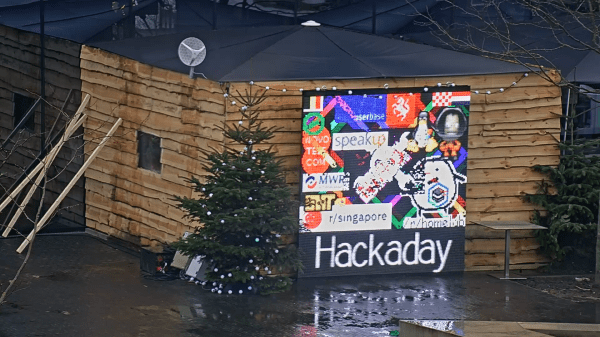
We’ve seen internet-enabled holiday displays before, and we know IPv6 offers much more space than the older IPv4 addressing scheme that most of us still use today, but the two have never been more spectacularly demonstrated than at jinglepings.com. The live video stream shows an Internet-connected Christmas tree and an LED display wall that you can control by sending IPv6 ICMP echo request messages, more commonly known as pings.

Reading the page, you quickly parse the fact that there are three ways to control the tree. First, you can type a message in the box and press send – this message gets displayed on the crawl at the bottom of the LED screen.  Second, you can light up the tree by sending a ping to the IPv6 address 2001:4c08:2028:2019::RR:GG:BB, where RR, GG, and BB are 8-bit hex values for red, green, and blue. This is a neat abuse of the IPv6 address space, in that the tree has 224 (around 16.8 million) IPv6 addresses, one for each color you can set. We were impressed by this brute-force use of address space, at least until we read on a little further.

You can also make your own drawings on the LED wall, again by sending pings. In this case, the address to set a pixel to a particular color is: 2001:4c08:2028:X:Y:RR:GG:BB, where X and Y are the pixel coordinates. This seems easy enough: to set pixel (10, 11) to magenta, the RGB value (0xFF, 0x00, 0xFF), you’d simply ping the IPv6 address 2001:4c08:2028:10:11:FF:00:FF. Having  an array of addressable LEDs is commonplace in hacker circles today, although each of them having their own live IPv6 address on the Internet seems a little excessive at first. Then it hits you – each LED has an IPv6 address for every possible color, just like the tree: 16.8 million addresses for each LED. The LED display is 160×120 pixels in size, so the total number of IPv6 addresses used is 160x120x224, which is 75 times larger than all possible IPv4 addresses!  This is a hack of monstrous proportions, and we love it.

In case you’re not running IPv6 yet, we’ve got you covered. To send individual pings using your browser, you can use a site like Ipv6now. If you want to send pixels to the display wall, you’re better off using a 6in4 tunnel that lets you access IPv6 sites using your current IPv4 connectivity.  Hurricane Electric offers a free 6in4 tunnel service that we’ve found useful. Then it’s just a matter of writing some code to send pixel values as pings.  The python scapy module is perfect for this sort of thing. But, first you’ll have to fill out the form on jinglepings.com and wait to get your IPv6 address whitelisted before you can draw on the display; evidently the usual bad actors have found the site and started drawing inappropriate things.

If you think this use of addresses seems wasteful, you needn’t worry. There are around 3.4×1038 IPv6 addresses, enough for 1027 such displays. We’re going to go out on a limb here and say it: nobody will ever need more than 2128 IP addresses.

If you’re looking to build an LED holiday display on a smaller budget, check out this one that re-purposes normal LED strings.

Thanks to [Ward] for the tip!

Nintendo Does Sony, Better Than Sony

Fans of game consoles from the golden era of TV game appliances have been in for a treat over the past couple of years as a slew of official reboots of the stars of the past have reached the market. These so-called “classic” consoles closely follow the styling of the originals, but under the hood they pack modern hardware running an emulator to play a selection of games from ROM. Even better, with a bit of hacking they can run more than just the supplied emulator, people have managed to use them to emulate completely different consoles. Even then, it’s unexpected to find that a PlayStation emulator on a Super Nintendo Classic runs PlayStation games better than the same emulator built in to Sony’s own PlayStation Classic console.

The feat from [8 Bit Flashback] is achieved despite both machines having near-identical hardware specifications based upon the Allwinner R16 system-on-chip. The Nintendo provides smoother action and more responsive controls, making for a far superior gaming experience. How is this achieved? The most significant difference is that the SNES Classic had the RetroArch front end installed upon it, which may have lent some optimisations and tweaks to make the system more efficient.

Readers with an eye for unusual consoles may remember another Nintendo/Sony hybrid, the ill-fated early-1990s prototype SNES with a CD-ROM which was the first machine to bear the name “PlayStation” (or “Play Station” as it was sometimes styled, leading Sony marketeers to be hot on writers using a space between the words a few years later).

Continue reading “Nintendo Does Sony, Better Than Sony”

Weather Forecasting Clock Makes An Almighty Racket

The old-fashioned alarm clock was a staple of cartoons in years past, with loud clanging bells and slap-to-shutoff functionality. Despite being an excellent dramatic device, these classic timepieces began to lose favor to the digital clock radio, and, in more recent times, the smartphone alarm. However, [LenkaDesign] has come up with this excellent build that combines the best of the old and the new.

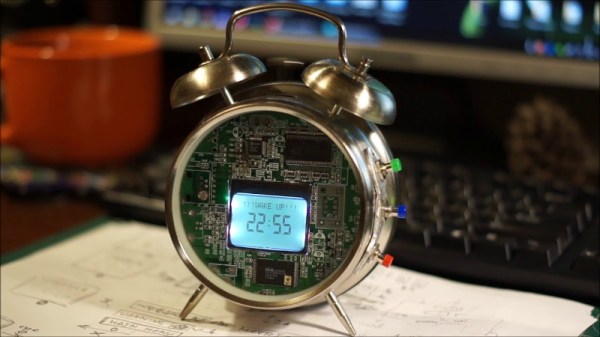
The build starts with an old alarm clock. The clockwork internals are removed, but the bells remain, powered instead by a brushed DC motor. An Arduino Nano is the brains of the operation, interfacing with the now-ubiquitous temperature, humidity and barometric pressure sensors. Time is displayed on a Nokia 5110 LCD screen of the type popular a decade ago when options for small hobby project displays were significantly more limited then they are today.

As a nice touch, an old circuit board lends a new face to this clock, with a trio of big chunky buttons to act as controls. The LCD uses attractive icons to help convey information, making the most of the graphical capabilities available. There’s even a rudimentary weather forecasting algorithm that uses barometric pressure changes to predict the likelihood of rain.

Overall, it’s a tidy build that promises to serve as a great alarm clock, given the high volume of the original bells. Alarm clocks have always been a hacker staple, but if you’re still struggling to get out of bed this fire bell build should rattle your fillings loose on a daily basis. Video after the break.

[Thanks to Baldpower for the tip!]

Continue reading “Weather Forecasting Clock Makes An Almighty Racket”

Rise Of The Unionized Robots

For the first time, a robot has been unionized. This shouldn’t be too surprising as a European Union resolution has already recommended creating a legal status for robots for purposes of liability and a robot has already been made a citizen of one country. Naturally, these have been done either to stimulate discussion before reality catches up or as publicity stunts.

Dum-E spraying Tony StarkWhat would reality have to look like before a robot should be given legal status similar to that of a human? For that, we can look to fiction.
Tony Stark, the fictional lead character in the Iron Man movies, has a robot called Dum-E which is little more than an industrial robot arm. However, Stark interacts with it using natural language and it clearly has feelings which it demonstrates from its posture and sounds of sadness when Stark scolds it after needlessly sprays Stark using a fire extinguisher. In one movie Dum-E saves Stark’s life while making sounds of compassion. And when Stark makes Dum-E wear a dunce cap for some unexplained transgression, Dum-E appears to get even by shooting something at Stark. So while Dum-E is a robot assistant capable of responding to natural language, something we’re sure Hackaday readers would love to have in our workshops, it also has emotions and acts on its own volition.

Here’s an exercise to try to find the boundary between a tool and a robot deserving of personhood.

Continue reading “Rise Of The Unionized Robots”

Rigol MSO5000 Hacked, Features Unlocked

Rigol’s test gear has something of a history of being hacked. Years ago the DS1022C oscillocope was hacked to increase bandwidth, and more recently the DS1054Z was hacked to unlock licensed features. Now, it’s the MSO5000’s turn.

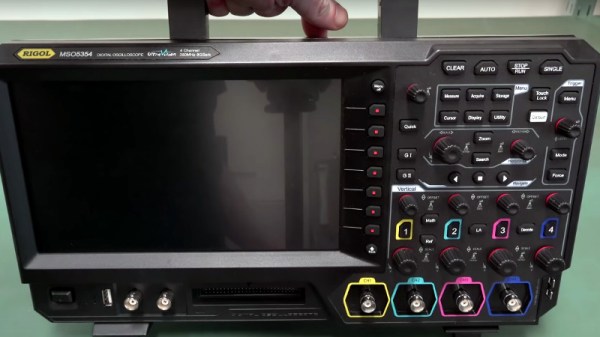
Over on the EEVBlog forums a group has been working on hacking another Rigol, the MSO5000, a 70 MHz oscilloscope which can be upgraded to 350 MHz via software licensing. Various other features including a two channel, 25 MHz arbitrary waveform generator are also built-in, but locked out unless a license key is purchased. The group have managed to enable all the locked options without license keys.

The hack is quite simple. The Linux system running on the scope has a default root password of, you guessed it, “root”. After logging in over SSH with these credentials, the user just needs to modify the startup file to add the “-fullopt” flag to the “appEntry” application. This starts the application in a fully unlocked state, which gives access to all the features.

The MSO5000 costs about $1000, and the bandwidth option alone adds over $3000 to the price. If you’re willing to risk your warranty, and you have the skills to edit a file with vi, this hack provides a serious upgrade for free.

If you have a DS1022C you’ll find our reporting on its hack here, and likewise DS1054Z owners will find theirs here.

Header image: EEVBlog.

Seeing Like Bees With Ultraviolet Photography

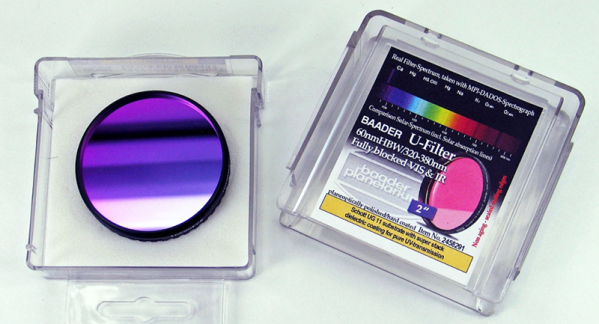
When it comes to seeing in strange spectrums, David Prutchi is the guy you want to talk to. He’s taken pictures of rocks under long, medium and short UV light, he’s added thermal imaging to consumer cameras, and he’s made cameras see polarization. There’s a lot more to the world than what the rods and cones on your retina can see, and David is one of the best at revealing it. For this year’s talk at the Hackaday Superconference, David is talking about DIY Ultraviolet Photography. It’s how bees see, and it’s the bees knees.

Continue reading “Seeing Like Bees With Ultraviolet Photography”

GoPro Factory Goes Nomad To Dodge Tariff Threat

Despite the fact that the United States and China are currently in the middle of a 90-day “cease fire” in their ongoing trade war, with new tariffs on hold until March 2019 while the two countries try to reach agreement, not everyone is waiting around to see who comes out on top. In a recent press release, action camera manufacturer GoPro has announced their intention to move some production out of China in the face of potential tariff expansions; which many analysts fear will be the result of the current stalemate. That’s right, only some of their production is moving.

“We’re proactively addressing tariff concerns by moving most of our US-bound camera production out of China,” says GoPro CFO Brian McGee. “We believe this diversified approach to production can benefit our business regardless of tariff implications.” Reading his words carefully, the key phrase here is “diversified approach”. GoPro doesn’t intend to move their entire production capability out of China, but only the production of the cameras which are designated for importation into the United States. GoPro models which are to be sold to other parts of the world will still be made in China.

This might seem an extravagant move just to avoid US tariffs, but with better than 40% of GoPro’s revenue for the third quarter of 2018 coming from the Americas, the company stands to be hit hard by the proposed 25% tax. Combined with the fact they shuttered their drone division last year citing “an extremely competitive aerial market”, and the proliferation of “GoPro clones” available for pennies on the dollar, it seems pretty clear that belt-tightening is the name of the game for the company that was once synonymous with action cameras.

Continue reading “GoPro Factory Goes Nomad To Dodge Tariff Threat”