Amateur Radio Just Isn’t Exciting

As ARRL president, [Rick Roderick, K5UR] spends a significant amount of time proselytising the hobby. He has a standard talk about amateur radio that involves tales gleaned from his many decades as a licence holder, and features QSL cards from rare DX contacts to show how radio amateurs talk all over the world.

He’s delivered this talk countless times, and is used to a good reception from audiences impressed with what can be done with radio. But when he delivered it to a group of young people, as Southgate ARC reports, he was surprised to see a lack of interest from his audience, to whom DX or contesting just don’t cut it when they have grown up with the pervasive Internet. Writing in the 2016 ARRL Annual Report, he said:

“Change generally doesn’t come easy to us. But when I looked out at that group of young faces and saw their disinterest in traditional ham pursuits, I realized that I had to change. We have to change. It won’t come easy, but it’s essential that we get to work on it now.”

If you were to profile a typical group of radio amateurs, it would not be difficult to see why [K5UR] found himself in this position. It might be an unflattering portrait for some amateurs, but it’s fair to say that amateur radio is a hobby pursued predominantly by older more well-off men with the means to spend thousands of dollars on commercial radios. It is also fair to say that this is hardly a prospect that would energize all but the most dedicated of youthful radio enthusiasts. This is not a new phenomenon, where this is being written it was definitely the case back in the days when they were issuing G7 callsigns, for instance.

Were Hackaday to find ourselves in the position of advising the ARRL on such matters, we’d probably suggest a return to the roots of amateur radio, a time in the early 20th century when it was the technology that mattered rather than the collecting of DXCC entities or grid squares, and an amateur had first to build their own equipment rather than simply order a shiny radio before they could make a contact. Give a room full of kids a kit-building session, have them make a little radio. And lobby for construction to be an integral part of the licensing process, it is very sad indeed that where this is being written at least, the lowest tier of amateur radio licence precludes home-made radio equipment. Given all that, why should it be a surprise that for kids, amateur radio just isn’t exciting?

We’ve shown you some fantastic amateur radio builds over the years. If you have a youngster with an interest in radio, show them a BitX transceiver, or the world of QRP.

Header image: enixii. [CC BY 2.0]. We hope these snoozing kids aren’t in the middle of a lecture on amateur radio.

A Case For The Desktop Vinyl Cutter

As far as desktop workbench fab tools go, it’s too easy to let 3D printers keep stealing the spotlight. I mean, who doesn’t appreciate that mechatronic “buzz” as our printer squirts a 3D CAD model into plastic life? While the 3D printer can take up a corner of my workbench, there’s still plenty of room for other desktop rapid-prototyping gadgets.

Today, I’d like to shed some light on vinyl cutters. Sure, we can start with stickers and perhaps even jumpstart an after-hours Etsy-mart, but there’s a host of other benefits besides just vinyl cutting. In fact, vinyl cutters might just be the unsung heroes of research in folding and papercraft.

Continue reading “A Case For The Desktop Vinyl Cutter”

Look What People Brought To Breakfast At DEF CON

Sunday was our Breakfast at Hackaday meetup and a swarm of folks showed up, take a look at the hardware they brought with them! Vegas can be a tough place to set up a meetup — especially if you don’t want to rent a room. We filtered into a Starbucks across the street from Caesar’s and ended up packing the high-top table areas. It turns out you get a really funny look from the baristas when you go through the coffee line and ask for four dozen pastries and a few buckets of coffee.

The size of the space made it hard to get a picture of the entire crowd. I did manage to get a posed photo with the people who showed up about a half hour early. Once it filled up all I got for crowd shots were people with their back to me and heads down comparing hardware projects — that might actually be more appropriate for DEF CON where people generally don’t want to be photographed (case in point our bandanna wearing friend).


There was a ton of different hardware on hand. If you look at a picture of the swag and pastries tables, look closely at the high-top behind that. There were a couple of people hacking on RTL-SDRs before we arrive (which means they were at least 45 minutes early).

I’m a fan of wearing your hardware projects at events and this year was really great for that. First, a Captain Phasma helmet from The Force Awakens. It’s 3D printed in ABS, using an acetone/ABS slurry to glue (actually to weld) the parts before sanding and painting to finish the job.

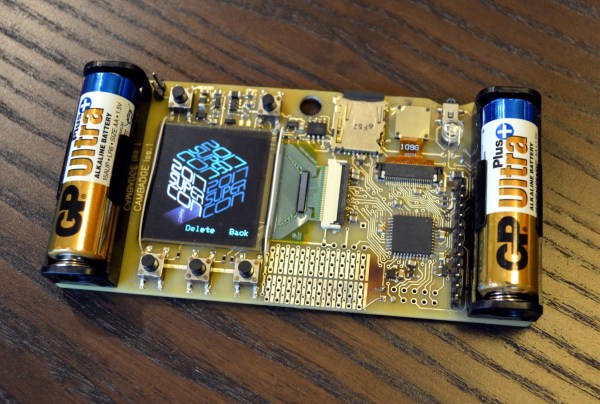
Most of the hacks on hand were unofficial hardware badges built specifically for DEF CON. I was at the Badge Build’s meetup and have a megapost on everything I saw there coming out a bit later. But here we get a look at the dragonfly badge which [Kerry] brought along with him as well as the rectangular PCB that was the prototype. The AND!XOR crew was in the house and I decided to bug [Hyr0n] about the password hashes I was trying to crack from their badge’s firmware. He pulled up the app and it wasn’t surprising to see so many of the Bender on a bender badges in the area. Their botnet was a huge hit this year!

At some point, I was handed this book-like box which had been laser cut and etched out of plywood. It’s a beautiful piece and I had no idea what I would find inside. Turns out it’s a complete quadcopter-badge fun kit. I must have been so enthralled with the electronics when we covered this badge a few weeks back that I completely missed the beautiful box they built for it.

Inside the box, you’ll find two versions of the badge (one that flies, the other that blinks and has a red PCB handkerchief), a separate PCB that is the controller, and a goodie bag with extra batteries and charging hardware. We didn’t fire this up at the meetup, but we’ll have it at the Hackaday Superconference for you to play with. It was really great to get a group picture with so many of the people who worked on making this badge happen.

There was one high-top over in the corner that had been mobbed with people all morning and I only got a look at it when the crowd started to clear out around noon. [Brian McEvoy] built a custom controller for OpenSCAD and did a great job of bringing along a demo. A tablet is running the software, with the controller connected via USB. There are 3 knobs on the right that allow you to adjust height, width, and depth. The fourth knob is for adjusting precision. That precision is displayed in a very clever way. You can see the LED strip with has a red dot on the right (the decimal point) and three colored pixels to the left of it. These are the tens, hundreds, and thousands, but just turn the crank until the red dot is at the other end of the strip and you’ll be setting precision to tenths, hundreths, etc. [Brian] even added a button you can hold down to 10x the precision without making a permanent adjustment. The project is driven by a Teensy LC board.

Is wonderful to see the Hackaday Community turn out for a meetup like this even though so much other stuff is going on at DEF CON. Thank you to all of you for coming to say hi, share your stories, and show off your handy work!

The Dark Arts – Remote File Inclusion

In the waning hours of 2010, a hacking group known as Lulzsec ran rampant across the Internet, leaving a path of compromised servers, a trail of defaced home pages, leaked emails, and login information in their wake. They were eventually busted via human error, and the leader of the group becoming an FBI informant. This handful of relatively young hackers had made a huge mess of things. After the digital dust had settled – researches, journalists, and coders began to dissect just how these seemingly harmless group of kids were able to harness so much power and control over the World Wide Web. What they found was not only eye-opening to web masters and coders, but shined a light on just how vulnerable all of our data was for everyone to see. It ushered in an era of renewed focus on security and how to write secure code.

In this Dark Arts series, we have taken a close look at the primary techniques the Luzsec hackers used to gain illegal access to servers. We’ve covered two them – SQL injection (SQLi) and cross-site scripting (XSS). In this article, we’ll go over the final technique called remote file inclusion (RFI).

DISCLAIMER: Fortunately, the surge of security-minded coding practices after the fall of Lulzsec has (for the most part) removed these vulnerabilities from the Internet as a whole. These techniques are very dated and will not work on any server that is maintained and/or behind a decent firewall, and your IP will probably get flagged and logged for trying them out. But feel free to set up a server at home and play around. Continue reading “The Dark Arts – Remote File Inclusion”

Failing Infrastructure And The Lessons It Teaches

Infrastructure seems so permanent and mundane that most of us never give it a second thought. Maintenance doesn’t make for a flashy news story, but you will frequently find a nagging story on the inside pages of the news cycle discussing the slowly degrading, crumbling infrastructure in the United States.

If not given proper attention, it’s easy for these structures to fall into a state of disrepair until one suddenly, and often catastrophically, fails. We’ve already looked at a precarious dam situation currently playing out in California, and although engineers have that situation under control for now, other times we haven’t been so lucky. Today we’ll delve into a couple of notable catastrophic failures and how they might be avoided in future designs.

Gaining Weight While Delaying Repairs

Most of us take infrastructure for granted every day. Power lines, roads, pipelines, and everything else have a sense of permanence and banality that can’t be easily shaken. Sadly, this reality shattered for most people in Minneapolis, Minnesota in August 2007.

Continue reading “Failing Infrastructure And The Lessons It Teaches”

Michael Ossmann Pulls DSSS Out Of Nowhere

[Michael Ossmann] spoke on Friday to a packed house in the wireless hacking village at DEF CON 25. There’s still a day and a half of talks remaining but it will be hard for anything to unseat his Reverse Engineering Direct Sequence Spread Spectrum (DSSS) talk as my favorite of the con.

DSSS is a technique used to transmit reliable data where low signal strength and high noise are likely. It’s used in GPS communications where the signal received from a satellite is often far too small for you to detect visually on a waterfall display. Yet we know that data is being received and decoded by every cell phone on the planet. It is also used for WiFi management packets, ZigBee, and found in proprietary systems especially any dealing with satellite communications.

[Michael] really pulled a rabbit out of a hat with his demos which detected the DSSS signal parameters in what appeared to be nothing but noise. You can see below the signal with and without noise; the latter is completely indiscernible as a signal at all to the eye, but can be detected using his techniques.

Detecting DSSS with Simple Math

[Michael] mentioned simple math tricks, and he wasn’t kidding. It’s easy to assume that someone as experienced in RF as he would have a different definition of ‘simple’ than we would. But truly, he’s using multiplication and subtraction to do an awful lot.

DSSS transmits binary values as a set called a chip. The chip for digital 1 might be 11100010010 with the digital 0 being the inverse of that. You can see this in the slide at the top of this article. Normal DSSS decoding compares the signal to expected values, using a correlation algorithm that multiplies the two and gives a score. If the score is high enough, 11 in this example, then a bit has been detected.

To reverse engineer this it is necessary to center on the correct frequency and then detect the chip encoding. GNU radio is the tool of choice for processing a DSSS capture from a SPOT Connect module designed to push simple messages to a satellite communication network. The first math trick is to multiply the signal by itself and then look at spectrum analysis to see if there is a noticeable spike indicating the center of the frequency. This can then be adjusted with an offset and smaller spikes on either side will be observed.

When visualized in a constellation view you begin to observe a center and two opposite clusters. The next math trick is to square the signal (multiply it by itself) and it will join those opposite clusters onto one side. What this accomplishes is a strong periodic component (the cycle from the center to the cluster and back again) which reveals the chip rate.

Detecting symbols within the chip is another math trick. Subtract each successive value in the signal from the last and you will mostly end up with zero (high signal minus high signal is zero, etc). But every time the signal spikes you’re looking at a transition point and the visualization begins to look like logic traced out on an oscilloscope. This technique can deal with small amounts of noise but becomes more robust with a bit of filtering.

This sort of exploration of the signal is both fun and interesting. But if you want to actually get some work done you need a tool. [Michael] built his own in the form of a python script that cobbles up a .cfile and spits out the frequency offset, chip rate, chip sequence length, and decoded chip sequence.

Running his sample file through with increasing levels of noise added, the script was rock solid on detecting the parameters of the signal. Interestingly, it is even measuring the 3 parts per million difference between the transmitter and receiver clocks in the detected chip rate value. What isn’t rock solid is the actual bit information, which begins to degrade as the noise is increased. But just establishing the parameters of the protocol being used is the biggest part of the battle and this is a dependable solution for doing that quickly and automatically.

You can give the script a try. It is part of [Michael’s] Clock Recovery repo. This talk was recorded and you should add it to your reminder list for after the con when talks begin to be published. To hold you over until then, we suggest you take a look at his RF Design workshop from the 2015 Hackaday Superconference.

North Carolina Hackerspace Destroyed By Fire, Members Vow To Rebuild

There’s something about old industrial buildings that just seems to attract hackerspaces. It could be the open floor plans typical in buildings that used to house big manufacturing operations, or it could be a desire to reinvigorate places where machines once hummed and skilled hands plied their trades. Whatever the attraction, the relationship is not without risk; old buildings with wood floors and frames can be tinderboxes, and tragedy can strike at any moment.

Such a fate befell The Foothills Community Workshop in Granite Falls, North Carolina, this past Friday. Details are still sketchy as the remnants of the 75,000-square foot former Shuford Mills textile factory are still smoldering, and the Fire Marshal’s investigation is not yet complete. Thankfully, no lives were lost, and injuries were limited to heat exhaustion of several of the firefighters from 16 counties who battled the blaze in the hot and humid North Carolina Piedmont.

Continue reading “North Carolina Hackerspace Destroyed By Fire, Members Vow To Rebuild”