Get Your Eclipse Glasses Emblazoned With Hackaday

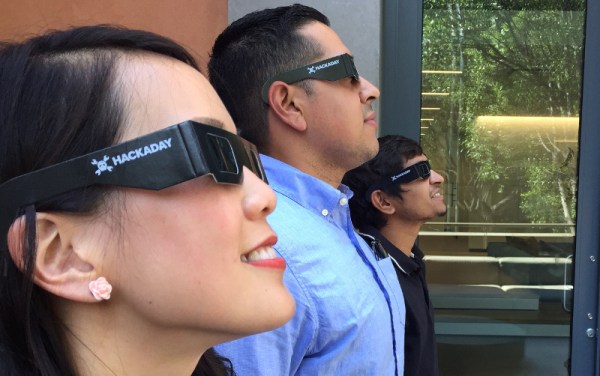
We’re getting ready to stare at the Sun for a few hours when a total solar eclipse is visible across the United States on August 21st. You could protect your eyes with some welding goggles, but why not wear a pair of Hackaday eclipse glasses instead?

UPDATE: And They’re Gone. We had a huge response to this with over 200 event pages made in just a few hours (and more coming since then; thank you, you’re awesome!). We had 500 glasses to give away and are sending them out in envelopes of 4. We would still love it if you made an event page but unfortunately we’ve run out of glasses to send out.

Let us know where you’ll be watching the eclipse and we’ll mail you some custom-printed Hackaday eclipse glasses (sorry, they’re all gone).  Head over to the Eclipse Meetups page, click the “Host a Meetup” button and tell us where you’ll be. We’ll add you to the map and contact you for the shipping address and the number of glasses you’ll need.

Whether you want others to join you or not is your choice, but we want to see a map full of pins where the Hackaday community is taking part in this momentous event.

As you can see, there are already a number of meetups watch the partial eclipse and that’s fine with us. No matter where you are, if you can see the eclipse we’re ready to send you some glasses. Hurry up though, they need to arrive before Monday!

Smart Speed Bumps Slow Only Speeding Cars

Like it or not speed bumps are an essential part of our road infrastructure especially in built-up places like near schools [Business Insider UK] reports non-Newtonian liquid filled speed bumps are being tested in Spain, Israel and Germany.

Traditional speed bumps do have their drawbacks; damage to the underside of low vehicles is common. While they should be uniform in dimensions, in practice they can vary significantly, making driving over unfamiliar bumps a bit unpredictable. This is all set to change with non-Newtonian bumps which are soft to drive over at slow speeds but for speeding drivers they harden up and act more like traditional bumps. This gives drivers following the letter of the law a better driving experience whilst still deterring speeding drivers..

Non-Newtonian materials are nothing new but we think this is a great way of purposing these type of materials. Roads are getting smart whether you like it or not. It’s time to embrace technology and improve our commutes.  Continue reading “Smart Speed Bumps Slow Only Speeding Cars”

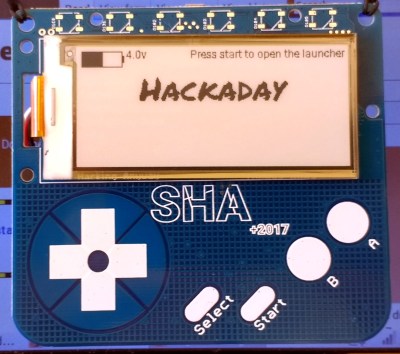
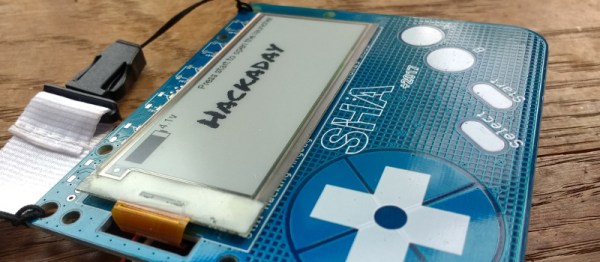
Hands On With The SHACamp 2017 Badge

The badge has become one of the defining features of a modern hacker camp, a wearable electronic device that serves as both event computer and platform for some mild software and hardware hacking. Some events have had astoundingly sophisticated badges while others are more simple affairs, and the phenomenon has even spawned an ecosystem of unofficial badges which have nothing to do with the event in question.
The SHACamp 2017 badge is the latest to come the way of a Hackaday writer, and certainly contains enough to be taken as representative of the state of hacker camp badges in 2017. It doesn’t have a star turn like CCCCamp 2015’s software defined radio, instead it’s an extremely handy little computer in its own right.

Continue reading “Hands On With The SHACamp 2017 Badge”

Another Arduino Compatible? This Time, It’s A Sony

When it comes to microcontroller development boards, we have a plethora of choices at our disposal. Each has its strengths and weaknesses, be they associated with its support and community, its interface capabilities, or its choice of processor family. Most boards you’ll find in our communities come from niche manufacturers, or at least from manufacturers who started as such. Just occasionally though along comes one whose manufacturer you will have heard of, even whose manufacturer the Man in the Street will have heard of.

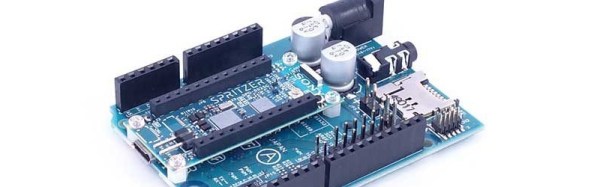
Which brings us neatly to today’s story, the quiet announcement from Sony, of a new microcontroller development board called the Spritzer. This is Arduino compatible in both physical footprint and IDE, is intended for IoT applications, and packs GPS, an audio codec, and an ARM Cortex M4 at 156 MHz. There is a Japanese page with a little more detail (Google Translate link), on which they talk about applications including audio beam forming with up to eight microphones, and a camera interface. 

The board is due to be available sometime early next year, and while it looks as though it will be an interesting device we’d sound a note of caution to Sony. It is not good enough to have an amazing piece of hardware; the software and community support must be more than just make-believe. If they can crack that then they might just have a winner on their hands, if they fail to make any effort then they will inevitably follow Intel into the graveyard of also-ran boards.

Thanks [Chris] for the tip.

2017’s VCF West Is Another Beloved Trip Down Memory Lane

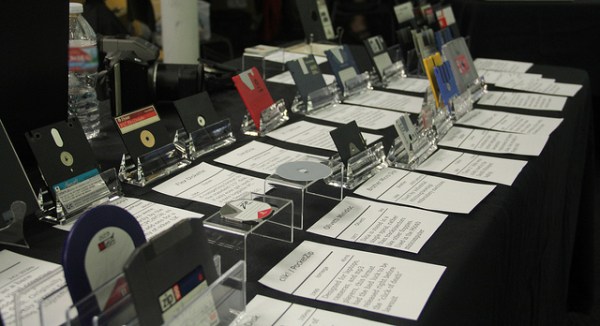
This past weekend, another smashing round of the Vintage Computer Festival was held at the Computer History Museum in Mountainview. As always, VCF West gathers the sages and lords of vintage computers onto a common ground to talk old-school hardware. It also draws in a collection of unique artifacts, many of which either still work, have been brought back to life, or have otherwise been reincarnated through a modern means. [Bil Herd] and I dropped in to join the crowd, and I snagged a few pics of some new faces and pieces that have been added to the experience since last year.

[Foone’s] Digital Media Archiving

Up first on our bucket list was [Foone], a librarian of digital media archiving. Outside of VCF, he runs a digital media backup gig to help folks backup their niche, often-failing, disk formats into something more modern. His drive for doing this backup features a special “reread” capability, where the file is actually reread dozens of time to validate that the right information was pulled from it.

Continue reading “2017’s VCF West Is Another Beloved Trip Down Memory Lane”

Making A Cheap Radar Unit Awesome

[JBeale] squeezed every last drop of performance from a $5 Doppler radar module, and the secrets of that success are half hardware, half firmware, and all hack.

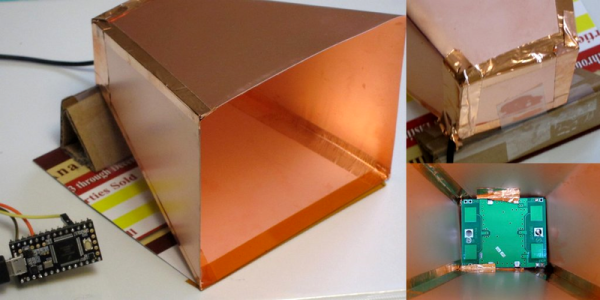
On the hardware side, the first prototype radar horn was made out of cardboard with aluminum foil taped around it. With the concept proven, [JBeale] made a second horn out of thin copper-clad sheets, but reports that the performance is just about the same. The other hardware hack was simply to tack a wire on the radar module’s analog output and add a simple op-amp gain stage, which extended the sensing range well beyond the ten feet or so that these things are usually used for.

With all that signal coming in, [JBeale] separates out the noise by taking an FFT of the Doppler frequency-shift signal. Figuring that people walk around 2.2 miles per hour, [JBeale] focuses on the corresponding 70 Hz frequency bin and finds that the radar will detect people out to 80 feet. Wow!

This trick of taking an el-cheapo radar unit and amplifying the signal to do something useful isn’t new to Hackaday. [Mathieu] did it with the very same HB-100 unit way back in 2013, and then again with a more modern CDM324 model. But [JBeale]’s hacked horn and clever backend processing push out the limits of what you can expect to do with these cheap units. Kudos.

[via PJRC]

The Sensors Automating Your Commute

In a bout of frustration I recently realized that the roads have all updated — most people have no idea how — and this sometimes hurts the flow of traffic. This realization happened when an unfortunate person stopped in a left turn lane well before the stop line. The vehicle didn’t trigger the sensor, so cycle after cycle went by and the traffic system never gave the left turn lane a green light, thinking the lane was unoccupied. Had the driver known about this the world would have been a better place. The first step in intelligent automation is sensing, and there are a variety of methods used to sense traffic’s flow.

Continue reading “The Sensors Automating Your Commute”