Creating A PCB In Everything: Friends Don’t Let Friends Use Fritzing

This week, we’re continuing our Creating A PCB In Everything series, where we go through the steps to create a simple, barebones PCB in different EDA suites. We’re done with Eagle, and now it’s time to move onto Fritzing.

fritzing-logoFritzing came out of the Interaction Design Lab at the University of Applied Sciences of Potsdam in 2007 as a project initiated by Professor Reto Wettach, André Knörig and Zach Eveland. It is frequently compared to Processing, Wiring, or Arduino in that it provides an easy way for artists, creatives, or ‘makers’ to dip their toes into the waters of PCB design.

I feel it is necessary to contextualize Fritzing in the space of ‘maker movement’, DIY electronics, and the last decade of Hackaday. Simply by virtue of being an editor for Hackaday, I have seen thousands of homebrew PCBs, and tens of thousands of amateur and hobbyist electronics projects. Despite what the Fritzing’s Wikipedia talk page claims, Fritzing is an important piece of software. The story of the ‘maker movement’ – however ill-defined that phrase is – cannot be told without mentioning Fritzing. It was the inspiration for CircuitLab, and the Fritzing influence can easily be seen in Autodesk’s 123D Circuits.

Just because a piece of software is important doesn’t mean it’s good. I am, perhaps, the world’s leading expert at assessing poorly designed and just plain shitty PCBs. You may scoff at this, but think about it: simply due to my vocation, I look at a lot of PCBs made by amateurs. EE professors, TAs, or Chris Gammell might beat me on volume, but they’re only looking at boards made by students using one tool. I see amateur boards built in every tool, and without exception, the worst are always designed in Fritzing. It should be unacceptable that I can even tell they’re designed in Fritzing.

Fritzing has its place, and that place is building graphical representations for breadboard circuits. Fritzing has no other equal in this respect, and for this purpose, it’s an excellent tool. You can also make a PCB in Fritzing, and here things aren’t as great. I want to do Fritzing for this Creating A PCB In Everything series only to demonstrate how bad PCB design can be.

For the next few thousand words, I am going to combine a tutorial for Fritzing with a review of Fritzing. Fritzing is an important piece of software, if only for being a great way to create graphics of breadboard circuits. As a PCB design tool, it’s lacking; creating parts from scratch is far too hard, and there’s no way to get around the grid snap tool. No one should ever be forced to create a PCB in Fritzing, but it does have its own very limited place.

Continue reading “Creating A PCB In Everything: Friends Don’t Let Friends Use Fritzing”
Porting NES To The ESP32

There’s an elephant in the room when it comes to the Raspberry Pi Zero. The Pi Zero is an immensely popular single board computer, but out of stock issues for the first year may be due to one simple fact: you can run a Nintendo emulator on it. Instead of cool projects like clusters, CNC controllers, and Linux-based throwies, all the potential for the Pi Zero was initially wasted on rescuing the princess.

Espressif has a new chip coming out, the ESP32, and it’s a miraculous Internet of Things thing. It’s cheap, exceptionally powerful, and although we expect the stock issues to be fixed faster than the Pi Zero, there’s still a danger: if the ESP32 can emulate an NES, it may be too popular. This was the hypothetical supply issue I posited in this week’s Hackaday Links post just twenty-four hours ago.

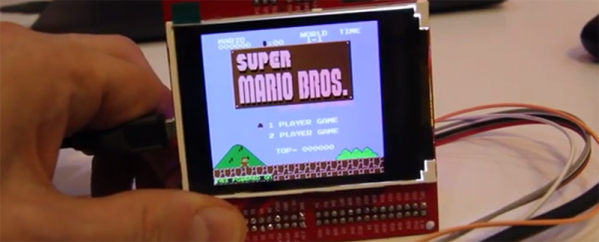
Hackaday fellow, Hackaday Supercon speaker, Espressif employee, and generally awesome dude [Sprite_tm] just ported an NES emulator to the ESP32. It seems Espressif really knows how to sell chips: just give one of your engineers a YouTube channel.

This build began when [Sprite] walked into his office yesterday and found a new board waiting for him to test. This board features the ESP-WROOM-32 module and breaks out a few of the pins to a microSD card, an FT2232 USB/UART module, JTAG support, a bunch of GPIOs, and a 320×240 LCD on the back. [Sprite]’s job for the day was to test this board, but he reads Hackaday with a cup of coffee every morning (like any civilized hacker) and took the links post as a challenge. The result is porting an NES emulator to the ESP32.

The ESP-32-NESEMU is built on the Nofrendo emulator, and when it comes to emulation, the ESP32 is more than capable of keeping the frame rate up. According to [Sprite], the display is the bottleneck; the SPI-powered display doesn’t quite update fast enough. [Sprite] didn’t have enough time to work on the sound, either, but the source for the project is available, even if this dev board isn’t.

Right now, you can order an ESP32; mine are stuck on a container ship a few miles from the port of Long Beach. Supply is still an issue, and now [Sprite] has ensured the ESP32 will be the most popular embedded development platform in recent memory. All of this happened in the space of 24 hours. This is awesome.

Continue reading “Porting NES To The ESP32”

Using The FCC EAS For Fun And Profit

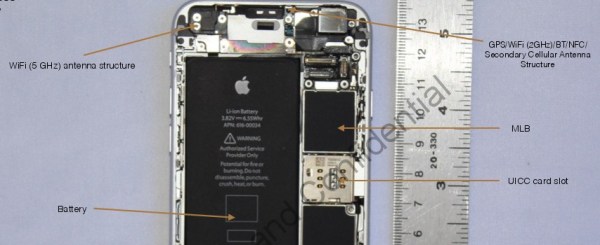
When a consumer electronics device is sold in the US, especially if it has a wireless aspect, it must be tested for compliance with FCC regulations and the test results filed with the FCC (see preparing your product for FCC testing). These documents are then made available online for all to see in the Office of Engineering and Technology (OET) Laboratory Equipment Authorization System (EAS). In fact, it’s this publishing in this and other FCC databases that has led to many leaks about new product releases, some of which we’ve covered, and others we’ve been privileged enough to know about before the filings but whose breaking was forced when the documents were filed, like the Raspberry Pi 3. It turns out that there are a lot of useful things that can be accomplished by poring over FCC filings, and we’ll explore some of them.

Continue reading “Using The FCC EAS For Fun And Profit”

A Completely Open Microcontroller

mriscv
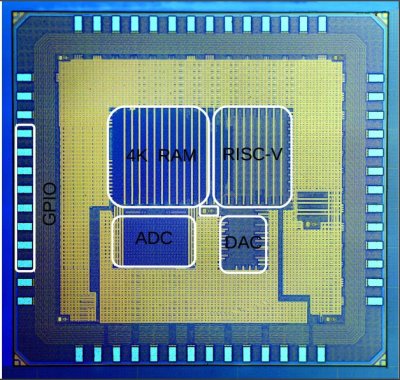
An annotated mRISCV die image

We don’t know about you, but the idea of an Arduino-class microprocessor board which uses completely open silicon is a pretty attractive prospect to us. That’s exactly [onchipUIS]’s stated goal. They’re part of a research group at the Universidad Industrial de Santander and have designed and taped out a RISCV implementation with Cortex M0-like characteristics.

The RISCV project has developed an open ISA (instruction set architecture) for modern 32-bit CPUs. More than 40 research groups and companies have now jumped on the project and are putting implementations together.

[onchipUIS] is one such project. And their twitter timeline shows the rapid progress they’ve been making recently.

mriscv_bonding
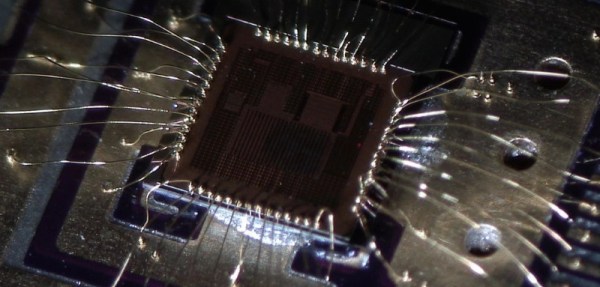
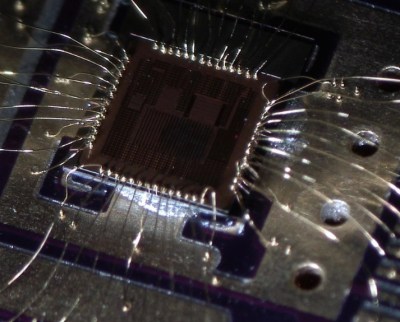
Die directly bonded to an OSHPark PCB

After tapeout, they started experimenting with their new wirebonding machine. Wirebonding, particularly manual bonding, on a novel platform is a process fraught with problems. Not only have [onchipUIS] successfully bonded their chip, but they’ve done so using a chip on board process where the die is directly bonded to a PCB. They used OSHPark boards and described the process on Twitter.

The board they’ve built breaks out all the chip’s peripherals, and is a convenient test setup to help them validate the platform. Check it, and some high resolution die images, out below. They’re also sending us a die to image using our electron microscope down at hackerfarm, and we look forward to the results!

Continue reading “A Completely Open Microcontroller”

Two Words That Don’t Mean What You Think They Do

sprites_enhanced_stripWhen you hear “gravity waves” or “sprites”, you’d think you would know what is being discussed. After all, those ripples in space-time that Einstein predicted would emanate from twin, colliding, black holes were recently observed to much fanfare. And who doesn’t love early 8-bit computer animations? So when we were browsing over at SpaceWeather we were shocked to find that we were wrong twice, in one photo (on the right). Continue reading “Two Words That Don’t Mean What You Think They Do”

Minimal Computer And Operating System: One Button, One LED

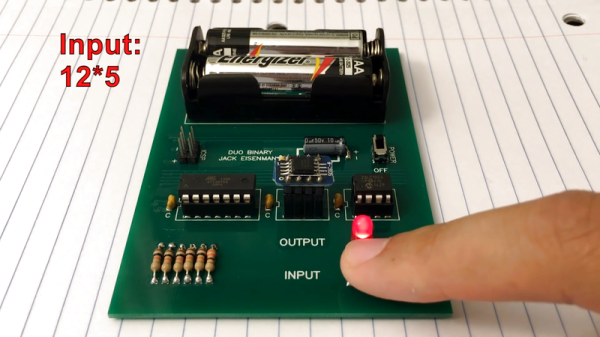
DUO BINARY is a very, very small computer system in every possible sense. It runs on an ATtiny84, which has even got “tiny” in its name. The user interface is a single button for data entry and a single LED for feedback, making this binary keyboard look frivolously over-complicated. It uses a devilish chimera of Morse code and a truncated ASCII to enter data, and the LED blinks the same back at you.

We’re guessing that [Jack Eisenmann] is the only person in the world who can control this thing, and you can watch him doing so in the video embedded below. Continue reading “Minimal Computer And Operating System: One Button, One LED”

Certification For Open Source Hardware Announced

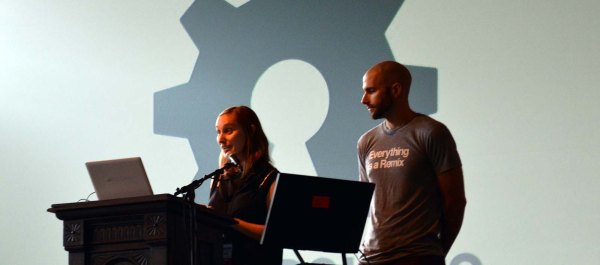
Today at the Open Hardware Summit in Portland, Alicia Gibb and Michael Weinberg of the Open Source Hardware Association (OSHWA) launched the Open Source Hardware Certification program. It’s live, and you can certify your own hardware as Open Hardware right now.

What Is Open Source Hardware?

Open Source Hardware can’t be defined without first discussing open source software. At its very core, open source software is just a copyright hack, enabled by a worldwide universal computer network. The rise of open source software is tied to the increasing ease of distributing said software, either through BBSes, Usenet, and the web. Likewise, Open Source Hardware is tied to the ease of distributing, modifying, and building hardware.

In the 1980s, there were no services that could deliver a custom circuit board to anywhere on the planet for a dollar per square inch. When open software began, CNC machines were expensive tools, now you can build a very good machine for just a week’s wages. We are currently living at the dawn of Open Source Hardware, enabled by the creation of Open Source design tools that have themselves been used to create physical tools. Inexpensive 3D printers, open source oscilloscopes, circuit board plotters, and the entire hackerspace movement are as revolutionary as the Internet. These devices and the Internet are the foundations for Open Hardware and software, respectively.  The objections to why hardware is incompatible with Open Source no longer apply and small-scale manufacturing techniques are only going to get better.

Continue reading “Certification For Open Source Hardware Announced”