New Part Day: Wireless BeagleBones On A Chip

The BeagleBone is a very popular single board computer, best applied to real-time applications where you need to blink LEDs really, really fast. Over the years, the BeagleBone has been used for stand-alone CNC controllers, the brains behind very large LED installations, and on rare occasions has been used to drive CRTs. If you just want a small Linux board, get a Pi. If you want to do something interesting with hardware, get a BeagleBone.

The BeagleBone ecosystem has grown a lot in the last year, from the wireless and Grove connector equipped BeagleBone Green, the robotics-focused BeagleBone Blue, the Zoolander-inspired Blue Steel. Now there’s a new BeagleBone, built around a very interesting System on Module introduced earlier this year.

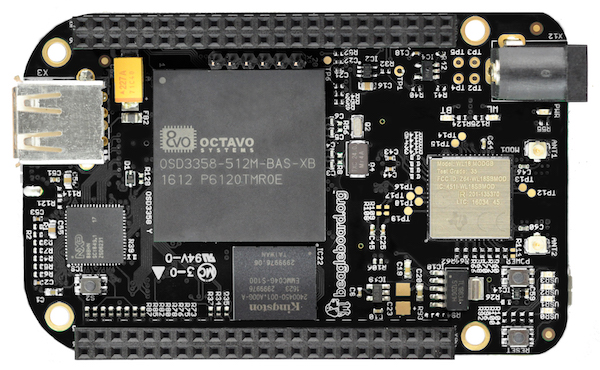
The new board is called the BeagleBone Black Wireless, and it brings to the table all you know and love about the BeagleBone. There’s a 1GHz ARM355x with two 32-bit 200MHz PRUs for the real-time pin toggling. RAM is set at 512MB, with 4GB of eMMC Flash and Debian pre-installed, and a microSD card for larger storage options. The new feature is wireless connectivity: a TI WiFi and Bluetooth module with provisions for 802.11s replaces the old Ethernet connector.

Taken at face value, the new BeagleBone Black Wireless deserves a mention — it’s a BeagleBone with wireless — but isn’t particularly noteworthy. But when you get to the gigantic brick of resin dropped squarely in the middle of the board does the latest device in the BeagleBone family become very, very interesting. The System on Module for this version of the BeagleBone is the BeagleBone On A Chip released a few months ago. The Octavo Systems OSD335x is, quite literally, a BeagleBone on a chip. It’s a BGA with big balls, making it solderable with hand-applied solder paste and a toaster oven reflow conversion. In fact, the BeagleBone Wireless was designed by [Jason Kridner] in Eagle as a 6-layer board. It’s still a bit beyond the standard capabilities of OSHPark, but the design can still be cut down, and shows how this BeagleBone on a Chip can be applied to other Open Hardware projects.


Automatic Resistance: Resistors Controlled By The Environment

Resistors are one of the fundamental components used in electronic circuits. They do one thing: resist the flow of electrical current. There is more than one way to skin a cat, and there is more than one way for a resistor to work. In previous articles I talked about fixed value resistors as well as variable resistors.

There is one other major group of variable resistors which I didn’t get into: resistors which change value without human intervention. These change by environmental means: temperature, voltage, light, magnetic fields and physical strain. They’re commonly used for automation and without them our lives would be very different.

Continue reading “Automatic Resistance: Resistors Controlled By The Environment”

The Healthy Maker: Tackling Vapors, Fumes And Heavy Metals

Fearless makers are conquering ever more fields of engineering and science, finding out that curiosity and common sense is all it takes to tackle any DIY project. Great things can be accomplished, and nothing is rocket science. Except for rocket science of course, and we’re not afraid of that either. Soldering, welding, 3D printing, and the fine art of laminating composites are skills that cannot be unlearned once mastered. Unfortunately, neither can the long-term damage caused by fumes, toxic gasses and heavy metals. Take a moment, read the material safety datasheets, and incorporate the following, simple practices and gears into your projects.

Continue reading “The Healthy Maker: Tackling Vapors, Fumes And Heavy Metals”

A Brief History Of ‘Drone’

In the early 1930s, Reginald Denny, an English actor living in Los Angeles, stumbled upon a young boy flying a rubber band-powered airplane. After attempting to help the boy by adjusting the rubber and control surfaces, the plane spun into the ground. Denny promised he would build another plane for the boy, and wrote to a New York model manufacturer for a kit. This first model airplane kit grew into his own hobby shop on Hollywood Boulevard, frequented by Jimmy Stewart and Henry Fonda.

The business blossomed into Radioplane Co. Inc., where Denny designed and built the first remote controlled military aircraft used by the United States. In 1944, Captain Ronald Reagan of the Army Air Forces’ Motion Picture unit wanted some film of these new flying targets and sent photographer David Conover to the Radioplane factory at the Van Nuys airport. There, Conover met Norma Jeane Dougherty and convinced her to go into modeling. She would later be known as Marilyn Monroe. The nexus of all American culture from 1930 to 1960 was a hobby shop that smelled of balsa sawdust and airplane glue. That hobby shop is now a 7-Eleven just off the 101 freeway.

Science historian James Burke had a TV wonderful show in the early 90s – Connections – where the previous paragraphs would be par for the course. Unfortunately, the timbre of public discourse has changed in the last twenty years and the worldwide revolution in communications allowing people to instantaneously exchange ideas has only led to people instantaneously exchanging opinions. The story of how the Dutch East India Company led to the rubber band led to Jimmy Stewart led to remote control led to Ronald Reagan led to Death of a Salesman has a modern fault: I’d have to use the word ‘drone’.

The word ‘propaganda’ only gained its negative connotation the late 1930s – it’s now ‘public relations’. The phrase ‘global warming’ doesn’t work with idiots in winter, so now it’s called ‘climate change’. Likewise, quadcopter pilots don’t want anyone to think their flying machine can rain hellfire missiles down on a neighborhood, so ‘drone’ is verboten. The preferred term is quadcopters, tricopters, multicopters, flying wings, fixed-wing remote-controlled vehicles, unmanned aerial systems, or toys.

I’m slightly annoyed by this and by the reminder I kindly get in my inbox every time I use the dreaded d-word. The etymology of the word ‘drone’ has nothing to do with spying, firing missiles into hospitals, or illegally killing American civilians. People like to argue, though, and I need something to point to when someone complains about my misuse of the word ‘drone’. Instead of an article on Hollywood starlets, the first remote control systems, and model aviation, you get an article on the etymology of a word. You have no one else to blame but yourself, Internet.

Continue reading “A Brief History Of ‘Drone’”

Extra-Large Denial Of Service Attack Uses DVRs, Webcams

Brace yourselves. The rest of the media is going to be calling this an “IoT DDOS” and the hype will spin out of control. Hype aside, the facts on the ground make it look like an extremely large distributed denial-of-service attack (DDOS) was just carried out using mostly household appliances (145,607 of them!) rather than grandma’s old Win XP system running on Pentiums.

Slide from <a href="http://slideplayer.org/slide/906693/">this talk</a> by Lisa Plesiutschnig
Replace computers with DVRs. Slide from this talk by Lisa Plesiutschnig

We can argue all day about whether a digital video recorder (DVR) or an IP webcam is an “IoT” device and whether this DDOS attack is the biggest to date or merely among them, but the class of devices exploited certainly are not traditional computers, and this is a big hit. Most of these devices run firmware out of flash, and it’s up to the end user (who is not a sysadmin) to keep it up to date or face the wrath of hackers. And it’s certainly the case that as more Internet-facing devices get deployed, the hacker’s attack surface will grow.

Why did the DDOS network use these particular devices? We’re speculating, but we’d guess it’s a combination of difficult-to-update firmware and user “convenience” features like uPnP. To quote the FBI “The UPnP describes the process when a device remotely connects and communicates on a network automatically without authentication.” You can see how this would be good for both the non-tech-savvy and hostile attackers, right? (Turn off UPnP on your router now.)

We alternate between Jekyll and Hyde on the IoT. On one hand, we love having everything in our own home hooked up to our local WiFi network and running on Python scripts. On the other hand, connecting each and every device up to the broader Internet and keeping it secure would be a system administration headache. Average users want the convenience of the latter without having to pay the setup and know-how costs of the former. Right now, they’re left out in the cold. And their toasters are taking down ISPs.

Artificial Skylight Brings Sunlight To Any Room

Humans aren’t supposed to be cooped up indoors all day, but who wants to be bothered by UV rays, insects, allergens, traffic, physical activity, and other people? On the other hand, a gloomy living space generally inhibits productivity — if not making it difficult to find what you’re looking for. So, if you’re looking to illuminate any room in your place, and you have the cash and the patience to wait for its widespread release, CoeLux is a skylight that needs no sky or sun — not that you’ll be able to tell the difference.

The Italian developers [CoeLux Srl] are perhaps wisely remaining tight-lipped on how the effect is achieved, but confirm that nanoparticles in the skylight mimic the effect of atmospheric fluctuations, compressing that vast deep blue into a few milimetres while maintaining the perception of infinite depth.

Continue reading “Artificial Skylight Brings Sunlight To Any Room”

Now Is The Golden Age Of Artisanal, Non-Traditional Tube Amps

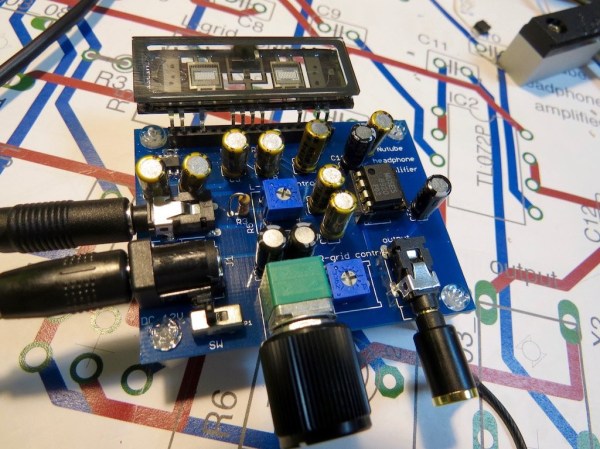
Earlier in the month, [Elliot Williams] quipped that it had been far too long since we saw a VFD-based amplifier build. Well, that dry spell is over. This week, [kodera2t] started showing off his design for a VFD headphone amp.

Here’s the thing, this isn’t using old surplus vacuum fluorescent displays. This is actually a new part. We first covered it about 18 months ago when Korg and Noritake announced the NuTube. It’s the VFD form factor you would find in old stereo and lab equipment, but housed in the familiar glass case is a triode specifically designed for that purpose.

Check out [kodera2t’s] video below where he walks through the schematic for his amplifier. Since making that video he has populated the boards and taken it for a spin — no video of that yet but we’re going to keep a watchful eye for a follow-up. Since these parts can be reliably sourced he’s even planning to sell it in his Tindie store. If you want to play around with this new tube that’s a pretty easy way to get the tube and support hardware all in one shot. This is not a hack, it’s being used for exactly what Korg and Noritake designed it to do, but we hope to see a few of these kits hacked for specific tastes in amp design. If you do that (or any other VFD hacking) we want to hear about it!

And now for the litany of non-traditional VFD amps we’ve grown to love. There is the Nixie amp where [Elliot] made the quip I mentioned above, here’s an old radio VFD amp project, in this one a VCR was the donor, and this from wayback that gives a great background on how this all works.

Continue reading “Now Is The Golden Age Of Artisanal, Non-Traditional Tube Amps”