The Most Powerful Diesel Engine

Ever. Literally.

A gearhead friend of ours sent along a link to a YouTube video (also embedded below) promising the world’s most powerful engine. Now, we’ll be the first to warn you that it’s just an advertisement, and for something that you’re probably not going to rush out and buy: the Wärtsilä 14RT marine engine.

A tiny bit of math: 96 cm cylinder diameter times 250 cm piston stroke = 1,809,557 CC. And it generates around 107,000 HP. That’s a fair bit, but it runs at a techno-music pace: 120 BPM RPM. With twelve cylinders, we’d love to hear this thing run. Two-strokes make such a wonderful racket! Wonder if they’ve tried to red-line it? It’s a good thing we don’t work at Wärtsilä.

Continue reading “The Most Powerful Diesel Engine”

How To Fail At Laser Cutting

Laser cutters are CNC power tools, which means an operator uploads a job digitally and then pushes START to let the machine do all the work while they lie back in a hammock sipping a margarita, occasionally leaping out in a panic because the sound coming from the machine changed slightly.

Like other power tools, laser cutters are built around doing one thing very well, but they require an operator’s full attention and support. The operator needs to handle all the other things that go on before, during, and after the job. It’s not too hard to get adequate results, but to get truly professional and repeatable ones takes work and experience and an attention to detail.

People often focus on success stories, but learning from failures is much more educational. In the spirit of exploring that idea, here are my favorite ways to fail at laser cutting and engraving. Not all of these are my own personal experience, but they are all someone’s personal experience.

Continue reading “How To Fail At Laser Cutting”

Path To Craftsmanship: The Art Of Throwing It Away

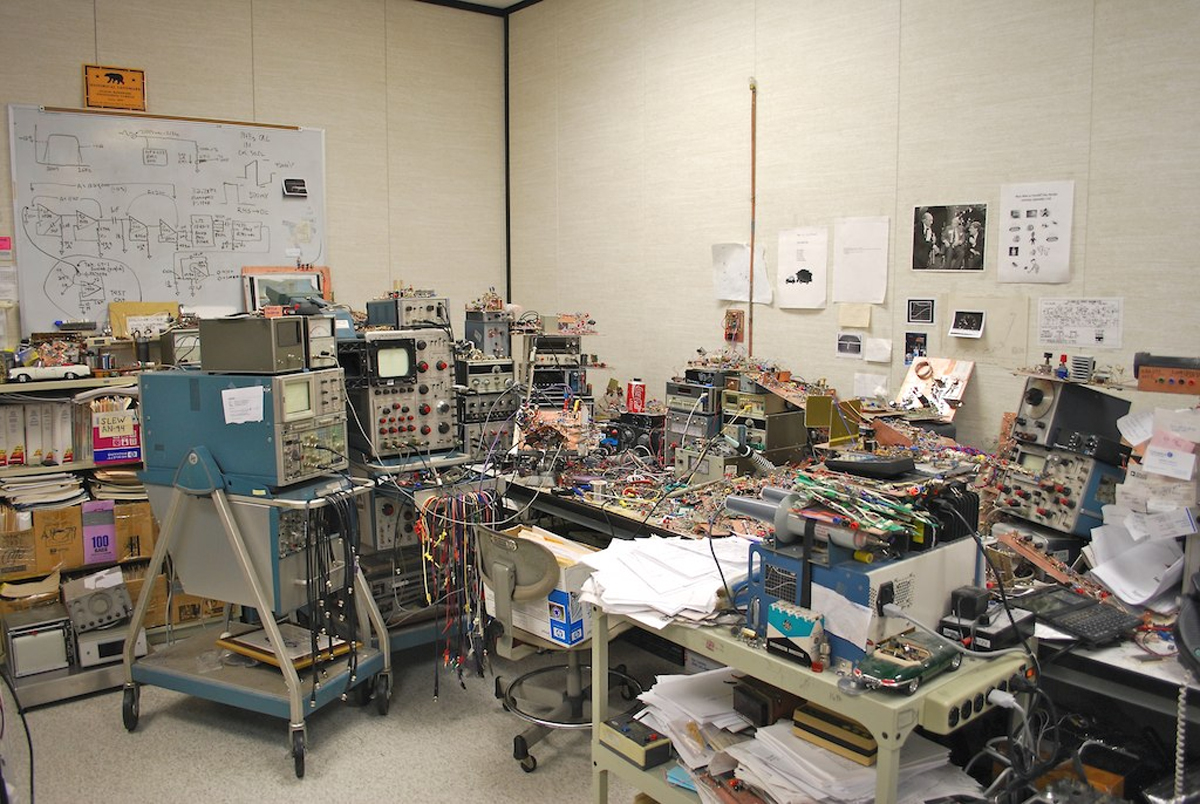
Some hackers build sharp, mildly toxic nests of parts, components, and thrifty finds around themselves. These nests, while not comfortable, are certainly comforting. They allow the hacker’s psyche to inhabit a locale as chaotic as their minds. Within these walls of stuff and clutter, stunning hacks pour out amid a small cloud of cursing. This article is not for them.

http://www.computerhistory.org/atchm/an-analog-life-remembering-jim-williams/
Very few of us can actually function in a workplace such like that of the venerable Jim Williams (photo from linked article). Thanks to the commenters for mentioning him in the previous article.

For the rest of us, clutter is a Zen destroying, seemingly unconquerable, monster that taunts our poor discipline and organizational skill from the dark corner of our minds. However, there is an easy solution that is oft overlooked. Somewhat obviously, most organization problems can be solved by simply not having things to organize.

It’s taken me a very long time to realize the source of my clutter woes. My first tactic was to blame myself for my inability to keep up with the mess. A more superior human would certainly be able to use their effortless discipline to keep a space organized. However, the clutter was a symptom of a problem completely separate from my actual ability to keep a space clean.

Continue reading “Path To Craftsmanship: The Art Of Throwing It Away”

Radio Shack Returns

In February 2015, Radio Shack–an icon in American malls and towns–filed for bankruptcy. You could say a lot of critical things about Radio Shack, but in many parts of the country, it was the only place you were going to go find electronic components on short notice. A lot of people of a certain age got their exposure to electronics via Radio Shack kits and parts.

Radio Shack did close a lot of stores. In fact, from 4,000 stores they are down to about 1,700. A New York hedge fund named Standard General bought all the Radio Shack assets and formed a new company (also called, oddly enough, Radio Shack). They just named [Dene Rogers] as CEO. He’s a veteran at retail sales, having been with Target in Australia and Sears in Canada.

Continue reading “Radio Shack Returns”

Autonomous Truck Teaches Itself To Powerslide

When you’re a teenager new to the sensations of driving, it seems counterintuitive to “turn into the skid”, but once you’ve got a few winters of driving under your belt, you’re drifting like a pro. We learn by experience, and as it turns out, so does this fully autonomous power-sliding rally truck.

Figuring out how to handle friction-optional roadways is entirely the point of the AutoRally project at Georgia Tech, which puts a seriously teched-up 1/5 scale rally truck through its paces on an outdoor dirt track. Equipped with high-precision IMU, high-resolution GPS, dual front-facing cameras, and Hall-effect sensors on each wheel sampled at 70 Hz, the on-board Quad-core i7 knows exactly where the vehicle is and what the relationship between it and the track is at all times. There’s no external sensing or computing – everything needed to run the track is in the 21 kg truck. The video below shows how the truck navigates the oval track on its own with one simple goal – keep the target speed as close to 8 meters per second as possible. The truck handles the red Georgia clay like a boss, dealing not only with differing surface conditions but also with bright-to-dark lighting transitions. So far the truck only appears to handle an oval track, but our bet is that a more complex track is the next step for the platform.

While we really like the ride-on scale of this autonomous chase vehicle, other than that there haven’t been too many non-corporate self-driving vehicle hacks around here lately. Let’s hope that AutoRally is an indication that the hackers haven’t ceded the field to Google entirely. Why let them have all the fun?

Continue reading “Autonomous Truck Teaches Itself To Powerslide”

Find The Source: WiFi Triangulation

[Michael] was playing with his ESP8266. Occasionally he would notice a WiFi access point come up with, what he described as, “a nasty name”. Perhaps curious about the kind of person who would have this sort of access point, or furious about the tarnishing of his formerly pure airspace, he decided to see if he could locate the router in question.

[Michael] built himself a warwalking machine. His ESP8266 went in along with a GPS module interfaced with a PIC micro controller. It was all housed in an off the shelf case with a keypad and OLED screen. He took his construction for a nice calming war walk around the neighborhood and came home with a nice pile of data to sort through. To save time, he placed the data in a SQL database and did the math using queries. After that it was a quick kludge to put together a website with the Google Maps API and some JavaScript to triangulate the computed results.

Sure enough, the person with the questionable WiFi access point shows up on the map.

Free Radio On My Phone

If you have owned Android phones, there’s a reasonable chance that as the kind of person who reads Hackaday you will at some time have rooted one of them, and even applied a new community ROM to it. When you booted the phone into its new environment it’s not impossible you would have been surprised to find your phone now sported an FM radio. How had the ROM seemingly delivered a hardware upgrade?

It’s something your cellphone carrier would probably prefer not to talk about, a significant number of phones have the required hardware to receive FM radio, but lack the software to enable it. The carriers would prefer you to pay for their data to stream your entertainment rather than listen to it for free through a broadcaster. If you are someone capable of upgrading a ROM you can fix that, but every other phone owner is left holding a device they own, but seemingly don’t own.

Across North America there is a group campaigning to do something about this situation. Free Radio On My Phone and their Canadian sister organization are lobbying the phone companies and manufacturers to make the FM radio available, and in the USA at least they have scored some successes.

We have covered numerous attempts to use the DMCA to restrict people’s access to the hardware they own, but this story is a little different. There is no question of intellectual property being involved here, it is simply that the carriers would rather their customers didn’t even know that they had bought an FM radio along with their phone. If this bothers you, thanks to Free Radio On My Phone you can now join with others and find a voice on the matter.

It’s interesting to note that many FM radio chips also support a wider bandwidth than the North American and European 88 to 108MHz or thereabouts. In parts of Asia the broadcast band extends significantly lower than this, and the chipset manufacturers make products to support these frequencies. This opens up the interesting possibility that given a suitable app a cellphone could be used to receive other services on these frequencies. Probably more of a bonus for European radio amateurs with their 70MHz allocation than for North American residents.

Via CBC News. Cellphone image: By Rob Brown [Public domain], via Wikimedia Commons.