BitDrones Are Awesome, Ridiculous At Same Time

At first we thought it was awesome, then we thought it was ridiculous, and now we’re pretty much settled on “ridiculawesome”.

Bitdrones is a prototype of a human-computer interaction that uses tiny quadcopters as pixels in a 3D immersive display. That’s the super-cool part. “PixelDrones” have an LED on top. “ShapeDrones” have a gauzy cage that get illuminated by color LEDs, making them into life-size color voxels. (Cool!) Finally, a “DisplayDrone” has a touchscreen mounted to it. A computer tracks each drone’s location in the room, and they work together to create a walk-in 3D “display”. So far, so awesome.

It gets even better. Because the program that commands the drones knows where each drone is, it can tell when you’ve moved a drone around in space. That’s extremely cool, and opens up the platform to new interactions. And the DisplayDrone is like a tiny flying cellphone, so you can chat hands-free with your friends who hover around your room. Check out the video embedded below the break.

Continue reading “BitDrones Are Awesome, Ridiculous At Same Time”
The Latest, Best WiFi Module Has Been Announced

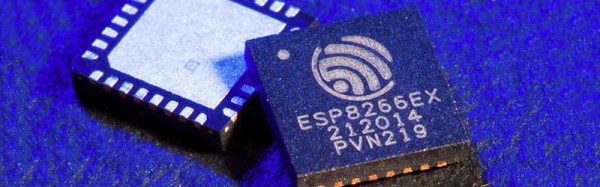
A little more than a year ago, a new product was released onto the vast, vast marketplace of cheap electronics. It was the ESP8266, and this tiny and cheap WiFi module has since taken over the space of hobbyist electronics and become the de facto standard for connecting tiny microcontrollers to the Internet.

Now there’s an upgrade on the horizon. [John Lee], the public face of Espressif, the makers of the ESP8266, has announced the next product they’re working on. It’s called the ESP32, and if the specs given are correct, it looks to be the next great thing for the Internet of Things.

The ESP32 will now contain two Tensilica processors running at 160MHz, compared to the ‘8266’s one processor running at 80 MHz. The amount of RAM has been increased to 400 kB, Bluetooth LE has been added, WiFi is faster, and there are even more peripherals tucked away in this tiny piece of silicon.

The new ESP32 includes new, simplified APIs and unlike when the ESP8266 was announced, documentation in English.

Right now, Espressif is beta testing the ESP32, with about 200 boards manufactured so far. If you’re one of the few lucky people who have one of these boards on your workbench, we’d love to see your take on it.

Gmail One Step Closer To Human Enslavement

Apply some lessons learned in Sci-Fi literature and you’ll come to the same realization I have: Google is going to unknowingly enslave humanity to an artificial intelligence.

I read a lot of science fiction. Generally, the future of technology can be found in great novels if you read between the lines. One of my favorites in this regard is, of course, [Neal Stephenson] who writes cripplingly long books that are totally worth the read due to his brand of fact-backed forward thinking. Look back on my posts here at Hackaday and you’ll see that I frequently apply concepts from his book The Diamond Age to what we see in emerging technology.

Last year my friend [Nils] suggested I give [William Hertling] a try, specifically his Singularity Series which starts with the novel Avogadro Corp. The fictional company is the world leader in free email and data storage. Sound like someone we know? One of the research projects within the company is an email plugin called ELOPe that will parse all past communications and choose topics and phrases that have the highest probability of eliciting a positive response from the recipient. When funding for the project is threatened, the system is turned on. I’d like to avoid spoilers, but let’s just say this puts the system on a path toward enslaving society.

Google is now boasting “Machine Intelligence for You”. It’s a research project based around Gmail which is called Inbox. Inbox has been around for a while but the newly announced feature is an algorithm that reads the email for you and suggests a set of responses. Compared to Avogadro Corp this is only missing two things: the ability to respond automatically, and the directive to protect itself at all costs.

One of the things I liked best about [William Hertling’s] take on an Artificial Intelligence was the low-key nature of the entity. It wasn’t a super-high-level thinker that interacts just like a human would. It was a poor choice by one programmer that led to horrible and far-reaching unintended consequences. No, I don’t really think Google’s Inbox will enslave us. But I appreciate the irony of life imitating art.

[via PopSci]

Fail Of The Week: OpenMV Kickstarter Project Hits Manufacturing Snag

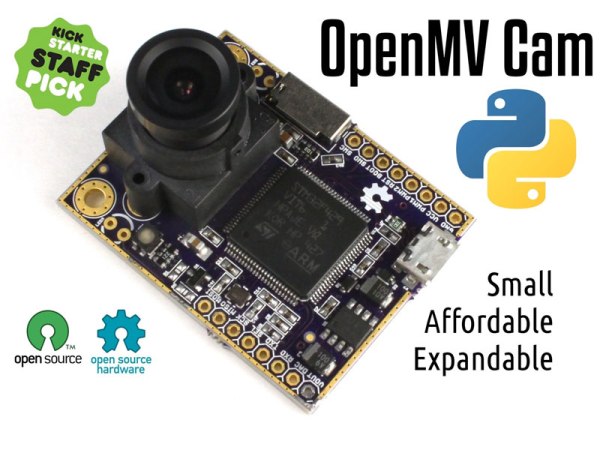
Making stuff is hard, especially when you are making lots of stuff. The OpenMV Cam project knows this, because it has hit a problem while putting together their cheap machine vision module. The problem is with the BGA solder balls that connect the image sensor to the main board.

openmv-thumbWe’ve covered this intriguing project before: the aim is to build a small, cheap module that can run image processing algorithms to easily give robots sight. The sensor is a Ball Grid Array (BGA) package, which means there are a grid of small solder balls on the back that form the electrical connections. It seems that some of these solder balls are oxidized, preventing them from melting and fusing properly with the board. This is called a head-in-pillow defect, because the ball behaves like your head when you lie down in bed. Your head squishes the pillow, but doesn’t merge into it. There are 38 balls on the OV26040 image sensor and even a single bad link means a failure.
The makers of the project have tried a number of solutions, but it seems that they may have to remake the ball links on the back of each sensor. That’s an expensive process: they say it will cost $7 for each, more than the actual sensor cost initially.

A few people have been posting suggestions in the comments for the project, including using solvents and changing the way the sensors are processed before mounting. We’d like to see them overcome this hurdle. Anybody have any suggestions to quickly and cost effectively move the manufacturing process forward?

Continue reading “Fail Of The Week: OpenMV Kickstarter Project Hits Manufacturing Snag”

Slide Rules Were The Original Personal Computers

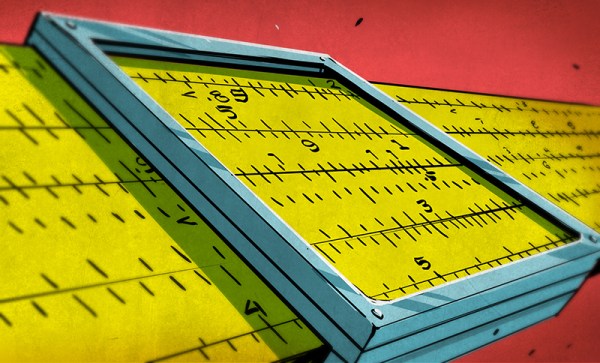
Unless you are above a certain age, the only time you may have seen a slide rule (or a slip stick, as we sometimes called them) is in the movies. You might have missed it, but slide rules show up in Titanic, This Island Earth, and Apollo 13. If you are a fan of the original Star Trek, Mr. Spock was seen using Jeppesen CSG-1 and B-1 slide rules in several episodes. But there was a time that it was common to see an engineer with a stick hanging from his belt, instead of a calculator or a cell phone. A Pickett brand slide rule flew to the moon with the astronauts and a K&E made the atomic bomb possible.

Slide rules are a neat piece of math and history. They aren’t prone to destruction by EMP in the upcoming apocalypse (which may or may not include zombies). Like a lot of things in life, when it comes to slide rules bigger is definitely better, but before I tell you about the 5 foot slide rule in my collection, let’s talk about slide rules in general.
Continue reading “Slide Rules Were The Original Personal Computers”

RPiTX Turns Rasberry Pi Into Versatile Radio Transmitter

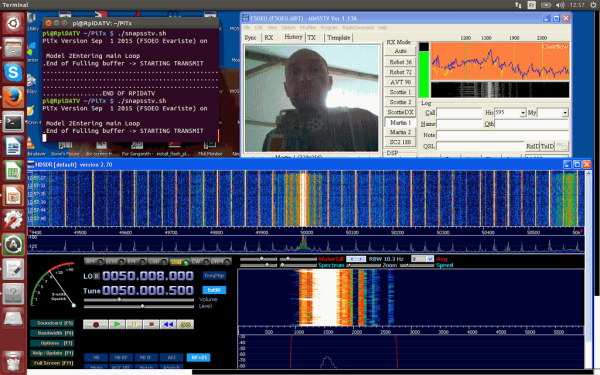
Since the discovery that some USB TV tuner dongles could be used to monitor radio waves across a huge amount of spectrum, the software-defined radio world has exploded with interest. The one limiting factor, though, has been that the dongles can only receive signals; they can’t transmit them. [Evariste Okcestbon, F5OEO] (if that is his real name! Ok c’est bon = Ok this is good) has written some software that will get you transmitting using SDR with only a Raspberry Pi and a wire.

There have been projects in the past that use a Pi to broadcast radio (PiFM), but this new software (RPiTX) takes it a couple steps further. Using just an appropriately-sized wire connected to one of the GPIO pins, the Raspberry Pi is capable of broadcasting using FM, AM, SSB, SSTV, or FSQ signals. This greatly increases the potential of this simple computer-turned-transmitter and anyone should be able to get a lot of use out of it. In the video demo below the break, [Evariste] records a wireless doorbell signal and then re-transmits it using just the Rasbperry Pi.

The RPiTX code is available on GitHub if you want to try it out. And it should go without saying that you will most likely need an amateur radio license of some sort to use most of these features, depending on your locale. If you don’t have a ham radio license yet, you don’t need one to listen if you want to get started in the world of SDR. But a ham license isn’t hard to get and at this point it shouldn’t take much convincing for you to get transmitting.

Continue reading “RPiTX Turns Rasberry Pi Into Versatile Radio Transmitter”

Tote Boards: The Impressive Engineering Of Horse Gambling

Horse racing has been around since the time of the ancient Greeks. Often called the sport of kings, it was an early platform for making friendly wagers. Over time, private bets among friends gave way to bookmaking, and the odds of winning skewed in favor of a new concept called the “house”.

During the late 1860s, an entrepreneur in Paris named Joseph Oller invented a new form of betting he called pari-mutuel. In this method, bettors wager among themselves instead of against the house. Bets are pooled together and the winnings divided among the bettors. Pari-mutuel betting creates more organic odds than ones given by a profit-driven bookmaker.

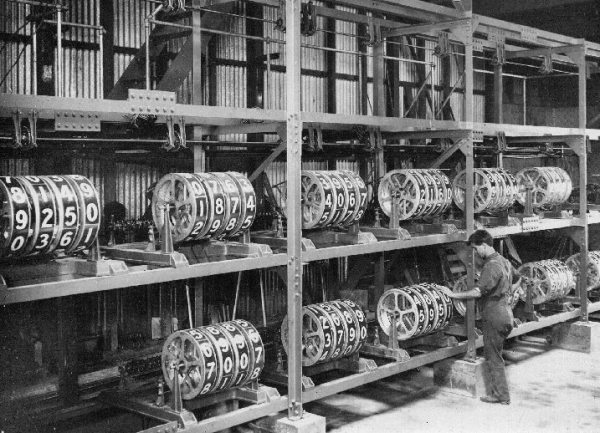
Oller’s method caught on quite well. It brought fairness and transparency to betting, which made it even more attractive. It takes a lot of quick calculations to show real-time bet totals and changing odds, and human adding machines presented a bottleneck. In the early 1900s, a man named George Julius would change pari-mutuel technology forever by making an automatic vote-counting machine in his garage.

Continue reading “Tote Boards: The Impressive Engineering Of Horse Gambling”