Atoms are small. Really small. You just won’t believe how minusculely microscopically mindbogglingly small they are. I mean you may think it’s a short way down the road to the chemist’s, but that’s just peanuts to atoms.
Atoms really are small. The atomic radius of a carbon atom is on the order of 0.1 nanometers, that’s 0.0000001 millimeters. It’s hard to grasp how fantastically small this is compared to objects we generally encounter, but as a starting point I’d recommend looking at the “Powers of Ten” video found below whose ability to convey the concept has been unrivaled since it was published in 1977.
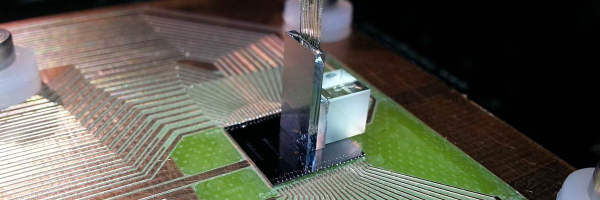
The term nanometer might be most familiar from the semiconductor industry, and its seemingly unstoppable march to smaller feature sizes. Feature sizes currently hover somewhere around the 10 nanometer mark. So while these multi-billion dollar facilities can achieve 10nm precision it’s somewhat surprising that sub-nanometer feature size positioning, and fabrication techniques are available at relatively low cost to the hacker hobbyist.
In this article we’re going to review some of the amazing work demonstrated by hobbyists in the area of the very very small through use of cutting edge, but low cost techniques.
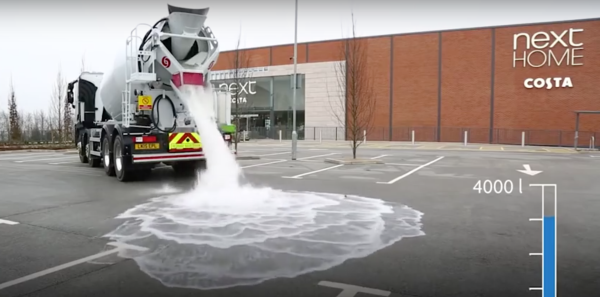
Concrete – it’s all around you. You probably walk on it, drive on it, and maybe even sit on it! From a civil engineering standpoint, concrete really is a miracle material. But, it does have its downsides, especially in heavily developed urban areas. One of the most glaring of those downsides is the tendency for water to pool and flood on concrete. However, a new concrete formula could dramatically improve that by allowing water to drain quickly through the concrete itself.
While all unsealed concrete technically absorbs water, it does so very inefficiently and quickly becomes saturated. Once that happens, water will pool on the surface. This causes obvious problems for cars, as they become susceptible to hydroplaning. It also creates the potential for flooding in heavily paved areas.
This new concrete formula, called Topmix Permeable, is designed to reduce pooling by letting the water flow through at the rate of 600 liters per minute per square meter! It does this by using larger gravel pieces in the mix, which leaves bigger gaps for the water to drain down into. From there, it can be absorbed by the underlying soil, or routed safely away from roadways and parking lots.
Of course, this formula isn’t perfect. Its ability to pass through water also makes it likely to crack and quickly deteriorate in cold climates, as the water freezing and thawing inside the concrete will easily damage it. But, in warmer climates that receive a lot of rainfall in bursts, it could significantly improve safety.
Imagine a world where the most widely-used cryptographic methods turn out to be broken: quantum computers allow encrypted Internet data transactions to become readable by anyone who happened to be listening. No more HTTPS, no more PGP. It sounds a little bit sci-fi, but that’s exactly the scenario that cryptographers interested in post-quantum crypto are working to save us from. And although the (potential) threat of quantum computing to cryptography is already well-known, this summer has seen a flurry of activity in the field, so we felt it was time for a recap.
How Bad Is It?
If you take the development of serious quantum computing power as a given, all of the encryption methods based on factoring primes or doing modular exponentials, most notably RSA, elliptic curve cryptography, and Diffie-Hellman are all in trouble. Specifically, Shor’s algorithm, when applied on a quantum computer, will render the previously difficult math problems that underlie these methods trivially easy almost irrespective of chosen key length. That covers most currently used public-key crypto and the key exchange that’s used in negotiating an SSL connection. That is (or will be) bad news as those are what’s used for nearly every important encrypted transaction that touches your daily life.
I came across an interesting question this weekend: how do you establish your East/West location on the globe without modern technology? The answer depends on what you mean by “modern”, it turns out you only have to go back about three centuries to find there was no reliable way. The technology that changed that was a clock; a very special one that kept accurate time despite changing atmospheric conditions and motion. The invention of the Harrison H1 revolutionized maritime travel.
We can thank Andy Weir for getting me onto this topic. I just finished his amazing novel The Martian and I can confirm that George Graves’ opinion of the high quality of that novel is spot on. For the most part, Andy lines up challenges that Mark Watney faces and then engineers a solution around them. But when it came to plotting location on the surface of Mars he made just a passing reference to the need to have accurate clocks to determine longitude. I had always assumed that a sextant was all you needed. But unless you have a known landmark to sight from this will only establish your latitude (North/South position).
Legendary electrical engineer and linear IC trailblazer Bob Widlar was just like you. What I mean is that he would use everything available to him to mock up circuits, create prototypes, and make things work. One of the simplest and coolest tools he used was a conductive paper called Teledeltos. This wonderful stuff allowed him to define and test various configurations for the oddly-shaped ballast resistors he used in some of his high-performance circuit designs. But it wasn’t created for people like you and Bob. Teledeltos paper was created and trademarked by communications giant Western Union to drastically improve the convenience of telegrams.
Development of the electric telegraph ushered in the era of global communication. Suddenly, people could send messages to the other side of the world in a fraction of the time it took by post. The telegraph absolutely revolutionized human communication. It was the e-mail and the Twitter of its time. The telegraph’s efficiency made the Pony Express pretty much obsolete by the 1860s. And for a very long time it was much cheaper for people to send a telegram than make a long-distance phone call.
The Advantages of Facsimile
Translated from ancient Greek, ‘teledeltos’ basically means writing tablet at a distance. Western Union began developing Teledeltos paper in the 1930s for the purpose of transmitting telegrams by facsimile, a method that would greatly reduce the time it took to input messages into the system and get them out on the other side. As long as both the sender and the receiver had facsimile machines, a handwritten telegram could be transmitted without having to be typed by a clerk or translated into code. Teledeltos paper was also used in a variety of chart recorders, like seismographs and map plotters. The ability to feed a handwritten message, a photograph, or a map of enemy territory into a machine that transmitted an exact copy was a real game changer.
Because of its composition, Teledeltos paper could be easily marked without an electrolyte. It marked so well that photographs and other graphic information could be transmitted, and no processing was required on the receiving end. A dry recording paper is also much less sensitive to light and to temperature extremes. More importantly, properly stored dry paper is impervious to fungal growth. Teledeltos paper could sit around indefinitely without becoming useless. The only real disadvantage to this type of paper was the somewhat laborious process that went into achieving the desired resistance. Fax machines eventually moved on to digital transmission and thermal printing technology.
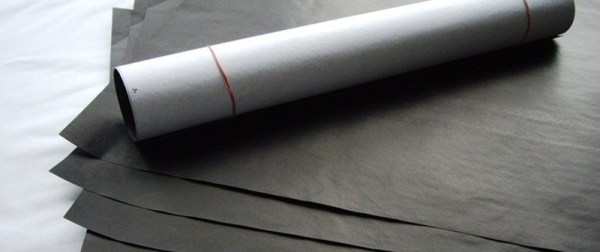
Teledeltos paper has a light gray electro-sensitive coating on one side, and the other side is carbon black. When a current is applied with a stylus to the coated side of the paper, the coating is instantly burned away, revealing the carbon black. Teledeltos paper could be marked using either AC or DC. Polarity didn’t matter, either, but the boys in the lab at Western Union had better luck when they used a positive stylus with DC rather than a negative one.
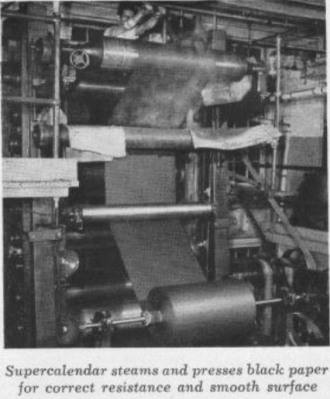
Teledeltos paper was made in two types—“L” for low resistance and “H” for high. The resistivity of a roll of Teledeltos paper depended on the quality of the conductive fibers that went into it. The paper’s electrical characteristics were also influenced by the fiber beating process and the distribution of the conductive fibers by the supercalender, a system of hard rollers used in papermaking and other processes that press and smooth paper and other materials to increase the density.
Teledeltos to the Rescue
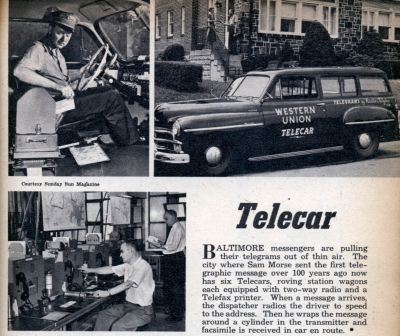
The Western Union Telecar printed telegrams on the go and delivered them to homes and businesses. Image credit: Modern Mechanix
Western Union was eager to extend its reach into private businesses and public places so that patrons who weren’t heavy telegram users didn’t have to visit a telegram office in order to share a bit of good news or to send their condolences. The company’s Telefax division came up with several types of machines to serve different business needs.
Some messages continued to be delivered by hand, but they weren’t printed at the central office. Western Union created a Telecar service to print telegrams transmitted to the car by the central office and deliver them to people’s homes. Messages were printed onto recording blanks that were cut automatically by a Telefax recorder situated in the car’s passenger area. The Telecar’s radio and amplification equipment was in the trunk.
The standard Telefax machine for office use was fairly large, like an early microwave oven. A smaller version called the DeskFax was only about the size of a breadbox, and these units occupied the desks of many businessmen and secretaries because of their convenience.
A Western Union DeskFax unit. Image from [B. Hilpert]Both the Telefax and the DeskFax scanned and recorded telegrams using a rotary drum mechanism. A message could either be typed or handwritten onto a telegram blank. The sender then wrapped the telegram around a drum and set the machine to send. The machine would scan the message optically and then transmit it to the central office.
Before sending it on to the recipient, an attendant at the telegram office had to remove the incoming message and wrap it around the drum of a transmitting machine. Once connected to the receiving party’s line, the far end unit would buzz to arouse attention. The receiving patron would then load a blank on to their DeskFax’s roller and set their machine to receive.
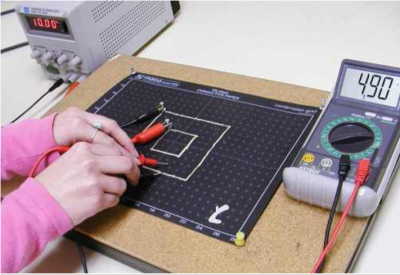
Conductive paper like Teledeltos has many applications aside from fax machines and Fathometers. For starters, it’s great for making one-offs of both standard and variable resistors. Conductive paint can be used as connection points for wires. The paper is also well-suited for simulating current flow through circuits using a fraction of the current intended in production. Vacuum tube designers used Teledeltos for modeling potentials. Teledeltos can also be used to visualize electromagnetic potentials and perform field plotting.
We’re sure that at least a few of our readers out there used Teledeltos or something like it in school or on the job. Did you know you can still buy it? Teledeltos paper itself is still available from two companies in the UK, Better Equipped and Timstar. In the US, you can get it from Pasco in packs of 50 and 100 sheets, with and without a grid pattern.
[Teledeltos paper image is a product photo from Better Equipped]
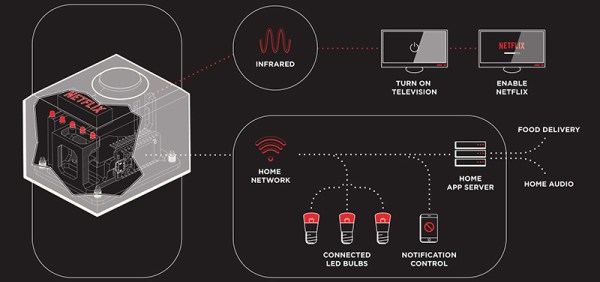
While the people at Netflix were busy killing weekends around the world with marathon viewings of 90s sitcoms, they also found time to release the Netflix Switch. It’s a small device with a single button that will control your TV, turn off the lights, and order a pizza. Remember, time you enjoy wasting is not wasted time.
The Netflix Switch is a relatively simple device powered by a Particle Core, an Arduino-compatible development board with on-board WiFi. Also in this box is a LiPo battery, a few LEDs, and an IR transmitter that will send the same IR signal as the Netflix button on your TV remote, should your remote have a Netflix button.
In an unprecedented break from reality, this astute corporate branding of electronics tinkering also has design files, schematics, and real instructions that come along with it. Netflix released all of the mechanical files for their switch in Solidworks format; for the low, low price of only $4000 per Solidworks license, you too can Netflix and Chill.
Although Netflix’ implementation of tapping into a DIY electronics movement that has been around for 100 years is lacking, the spirit of the build is laudable. A single button connected to the Internet is a universal tool, and whether you want to order a pizza or make a ‘do not disturb’ button for your phone, the only limitation for the Netflix and Chill button is your imagination.
For most of us, hacking is a hobby, a pleasant diversion from reality. Yes, a lot of us work on projects which have the potential to change the world – witness the 2015 Hackaday Prize semifinalist list. But in general, almost any of us could walk away from the shop at any time without dire consequences. Indeed, that’s the reason a lot of our work benches are littered with projects started with the best of intentions but left unfinished for lack of funds, lack of interest, or lack of time. We’re free to more or less willingly shelve a project and come back to it whenever we please, or not at all.
But not everyone has that luxury. For some people, hacking is much more than a hobby – it’s a means of survival. Sometimes people are thrown into situations where they have to cobble together a solution to an immediate problem with whatever is at hand, when the penalty for failure is much higher than a cluttered bench and a bruised ego. I’ve already covered one such case, where biohacked insulin saved hundreds of lives in occupied Shanghai in WWII.
In this occasional series I’ll explore historical cases where hacking really counted; cases where lives were saved or improved by a hack performed under desperate conditions.
A Bustle in the Hedgerow
Unsurprisingly, war offers a lot of opportunities for field expedient solutions under dire circumstances, and battlefield conditions might be the most extreme example of hacking when it counts.
In the early days of the Invasion of Normandy during WWII, Allied forces were having a difficult time dealing with the bocage terrain of northern France. A mixture of pasture and woodland, the Normandy bocage was a natural killing field for Allied tanks because the woodlands took the form of hedgerows – earthen dikes topped with thick tangles of brush. Hedgerows separated pastures and kept livestock controlled, but also made things tough on infantry and mechanized cavalry alike. Climbing the steep hedgerows exposed the vulnerable bottom hull of the tanks to enemy fire, and waiting for engineers to demolish the hedgerows with explosive made them sitting ducks for German artillery. The Allied advance was seriously hampered by the hedgerows, and both men and materiel were being winnowed down from fixed German positions chosen specifically to take advantage of the bocage terrain.
Enter Sgt. Curtis Grubb Culin III. Sgt. Culin, a tanker himself, was acutely aware of how vulnerable he was in his Sherman M4. The hedgerows were the problem, one apparently known to Allied command prior to the invasion for which no provision had been made. In the tradition of soldiers at the front of every battle throughout history, Sgt. Culin and his fellow tankers had to improvise a solution.
While kicking around ideas, one of the men suggested setting saw teeth on the front of a tank to cut through the hedgerows. He later attributed the comment to “A Tennessee hillbilly named Roberts”, and it was met with general laughter from the group as a crackpot scheme. But Sgt. Culin saw the potential in the idea, and began to develop it into a prototype.
Raw materials for his prototype were not hard to come by. Czech hedgehogs, giant anti-tank barriers made of crossed steel beams, still littered the Normandy beaches. The failed German defenses were harvested with a cutting torch and welded to the underside of a tank to form a series of “tusks” across the hull between the tracks. Equipped with these tusks, the tank could now blast through the tangled roots of the brush-covered earth of the hedgerow dykes.
When demonstrated for General Omar Bradley, he was impressed enough to order them built in quantity for the tanks. Eventually the prototype became an engineered product (dubbed the “Culin Rhino Device”) that was fitted to many tanks before being shipped over from England. Rhino-equipped tanks ripped across Normandy and shredded the German battle plan, which assumed the hedgerows would funnel Allied forces through heavily defended chokepoints.
Without Sgt. Culin’s battlefield hack, and his inspiration by a hillbilly named Roberts whom history otherwise forgets, the invasion of Europe might have taken a very different course. The fact that he did the hack while under fire makes it all the more impressive, and is a perfect example of hacking when it counts.
Know of any more examples of hacking when it counts? Send us a tip for use in a future Hacking When it Counts article.



![A Western Union DeskFax unit. Image from [B. Hilpert]http://www.cs.ubc.ca/~hilpert/e/deskfax/](https://hackaday.com/wp-content/uploads/2015/09/deskfax.jpg?w=400)
 The Netflix Switch is a relatively simple device powered by a