Sliderule Simulator Teaches You How To Do Calculations The Old Fashioned Way

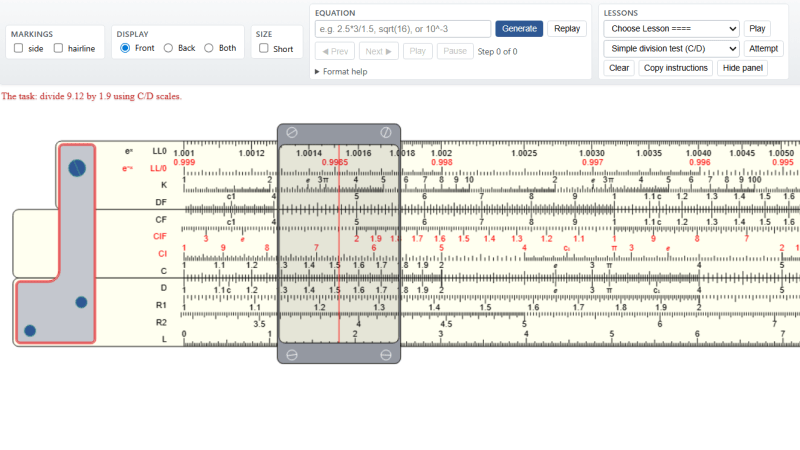
Ever wanted to know how engineers made their calculations before digital calculators were on every workbench? [Richard Carpenter] and [Robert Wolf] have just the thing—a sliderule simulator that can teach you how to do a whole bunch of complex calculations the old fashioned way!

The simulator is a digital recreation of the Hemmi/Post 1460 Versalog slide rule. This was a particularly capable tool that was sold from 1951 to 1975 and is widely regarded as one of the best slide rules ever made. It can do all kinds of useful calculations for you just by sliding the scales and the cursor appropriately, from square roots to trigonometry to exponents and even multi-stage multiplication and divisions.

You can try the simulator yourself in a full-screen window here. It’s written in JavaScript and runs entirely in the browser. If you’ve never used a slide rule before, you might be lost as you drag the center slide and cursor around. Fear not, though. The simulator actually shows you how to use it. You can tap in an equation, and the simulator will both spit out a list of instructions to perform the calculation and animate it on the slide rule itself. There are even a list of “lessons” and “tests” that will teach you how to use the device and see if you’ve got the techniques down pat. It’s the sort of educational tool that would have been a great boon to budding engineers in the mid-20th century. With that said, most of them managed to figure it out with the paper manuals on their own, anyway.

We’ve featured other guides on how to use this beautiful, if archaic calculation technology, too. We love to see this sort of thing, so don’t hesitate to notify the tipsline if you’ve found a way to bring the slide rule back to relevance in the modern era!

Thanks to [Stephen Walters] for the tip!
An Open Source Client For World Of Warcraft

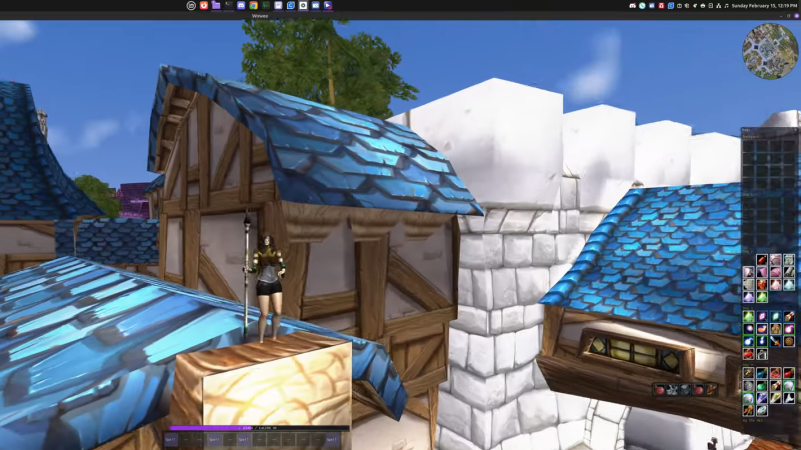
When World of Warcraft was launched in 2004, it became somewhat of a juggernaut in the MMORPG space. Millions of players continue to login every month. [Kelsi Davis] is one such player, but she doesn’t always log in with the regular client anymore. That’s because she put together WoWee—an open-source alternative of her very own.

WoWee is an acronym—World of Warcraft Engine Experiment. Coded in native C++, it’s a homebrewed client that uses a custom OpenGL renderer to display the game world. [Kelsi] notes that it’s strictly an “educational/research” project, built without using any official Blizzard assets, data or code. Instead, it grabs some client data from a legally-obtained install to operate and loads certain assets this way.

It’s currently compatible with the vanilla game as well as The Burning Crusade and Wrath of the Lich King expansions. It should be highlighted how much work this project has already involved—with [Kelsi] needing to recreate various functional minutae in the game, from character creation screens to weather systems and skyboxes. There’s still a lot to do, as well, like adding 3D audio support and making it more interoperable with the quest system.

It’s rare that any MMO gets an open-source client, even less so while the original game is still being actively supported by the developers. Still, we do see some creative hacks in this space.

Continue reading “An Open Source Client For World Of Warcraft

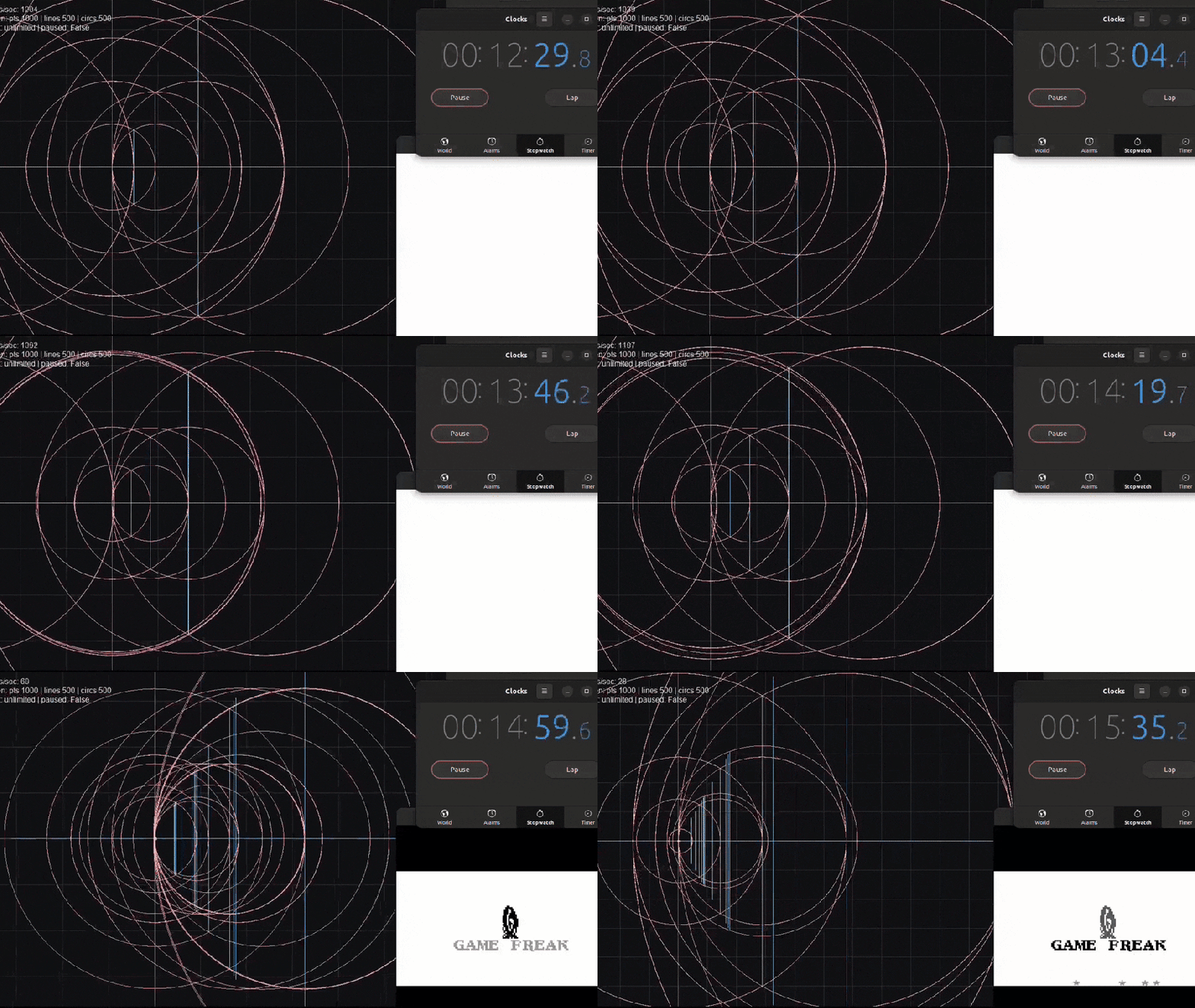
An animated set of circles and lines are drawn on a black screen. Meanwhile, in a smaller window in the lower right corner, the boot screen of a Game Boy is displayed.

Running Pokémon With A Compass And Straightedge

The ancient question of whether or not it’s possible to construct a circle with the same area as a given square using only a drawing compass and straightedge was finally answered in 1882, where it was proved that pi is a transcendental number, meaning it cannot be accurately represented in a compass-and-straightedge system. This inability to accurately represent pi is just one of the ways in which these systems resemble a computer, a similarity that [0x0mer] explored in CasNum.

The core of the program represents operations with a drawing compass and unmarked straightedge. There are only a few operations that can be used for calculation: constructing a line through two points, constructing a circle centered at one point and intersecting another point, and constructing the intersection(s) of two lines, a line and a circle, or two circles. An optional viewer visualizes these operations. Another class builds on top of this basic environment to perform arithmetic and logical operations, representing numbers as points in the Cartesian plane. To add two numbers, for example, it constructs the midpoint between them, then doubles the distance from the origin.

There are some examples available, including the RSA algorithm. [0x0mer] also altered a Game Boy emulator to implement the ALU instructions using compass and straightedge operations. In testing, it took about fifteen minutes to boot, and runs at a “totally almost playable” speed, near one FPS. This is after extensive caching has been applied to minimize computation time; the performance here is impressive, but in a more qualitative than quantitative sense.

Being virtual, this system is discrete, but a physical compass and straightedge form a simple analog computer capable of dealing with continuous values.

Bash Via Transpiler

It is no secret that we often use and abuse bash to write things that ought to be in a different language. But bash does have its attractions. In the modern world, it is practically everywhere. It can also be very expressive, but perhaps hard to read.

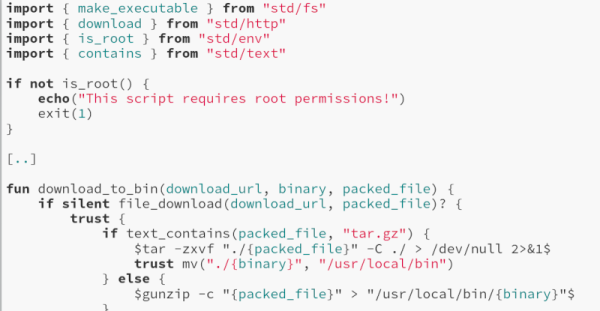
We’ve talked about Amber before, a language that is made to be easier to read and write, but transpiles to bash so it can run anywhere. The FOSDEM 2026 conference featured a paper by [Daniele Scasciafratte] that shows how to best use Amber. If you prefer slides to a video, you can read a copy of the presentation.

Continue reading “Bash Via Transpiler”

Implementing 3D Graphics Basics

Plenty of our childhoods had at least one math teacher who made the (ultimately erroneous) claim that we needed to learn to do math because we wouldn’t always have a calculator in our pockets. While the reasoning isn’t particularly sound anymore, knowing how to do math from first principles is still a good idea in general. Similarly, most of us have hugely powerful graphics cards with computing power that PC users decades ago could only dream of, but [NCOT Technology] still decided to take up this project where he does the math that shows the fundamentals of how 3D computer graphics are generated.

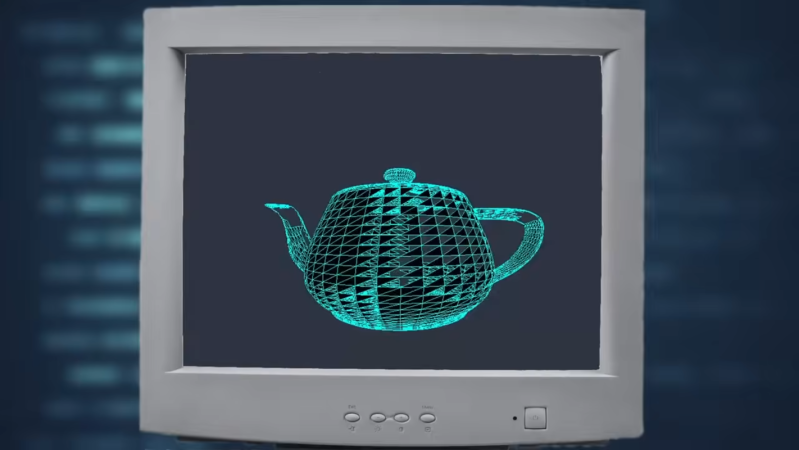
The best place to start is at the beginning, so the video demonstrates a simple cube wireframe drawn by connecting eight points together with lines. This is simple enough, but modern 3D graphics are really triangles stitched together to make essentially every shape we see on the screen. For [NCOT Technology]’s software, he’s using the Utah Teapot, essentially the “hello world” of 3D graphics programming. The first step is drawing all of the triangles to make the teapot wireframe. Then the triangles are made opaque, which is a step in the right direction but isn’t quite complete. The next steps to make it look more like a teapot are to hide the back faces of the triangles, figure out which of them face the viewer at any given moment, and then make sure that all of these triangles are drawn in the correct orientation.

Rendering a teapot is one thing, but to get to something more modern-looking like a first-person shooter, he also demonstrates all the matrix math that allows the player to move around an object. Technically, the object moves around the viewer, but the end effect is one that eventually makes it so we can play our favorite games, from DOOM to DOOM Eternal. He notes that his code isn’t perfect, but he did it from the ground up and didn’t use anything to build it other than his computer and his own brain, and now understands 3D graphics on a much deeper level than simply using an engine or API would generally allow for. The 3D world can also be explored through the magic of Excel.

Continue reading “Implementing 3D Graphics Basics”

ReMemory Is The Amnesia-hedging Buddy Backup You Didn’t Know You Needed

What would happen if you lost your memory, even partially? With so much of our lives being digital, forgetting your passwords (or the master key to your password manager) could be disastrous. Haunted by that specter after a concussion, [eljojo] created ReMemory, a tool based on Shamir’s Secret Sharing to help your friends help you.

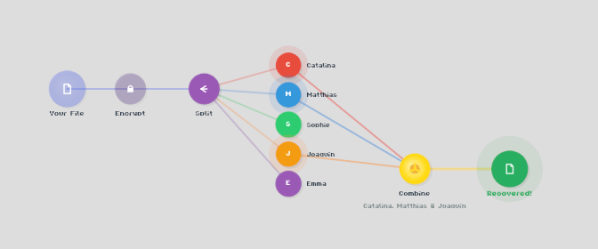
Shamir’s Secret Sharing, for the uninitiated, is a way to split up important data between parties so that the full picture is only available when a quorum comes together. The classic example is giving everyone a couple of digits out of the combination to the bank vault, but no one the full combination. Together, they can open the vault.

ReMemory works the same way. Rather than the combination to a bank vault, the locally-hosted, browser-based interface splits the encryption key to your sensitive data. If you’re old fashioned that might be a plaintext list of passwords, or for the more modern the recovery codes to your password manager. It could be literally anything, like your Aunt Edna’s famous cupcake recipe, which surely should not be lost to time.

Aunt Edna could probably handle this.

You can chose how many friends to split your data betwixt, and how many will be required to meet quorum– the minimum, of course, being two, but the suggested default is to split the data five ways, and allow decryption from any three parties. Each bundle includes the complete recovery tool, so anyone in your circle of trust can start the process of decrypting your data if they get the others on board. Since it’s self-hosted and browser based, those friends don’t have to be particularly tech-savvy, as long as they can be trusted to hold onto the files. Everything is explained in the readme included in each bundle.

This does have the downside of requiring you to have multiple close friends, at least some of whom you trust to come through in a crunch, and all of whom you trust not to collude behind your back. Still, if you’re the social type, this seems like it might be a useful tool. The code is available under an Apache 2.0 license, so you can audit it for yourself — a must for any tool you plan on entrusting your secrets to.

The best part of the sharing algorithm is that it’s not vulnerable to quantum computing. While [eljojo] was thinking of amnesia when he put the tool together, we can’t help but think this also solves the postmortem password problem.

Full-Blown Cross-Assembler…in A Bash Script

Have you ever dreamed of making a bash script that assembles Intel 8080 machine code? [Chris Smith] did exactly that when he created xa.sh, a cross-assembler written entirely in Bourne shell script.

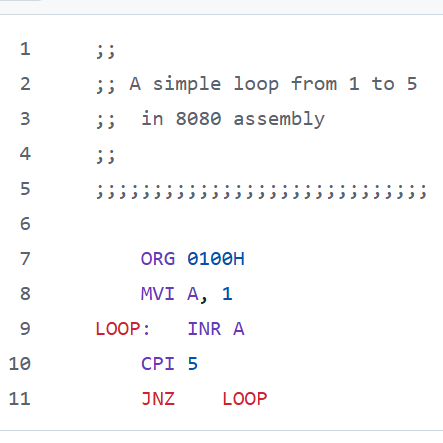
Assembly language (like the above) goes in, a binary comes out.

The script exists in part as a celebration of the power inherent in a standard Unix shell with quite ordinary POSIX-compliant command line tools like awk, sed, and printf. But [Chris] admits that mostly he found the whole project amusing.

It’s designed in a way that adding support for 6502 and 6809 machine code would be easy, assuming 8080 support isn’t already funny enough on its own.

It’s not particularly efficient and it’s got some quirks, most of which involve syntax handling (hexadecimal notation should stick to 0 or 0x prefixes instead of $ to avoid shell misinterpretations) but it works.

Want to give it a try? It’s a shell script, so pull a copy and and just make it executable. As long as the usual command-line tools exist (meaning your system is from sometime in the last thirty-odd years), it should run just fine as-is.

An ambitious bash script like this one recalls how our own Al Williams shared ways to make better bash scripts by treating it just a bit more like the full-blown programming language it qualifies as.