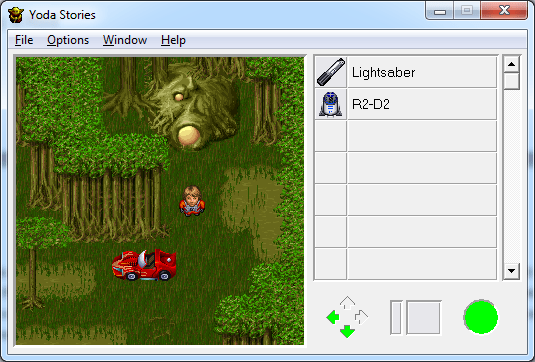
Star Wars: Yoda Stories was released by LucasArts in 1997 to minimal critical acclaim. As IGN said, “like Phantom Menace proved, just because it’s Star Wars doesn’t mean it’s good.” This didn’t stop [Zach] from playing it, and years later, taking an interest in reverse engineering the game.
[Zach]’s reverse engineering of Star Wars: Yoda Stories (google cache) takes a look at the game’s data file. This binary file is parsed by the game at run time to extract sound effects, sprites, and map tiles. Perhaps the best known game data file type was Doom’s WAD file, which had purpose built editing programs from third parties.
After a quick look at the data file in HxD, [Zach] began writing scripts in C# to extract different sections of the data file. Once the sections were found, more code was used to apply a color palette and generate bitmaps.
In the end, [Zach] managed to get a couple thousand tiles of the game’s data. He found some interesting ones, such as the sports car that he replaced the X-Wing with in his mod. The engine for an earlier Lucasarts game, Indiana Jones and His Desktop Adventures, should be very similar, and once we find the Mac install disk and a copy of ResEdit, we’ll post something on Hackaday.io.
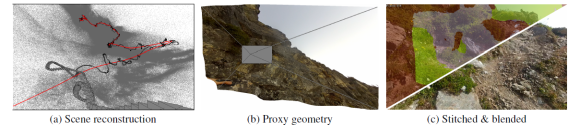 First person video – between Google Glass, GoPro, and other sports cameras, it seems like everyone has a camera on their head these days. If you’re a surfer or skydiver, that might make for some awesome footage. For the rest of us though, it means hours of boring video. The obvious way to fix this is time-lapse. Typically time-lapse throws frames away. Taking 1 of every 10 frames results in a 10x speed increase. Unfortunately, speeding up a head mounted camera often leads to a video so bouncy it can’t be watched without an air sickness bag handy. [Johannes Kopf], [Michael Cohen], and [Richard Szeliski] at Microsoft Research have come up with a novel solution to this problem with