Homebrew Radio Telescope Bags Pulsar

When one mulls the possibility of detecting pulsars, to the degree that one does, thoughts turn to large dish antennas and rack upon rack of sensitive receivers, filters, and digital signal processors. But there’s more than one way to catch the regular radio bursts from these celestial beacons, and if you know what you’re doing, a small satellite dish and an RTL-SDR dongle will suffice.

Granted, [Job Geheniau] has had a lot of experience exploring the radio universe. His website has a long list of observations and accomplishments achieved using his “JRT”, or “Job’s Radio Telescope.” The instrument looks like a homebrewer’s dream, with a 1.9-m satellite TV dish and precision azimuth-elevation rotator. Behind the feedhorn are a pair of low-noise amplifiers and bandpass filters to massage the 1,420 MHz signal that’s commonly used for radio astronomy, plus a Nooelec Smart SDR dongle and an Airspy Mini. Everything is run via remote control, as the interference is much lower with the antenna situated at his family’s farm, 50 km distant from his home in The Hague.

As for the pulsar, bloodlessly named PSR B0329+54, it’s a 5-million-year-old neutron star located in the constellation of Camelopardalis, about 3,500 light-years away. It’s a well-characterized pulsar and pulses at a regular 0.71452 seconds, but it’s generally observed with much, much larger antennas. [Job]’s write-up of the observation contains a lot of detail on the methods and software he used, and while the data is far from clear to the casual observer, it sure seems like he bagged it.

We’ve seen quite a few DIY radio astronomy projects before, both large and small, but this one really impresses with what it accomplished.

[via RTL-SDR.com]

Truly Giant Telescope Could Image Exoplanets

Have you ever wished we could peek at all these exoplanets that have been recently discovered? We aren’t likely to visit anytime soon, but it would be possible to build a truly giant telescope that could take a look at something like that. At least according to [SciShow Space] in a recent video you can see below.

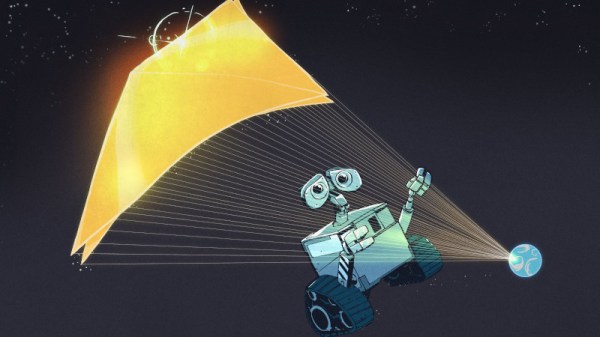
The idea put forth in a recent scientific paper is to deliberately create the conditions that naturally form gravitational lenses. If you recall, scientists have used these naturally-occurring lenses to image the oldest star ever observed. These natural super-telescopes have paid off many times, but you can’t pick what you want to look at. It is all a function of the distance to the star creating the lens and the direction a line between us points.

But what if you could create your own gravity lens? Granted, we probably aren’t going to do that in our garages. However, a recent paper talks about launching an optical detector that you could maneuver so that it was on a line that would pass through the object you want to see and our own sun. We clearly have the technology to do this. After all, we have several nice space telescopes, and several probes operating far away from the sun.

That is one of the biggest catches, though. This new telescope will need to be some 550 AU from the sun to get good results. For the record, the Earth is 1 AU (about 8 light minutes) out. Pluto — maybe not a planet anymore, but still a signpost on the way out of the solar system — is a scant 39 AU out. Voyager I, which has been racing away from the sun since 1977 is only about 156 AU out.

Because the craft would be so far out, it would be practically a one-shot mission. You also have to have something reliable enough to go the 17 years it would take with today’s technology to get in place. You also need a way to get the data back over that distance. All doable, but non-trivial.

The paper simulates what the Earth would look like using this technique from a nearby star. The images are shockingly good, especially after a bit of post-processing. Meanwhile, we may have to settle for more modest images. You might not see detail, but it is possible to find exoplanets with reasonably modest equipment.

Continue reading “Truly Giant Telescope Could Image Exoplanets”

Voyager 1 Talks Some Nonsense, But Is Still Working

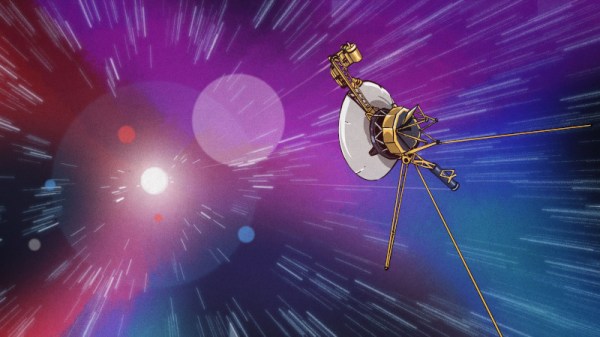
The Voyager 1 interplanetary probe was launched in 1977 and has now reached interstellar space where it is the furthest-traveled man-made object. It’s hugely exceeded its original mission and continues to return valuable scientific data, but there’s an apparent fault which is leaving its controllers perplexed. Onboard is an attitude control system which keeps the craft’s antennas pointing at Earth, and while it evidently still works (as we’re still in touch with the probe) and other systems are fine, it’s started returning incomprehensible data. Apparently it’s developed a habit of reporting random data, or states the antenna can’t possibly be in.

That a 45 year old computer is still working at all is testament to the skills of its designers, and at 14.5 billion miles away a repair is impossible however much we’d be fascinated to know about the failure modes of old electronics in space.  It’s postulated that they might simply live with the fault if the system is still working, issue a software fix, or find some way to use one of the craft’s redundant systems to avoid the problem. Meanwhile we can rest easily in our beds, because we’re still a couple of centuries away from its return as a giant alien sentient machine.

We’ve featured the Voyager program a few times before here at Hackaday, not least when we took a close look at one of its instruments.

Thanks [Jon Woodcock] for the tip.

Can You Hear Me Now? Lunar Edition

Despite what it looks like in the movies, it is hard to communicate with astronauts from Earth. There are delays, and space vehicles don’t usually have a lot of excess power. Plus everything is moving and Doppler shifting and Faraday rotating. Even today, it is tricky. But how did Apollo manage to send back TV, telemetry, and voice back in 1969? [Ken Shirriff] and friends tell us part of the story in a recent post where he looks at the Apollo premodulation processor.

Things like weight and volume are always at a premium in a spacecraft, as is power. When you look at pictures of this solid box that weighs over 14 pounds, you’ll be amazed at how much is crammed into a relatively tiny spot. Remember, if this box was flying in 1969 it had to be built much earlier so there’s no way to expect dense ICs and modern packaging. There’s not even a printed circuit board. The components are attached to metal pegs in a point-to-point fashion. The whole thing lived near the bottom of the Command Module’s lower equipment bay.

Continue reading “Can You Hear Me Now? Lunar Edition”

Can You Help NASA Build A Mars Sim In VR?

No matter your project or field of endeavor, simulation is a useful tool for finding out what you don’t know. In many cases, problems or issues aren’t obvious until you try and do something. Where doing that thing is expensive or difficult, a simulation can be a low-stakes way to find out some problems without huge costs or undue risks.

Going to Mars is about as difficult and expensive as it gets. Thus, it’s unsurprising that NASA relies on simulations in planning its missions to the Red Planet. Now, the space agency is working to create a Mars sim in VR for training and assessment purposes. The best part is that you can help!

Continue reading “Can You Help NASA Build A Mars Sim In VR?”

With Rocket Lab’s Daring Midair Catch, Reusable Rockets Go Mainstream

We’ve all marveled at the videos of SpaceX rockets returning to their point of origin and landing on their spindly deployable legs, looking for all the world like something pulled from a 1950s science fiction film.  On countless occasions founder Elon Musk and president Gwynne Shotwell have extolled the virtues of reusable rockets, such as lower operating cost and the higher reliability that comes with each booster having a flight heritage. At this point, even NASA feels confident enough to fly their missions and astronauts on reused SpaceX hardware.

Even so, SpaceX’s reusability program has remained an outlier, as all other launch providers have stayed the course and continue to offer only expendable booster rockets. Competitors such as United Launch Alliance and Blue Origin have teased varying degrees of reusability for their future vehicles, but to date have nothing to show for it beyond some flashy computer-generated imagery. All the while SpaceX continues to streamline their process, reducing turnaround time and refurbishment costs with each successful reuse of a Falcon 9 booster.

But that changed earlier this month, when a helicopter successfully caught one of Rocket Lab’s Electron boosters in midair as it fell back down to Earth under a parachute. While calling the two companies outright competitors might be a stretch given the relative sizes and capabilities of their boosters, SpaceX finally has a sparing partner when it comes to the science of reusability. The Falcon 9 has already smashed the Space Shuttle’s record turnaround time, but perhaps Rocket Lab will be the first to achieve Elon Musk’s stated goal of re-flying a rocket within 24 hours of its recovery.

Continue reading “With Rocket Lab’s Daring Midair Catch, Reusable Rockets Go Mainstream”

NASA’s Giant SLS Rocket Rolled Back For Repairs

There’s little debate that the most exciting move in a rocket’s repertoire is when it launches itself skywards on a column of flame. But failing that, it’s still pretty interesting to see how these massive vehicles get juggled around down here on terra firma before getting fired off into the black. Which is great for anyone interested in NASA’s towering Space Launch System (SLS), as it’s been doing an awful lot of milling about on the ground for a vehicle designed to return humanity to the Moon.

Most recently, the SLS completed a trek from the iconic Vehicle Assembly Building (VAB) to launch pad 39B and back again aboard the same “crawler” that moved the Space Shuttle and Saturn V before it. While the nearly 60-year-old tracked vehicle has received some updates to carry the 98 meter (322 ft) tall booster, clearly the space agency subscribes to the “if it ain’t broke, don’t fix it” school of thought.

The ICPS being loaded onto the SLS

The SLS itself however is definitely in need of some work. The rocket was brought out to the pad for the first time on March 18th, where it was to conduct what’s known as a “wet dress rehearsal” — a test of the pre-flight operations, propellant loading, and countdown that includes everything except engine ignition. Unfortunately, the test was plagued with technical issues, and after three attempts, it was decided to bring the rocket back into the VAB to make the necessary repairs to both it and the ground support equipment.

One issue involves a valve in the Interim Cryogenic Propulsion Stage (ICPS), a propulsion module that’s being used on the early SLS flights to provide the trans-lunar injection (TLI) burn that will send the Orion spacecraft on a course towards the Moon. As the name implies, the ICPS is destined to be replaced with the larger Exploration Upper Stage on later missions. There’s also a leak on the launch tower itself that will need to be addressed. After the identified problems are repaired and some adjustments are made, the SLS will once again be rolled out to the pad to reattempt the launch rehearsal.

Now in development for over a decade, the Space Launch System has been plagued with technical issues and delays. At the same time, commercial launch providers like SpaceX have moved the state of the art forward considerably, leading many to wonder if the mind-bogglingly expensive rocket will be able to compete with in-development vehicles such as Starship and New Glenn. The fact that missions which were previously assigned to the SLS have started to get shifted over to commercial rockets would seem to indicate that even NASA is losing confidence in their flagship program.