StarPointer Keeps Scope On Target With Stellarium

On astronomical telescopes of even middling power, a small “finderscope” is often mounted in parallel to the main optics to assist in getting the larger instrument on target. The low magnification of the finderscope offers a far wider field of view than the primary telescope, which makes it much easier to find small objects in the sky. Even if your target is too small or faint to see in the finderscope, just being able to get your primary telescope pointed at the right celestial neighborhood is a huge help.

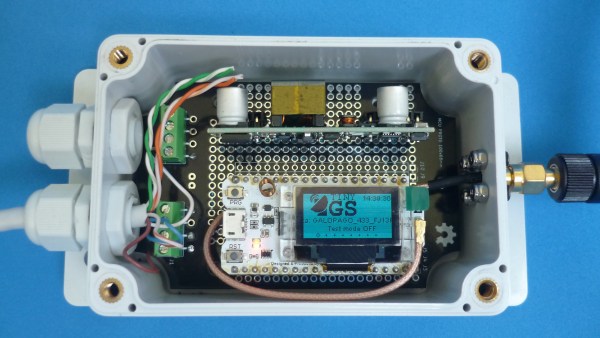
But [Dilshan Jayakody] still thought he could improve on things a bit. Instead of a small optical scope, his StarPointer is an electronic device that can determine the orientation of the telescope it’s mounted to. As the ADXL345 accelerometer and HMC5883L magnetometer inside the STM32F103C8 powered gadget detect motion, the angle data is sent to Stellarium — an open source planetarium program. Combined with a known latitude and longitude, this allows the software to show where the telescope is currently pointed in the night sky.

As demonstrated in the video after the break, this provides real-time feedback which is easy to understand even for the absolute beginner: all you need to do is slew the scope around until the object you want to look at it under the crosshairs. While we wouldn’t recommend looking at a bright computer screen right before trying to pick out dim objects in your telescope’s eyepiece, we can certainly see the appeal of this “virtual” finderscope.

Then again…who said this technique had to be limited to optical observations? As the StarPointer is an open hardware project, you could always integrate the tech into that DIY radio telescope you’ve always dreamed of building in the backyard.

Continue reading “StarPointer Keeps Scope On Target With Stellarium

South Korea’s KSLV-2 Rocket Delivers Payloads To Orbit

South Korea’s domestically developed KSLV-2 “Nuri” rocket successfully placed six payloads into low Earth orbit Tuesday, after lifting off from from Naro Space Center at 4 PM KST. This follows an earlier attempt in October which failed to reach orbit after the booster’s third stage engine shutdown prematurely. The flight followed an initial trajectory over the East China Sea, after which the upper stage steered out towards the Philippine Sea, finally placing the payload in the desired orbital inclination of 98 degrees. This less-than-ideal path wasted energy, but ensured that the first and second stages fell into the ocean and not onto people. Success was confirmed shortly after launch as the vehicle passed over South Korea’s King Sejong Station in Antarctica.

The payload on this test flight was primarily a mass simulator of 1.3 metric tons, but a small Performance Verification Satellite (PVSAT) was included, for a grand total of 1.5 metric tons. The PVSAT itself monitors vehicle performance, but also serves as a carrier for four CubeSats. These were developed by engineering teams at various local universities and will be deployed in the coming days.

If you’re inclined to track these, the launch has been given COSPAR ID 2022-065 and the first three objects (third stage, dummy mass, and PVSAT) have been assigned the NORAD catalog numbers 52894, 52895, and 52896. It’s too early to tell which is which at this point, but as more data about their respective orbits are collected, it should be possible to tell them apart. The next four catalog numbers, 52897 – 52900, have been reserved for the CubeSats once they are released.

With this launch, South Korea has become the 10th nation to put a payload into space using its own domestic technology, and the 7th to loft a payload of more than one ton to orbit — joining the ranks of the United States, Russia, Japan, China, France, and India.

Continue reading “South Korea’s KSLV-2 Rocket Delivers Payloads To Orbit”

NASA Mission Off To Rough Start After Astra Failure

When Astra’s diminutive Rocket 3.3 lifted off from its pad at the Cape Canaveral Space Force Station on June 12th, everything seemed to be going well. In fact, the mission was progressing exactly to plan right up until the end — the booster’s second stage Aether engine appeared to be operating normally until it abruptly shut down roughly a minute ahead of schedule. Unfortunately, orbital mechanics are nothing if not exacting, and an engine burn that ends a minute early might as well never have happened at all.

According to the telemetry values shown on-screen during the live coverage of the launch, the booster’s upper stage topped out at a velocity of 6.573 kilometers per second, well short of the 7.8 km/s required to attain a stable low Earth orbit. While the video feed was cut as soon as it was clear something had gone wrong, the rigid physics of spaceflight means there’s little question about the sequence of events that followed. Without the necessary energy to stay in orbit, the upper stage of the rocket would have been left in a sub-orbital trajectory, eventually reentering the atmosphere and burning up a few thousand kilometers downrange from where it started.

An unusual white plume is seen from the engine as it shuts down abruptly.

Of course, it’s no secret that spaceflight is difficult. Doubly so for startup that only has a few successful flights under their belt. There’s no doubt that Astra will determine why their engine shutdown early and make whatever changes are necessary to ensure it doesn’t happen again, and if their history is any indication, they’re likely to be flying again in short order. Designed for a Defense Advanced Research Projects Agency (DARPA) competition that sought to spur the development of cheap and small rockets capable of launching payloads on short notice, Astra’s family of rockets have already demonstrated unusually high operational agility.

Astra, and the Rocket 3.3 design, will live to fly again. But what of the payload the booster was due to put into orbit? That’s a bit more complicated. This was the first of three flights that were planned to assemble a constellation of small CubeSats as part of NASA’s TROPICS mission. The space agency has already released a statement saying the mission can still achieve its scientific goals, albeit with reduced coverage, assuming the remaining satellites safely reach orbit. But should one of the next launches fail, both of which are currently scheduled to fly on Astra’s rockets, it seems unlikely the TROPICS program will be able to achieve its primary goal.

So what exactly is TROPICS, and why has NASA pinned its success on the ability for a small and relatively immature launch vehicle to make multiple flights with their hardware onboard? Let’s take a look.

Continue reading “NASA Mission Off To Rough Start After Astra Failure”

How Is Voyager Still Talking After All These Years?

The tech news channels were recently abuzz with stories about strange signals coming back from Voyager 1. While the usual suspects jumped to the usual conclusions — aliens!! — in the absence of a firm explanation for the anomaly, some of us looked at this event as an opportunity to marvel at the fact that the two Voyager spacecraft, now in excess of 40 years old, are still in constant contact with those of us back on Earth, and this despite having covered around 20 billion kilometers in one of the most hostile environments imaginable.

Like many NASA programs, Voyager has far exceeded its original design goals, and is still reporting back useful science data to this day. But how is that even possible? What 1970s-era radio technology made it onto the twin space probes that allowed it to not only fulfill their primary mission of exploring the outer planets, but also let them go into an extended mission to interstellar space, and still remain in two-way contact? As it turns out, there’s nothing magical about Voyager’s radio — just solid engineering seasoned with a healthy dash of redundancy, and a fair bit of good luck over the years.

Continue reading “How Is Voyager Still Talking After All These Years?”

Laser Propulsion Could Satisfy Our Spacecraft’s Need For Speed

There are many wonderful places we’d like to visit in the universe, and probably untold numbers more that we haven’t even seen or heard of yet. Unfortunately…they’re all so darn far away. A best-case-scenario trip to Mars takes around six months with present technology, meanwhile, if you want to visit Alpha Centauri it’s a whole four lightyears away!

When it comes to crossing these great distances, conventional chemical rocket technology simply doesn’t cut the mustard. As it turns out though, lasers could hold the key to cutting down travel times in space!

Continue reading “Laser Propulsion Could Satisfy Our Spacecraft’s Need For Speed”

That’s No Asteroid…Oh, Actually It Is

How important is it to identify killer asteroids before they strike your planet? Ask any dinosaurs. Oh, wait… Granted you also need a way to redirect them, but interest in finding them has picked up lately including a new privately funded program called the Asteroid Institute.

Using an open-source cloud platform known as ADAM — Asteroid  Discovery Analysis and Mapping — the program,  affiliated with B612 program along with others including the University of Washington, has already discovered 104 new asteroids and plotted their orbits.

What’s interesting is that the Institute doesn’t acquire any images itself. Instead, it uses new techniques to search through existing optical records to identify previously unnoticed asteroids and compute their trajectories.

You have to wonder how many other data sets are floating around that hold unknown discoveries waiting for the right algorithm and computing power. Of course, once you find the next extinction asteroid, you have to decide what to do about it. Laser? Bomb? A gentle push at a distance? Or hope for an alien obelisk to produce a deflector ray? How would you do it?

NASA is experimenting with moving asteroids. If you want to find some on your own, you might want to check out the atlas of existing ones.

Continue reading “That’s No Asteroid…Oh, Actually It Is”

NASA Turns To Commercial Partners For Spacesuits

When NASA astronauts aboard the International Space Station have to clamber around on the outside of the orbiting facility for maintenance or repairs, they don a spacesuit known as the Extravehicular Mobility Unit (EMU). Essentially a small self-contained spacecraft in its own right, the bulky garment was introduced in 1981 to allow Space Shuttle crews to exit the Orbiter and work in the craft’s cavernous cargo bay. While the suits did get a minor upgrade in the late 90s, they remain largely the product of 1970s technology.

Not only are the existing EMUs outdated, but they were only designed to be use in space — not on the surface. With NASA’s eyes on the Moon, and eventually Mars, it was no secret that the agency would need to outfit their astronauts with upgraded and modernized suits before moving beyond the ISS. As such, development of what would eventually be the Exploration Extravehicular Mobility Unit (xEMU) dates back to at least 2005 when it was part of the ultimately canceled Constellation program.

NASA’s own xEMU suit won’t be ready by 2025.

Unfortunately, after more than a decade of development and reportedly $420 million in development costs, the xEMU still isn’t ready. With a crewed landing on the Moon still tentatively scheduled for 2025, NASA has decided to let their commercial partners take a swing at the problem, and has recently awarded contracts to two companies for a spacesuit that can both work on the Moon and replace the aging EMU for orbital use on the ISS.

As part of the Exploration Extravehicular Activity Services (xEVAS) contract, both companies will be given the data collected during the development of the xEMU, though they are expected to create new designs rather than a copy of what NASA’s already been working on. Inspired by the success of the Commercial Crew program that gave birth to SpaceX’s Crew Dragon, the contract also stipulates that the companies will retain complete ownership and control over the spacesuits developed during the program. In fact, NASA is even encouraging the companies to seek out additional commercial customers for the finished suits in hopes a competitive market will help drive down costs.

There’s no denying that NASA’s partnerships with commercial providers has paid off for cargo and crew, so it stands to reason that they’d go back to the well for their next-generation spacesuit needs. There’s also plenty of incentive for the companies to deliver a viable product, as the contact has a potential maximum value of $3.5 billion. But with 2025 quickly approaching, and the contact requiring a orbital shakedown test before the suits are sent to the Moon, the big question is whether or not there’s still enough time for either company to make it across the finish line.

Continue reading “NASA Turns To Commercial Partners For Spacesuits”