For decades, astronauts have been forced to endure space-friendly MREs and dehydrated foodstuffs, though we understand both the quality and the options have increased with time. But if we’re serious about long-term space travel, colonizing Mars, or actually having a restaurant at the end of the universe, the ability to bake and cook from raw ingredients will become necessary. This zero-gravity culinary adventure might as well start with a delicious experiment, and what better than chocolate chip cookies for the maiden voyage?
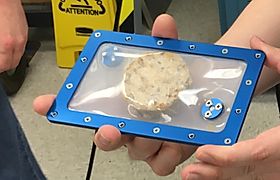
That little filtered vent lets steam out and keeps crumbs in. Image via Zero-G Kitchen
The vessel in question is the Zero-G Oven, built in a collaboration between Zero-G Kitchen and Nanoracks, a Texas-based company that provides commercial access to space. In November 2019, Nanoracks sent the Zero-G oven aloft, where it waited a few weeks for the bake-off to kick off. Five pre-formed cookie dough patties had arrived a few weeks earlier, each one sealed inside its own silicone baking pouch.
The Zero-G Oven is essentially a rack-mounted cylindrical toaster oven. It maxes out at 325 °F (163 °C), which is enough heat for Earth cookies if you can wait fifteen minutes or so. But due to factors we haven’t figured out yet, the ISS cookies took far longer to bake.
The Apollo missions still inspire people today, decades after they took place. A fortunate side effect of the global public relations campaign is that a lot of information is publicly available for us to review and process. We’re right around the 49th anniversary of Apollo 14 mission, so it was a good time for [Frank O’Brien] to take readers through Apollo Guidance Computer and the hack that saved Apollo 14 (while it was in lunar orbit).
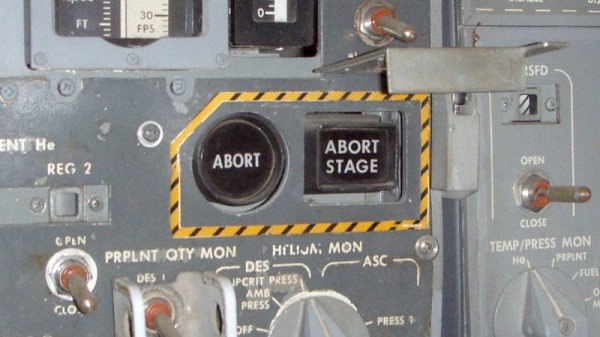
Space fans would already know many parts of this piece, but [Frank] weaves it together into a single narrative around a problematic “Abort” button that was found to be making intermittent contact as the crew were preparing to land on the moon. An inconvenient timing would have unnecessarily aborted the mission, which was obviously Not Good. [Frank] brings us up to speed on AGC fundamentals, just enough to understand the technical constraints for the hack, devised within the time constraints they faced.
For those that prefer a short video summary [Scott Manley] covered this same hack on YouTube. And for another perspective on the scope of this task, remember this was years before we had vi or emacs. When they were contemplating flipping status bits as programs were running, it’s not trivial to do a global search for code that might examine those bits. Look at the tome of source code AGC programmer [Don Eyles] worked with. Space fans who want to learn more can check out [Don]’s book.
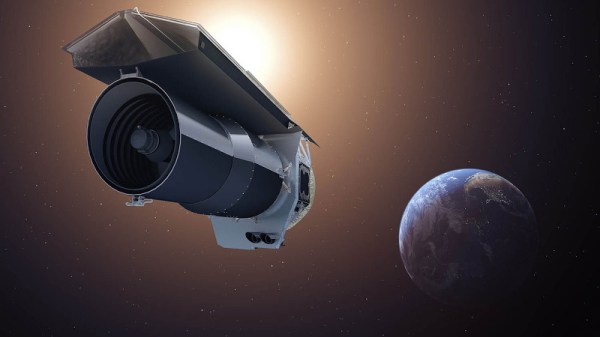
Today, after 16 years of exemplary service, NASA will officially deactivate the Spitzer Space Telescope. Operating for over a decade beyond its designed service lifetime, the infrared observatory worked in tandem with the Hubble Space Telescope to reveal previously hidden details of known cosmic objects and helped expand our understanding of the universe. In later years, despite never being designed for the task, it became an invaluable tool in the study of planets outside our own solar system.
While there’s been no cataclysmic failure aboard the spacecraft, currently more than 260 million kilometers away from Earth, the years have certainly taken their toll on Spitzer. The craft’s various technical issues, combined with its ever-increasing distance, has made its continued operation cumbersome. Rather than running it to the point of outright failure, ground controllers have decided to quit while they still have the option to command the vehicle to go into hibernation mode. At its distance from the Earth there’s no danger of it becoming “space junk” in the traditional sense, but a rogue spacecraft transmitting randomly in deep space could become a nuisance for future observations.
From mapping weather patterns on a planet 190 light-years away in the constellation Ursa Major to providing the first images of Saturn’s largest ring, it’s difficult to overstate the breadth of Spitzer’s discoveries. But these accomplishments are all the more impressive when you consider the mission’s storied history, from its tumultuous conception to the unique technical challenges of long-duration spaceflight.
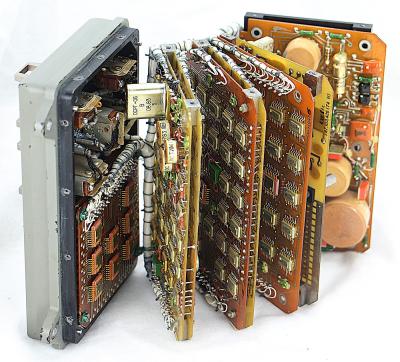
The Soyuz series of spacecraft made their maiden voyage in 1966, and are still flying today. The clock in question comes from somewhere in the middle, around 1996. On the outside, it seems like any spaceship gizmo, and the digital clock keeps local time along with a stopwatch and an alarm function. The guts are much more interesting with no less than 10 PCBs sandwiched inside the small enclosure.
The system consists of dual layer-boards with a mix of SMD and through-hole components that are interconnected by a series of wires that are bunched and packed to create a wiring harness. The pictures show a very clever way of setting up the stack and the system is serviceable by design as the bunch opens up like a book. This gives access to the unique looking components that include 14-pin flat pack chips, large ceramic multicoil inductors, green colored resistors, and orange rectangular diodes.
There are isolated PSU boards, control boards, clock circuitry, some glue logic to put things together, and LED displays with driver circuits. [Ken Shirriff] dives into the clocking circuit and the various parts involved along with a comparison with US technology. There is a lot of interesting detail in these boards, and it may be a source of inspiration for some.
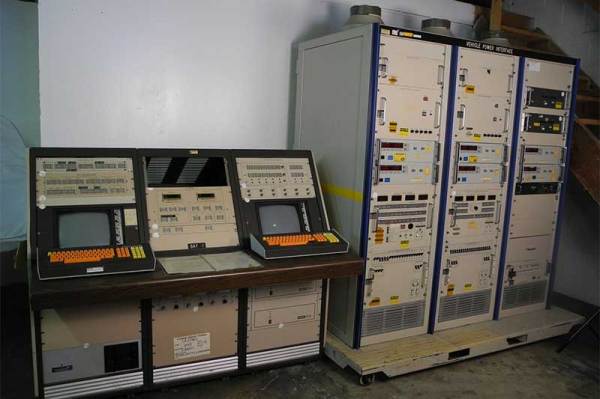
Got $75K spare? Then this is the eBay deal for you! [jvanorsdal] pointed us to this eBay bargain: the VPI Vehicle Power Interface Rack & Console Hubble Space Telescope. This was the actual system used to test the power systems of the Hubble Space Telescope before it was launched, so it’s a genuine piece of space history.
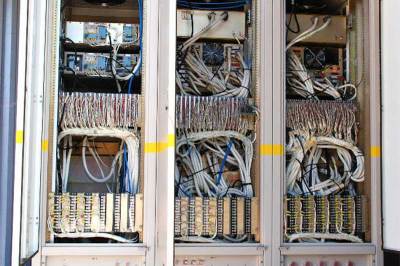
For the price you get two, yes two CRT displays, six HP power supplies and a huge amount of hand-wired history. Even if you aren’t going to bid, it is worth taking a look at the insides of this thing, as it is all hand-soldered and the cable routing is a thing of beauty. I have absolutely no use for this, but I totally want it for my living room.
There are a few gotchas, though. Because it is NASA space hardware, you can’t export it to places like Iran, and the shipping cost for the US is a cool $1.5K. Considering the size of the thing, that is not so bad, perhaps: it is built into a three rack metal cabinet with built-in wheels that measures over 7 feet long and weighs over 800 lbs.
Interested? It is on sale for $75k, and there is a handy buy it now button on the site.
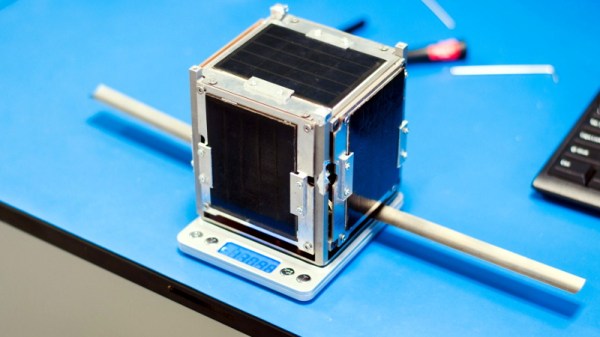
On the 3rd of June 2019, a 1U CubeSat developed by students of the AGH University of Science and Technology in Kraków was released from the International Space Station. Within a few hours it was clear something was wrong, and by July 30th, the satellite was barely functional. A number of problems contributed to the gradual degradation of the KRAKsat spacecraft, which the team has thoroughly documented in a recently released paper.
We all know, at least in a general sense, that building and operating a spacecraft is an exceptionally difficult task on a technical level. But reading through the 20-pages of “KRAKsat Lessons Learned” gives you practical examples of just how many things can go wrong.
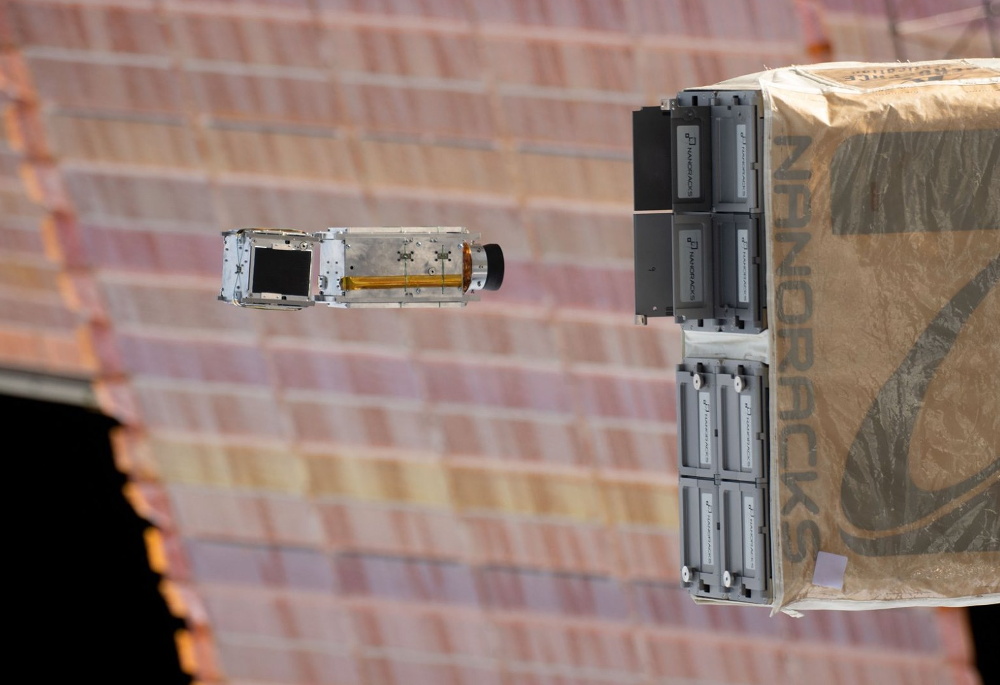
KRAKsat being released from the ISS
It all started with a steadily decreasing battery voltage. The voltage was dropping slowly enough that the team knew the solar panels were doing something, but unfortunately the KRAKsat didn’t have a way of reporting their output. This made it difficult to diagnose the energy deficit, but the team believes the issue may have been that the tumbling of the spacecraft meant the panels weren’t exposed to the amount of direct sunlight they had anticipated.
This slow energy drain continued until the voltage dropped to the point that the power supply shut down, and that’s were things really started going south. Once the satellite shut down the batteries were able to start charging back up, which normally would have been a good thing. But unfortunately the KRAKsat had no mechanism to remain powered down once the voltage climbed back above the shutoff threshold. This caused the satellite to enter into and loop where it would reboot itself as many as 150 times per orbit (approximately 90 minutes).
The paper then goes into a laundry list of other problems that contributed to KRAKsat’s failure. For example, the satellite had redundant radios onboard, but the software on them wasn’t identical. When they needed to switch over to the secondary radio, they found that a glitch in its software meant it was unable to access some portions of the onboard flash storage. The team also identified the lack of a filesystem on the flash storage as another stumbling block; having to pull things out using a pointer and the specific memory address was a cumbersome and time consuming task made all the more difficult by the spacecraft’s deteriorating condition.
Of course, building a satellite that was able to operate for a couple weeks is still an impressive achievement for a student team. As we’ve seen recently, even the pros can run into some serious technical issues once the spacecraft leaves the lab and is operating on its own.
They say you can’t make an omelette without breaking a few eggs, and there are few fields where this idiom is better exemplified than rocketry. It’s a forgone conclusion that when you develop a new booster, at least a few test articles are going to be destroyed in the process. In fact, some argue that a program that doesn’t push the hardware to the breaking point is a program that’s not testing aggressively enough.
This might seem like an odd way to spend $62 million, but for SpaceX, it’s worth it to know that the Crew Dragon Launch Abort System (LES) will work under actual flight conditions. The LES has already been successfully tested once, but that was on the ground and from a standstill. It allowed engineers to see how the system would behave should an abort occur while the rocket was still on the pad, but as the loss of the Soyuz MS-10 dramatically demonstrated, astronauts may need to make a timely exit from a rocket that’s already well on the way to space.
In an actual emergency, the crewed spacecraft will very likely be speeding away from a violent explosion and rapidly expanding cloud of shrapnel. The complete destruction of the Falcon 9 that will be carrying the Crew Dragon during Saturday’s test will serve to create the same sort of conditions the spacecraft will need to survive if the LES has any hope of bringing the crew home safely. So even if there was some way to prevent the booster from breaking up during the test, it’s more useful from an engineering standpoint to destroy it.
Of course, that only explains why the Falcon 9 will be destroyed during this test. But exactly how this properly functioning booster will find itself being ripped to pieces high over the Atlantic Ocean in a matter of seconds is an equally interesting question.




 This might seem like an odd way to spend $62 million, but for SpaceX, it’s worth it to know that the Crew Dragon Launch Abort System (LES) will work under actual flight conditions. The LES has already been successfully tested once, but that was on the ground and from a standstill. It allowed engineers to see how the system would behave should an abort occur while the rocket was still on the pad,








