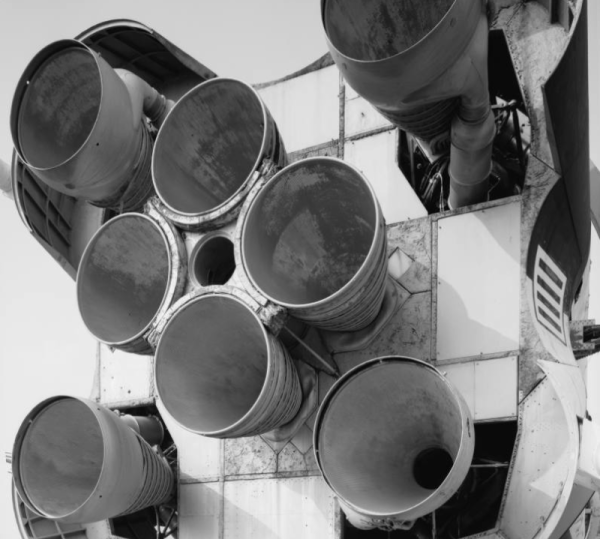
According to recent news reports, NASA’s Marshall Space Flight Center in Huntsville Alabama wants to give away a piece of history — an engineering test article of a Saturn I Block I booster. The catch? You’ll need to pay to haul it off, which will cost about $250,000. According to C|Net, the offer appears to be for museums and schools, but it’s likely that price tag would probably scare most private buyers off anyway.
On the other hand, if you are a museum, library, school, or university, you can score cheap or free NASA stuff using their GSAXcess portal. In general, you do have to pay shipping. For example, a flexible thermal blanket from the shuttle costs $37.28. A heat tile runs about $25.
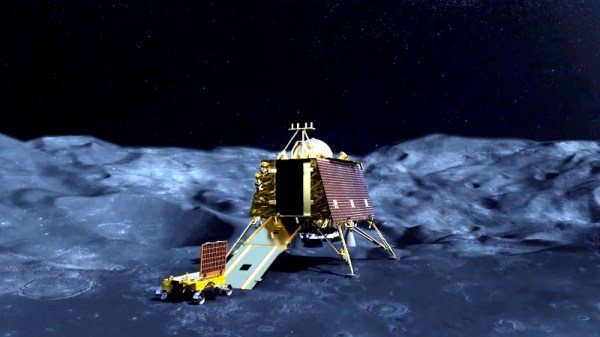
On July 22nd, India launched an ambitious mission to simultaneously deliver an orbiter, lander, and rover to the Moon. Launched from the Satish Dhawan Space Centre on a domestically-built GSLV Mk III rocket, Chandrayaan-2 is expected to enter lunar orbit on August 20th. If everything goes well, the mission’s lander module will touch down on September 7th.
Attempting a multifaceted mission of this nature is a bold move, but the Indian Space Research Organisation (ISRO) does have the benefit of experience. The Chandrayaan-1 mission, launched in 2008, spent nearly a year operating in lunar orbit. That mission also included the so-called Moon Impact Probe (MIP), which deliberately crashed into the surface near the Shackleton crater. The MIP wasn’t designed to survive the impact, but it still secured India a position on the short list of countries that have placed an object on the lunar surface.
If the lander component of Chandrayaan-2, named Vikram after Indian space pioneer Vikram Sarabhai, can safely touch down on the lunar surface it will be a historic accomplishment for the ISRO. To date, the only countries to perform a controlled landing on the Moon are the Soviet Union, the United States, and China. Earlier in the year, it seemed Israel would secure its position as the fourth country to perform the feat with their Beresheet spacecraft, but a last second fault caused the craft to crash into the surface. The loss of Beresheet, while unfortunate, has given India an unexpected chance to take the coveted fourth position despite Israel’s head start.
We have a few months before the big event, but so far, everything has gone according to plan for Chandrayaan-2. As we await word that the spacecraft has successfully entered orbit around the Moon, let’s take a closer look at how this ambitious mission is supposed to work.
What is this world coming to when a weather satellite that was designed for a two-year mission starts to fail 21 years after launch? I mean, really — where’s the pride these days?
All kidding aside, it seems like NOAA-15, a satellite launched in 1998 to monitor surface temperatures and other meteorologic and climatologic parameters, has recently started showing its age. This is the way of things, and generally the decommissioning of a satellite is of little note to the general public, except possibly when it deorbits in a spectacular but brief display across the sky.
But NOAA-15 and her sister satellites have a keen following among a community of enthusiasts who spend their time teasing signals from them as they whiz overhead, using homemade antennas and cheap SDR receivers. It was these hobbyists who were among the first to notice NOAA-15’s woes, and over the past weeks they’ve been busy alternately lamenting and celebrating as the satellite’s signals come and go. Their on-again, off-again romance with the satellite is worth a look, as is the what exactly is going wrong with this bird in the first place.
In the early 1990s, NASA experienced a sea change in the way it approached space exploration. Gone were the days when all their programs would be massive projects with audacious goals. The bulk of NASA’s projects would fall under the Discovery Project and hew to the mantra “faster, better, cheaper,” with narrowly focused goals and smaller budgets, with as much reuse of equipment as possible.
The idea for what would become the Mars InSight mission first appeared in 2010 and was designed to explore Mars in ways no prior mission had. Where Viking had scratched the surface in the 1970s looking for chemical signs of life and the rovers of the Explorer program had wandered about exploring surface geology, InSight was tasked with looking much, much deeper into the Red Planet.
Sadly, InSight’s primary means of looking at what lies beneath the regolith of Mars is currently stuck a few centimeters below the surface. NASA and JPL engineers are working on a fix, and while it’s far from certain that that they’ll succeed, things have started to look up for InSight lately. Here’s a quick look at what the problem is, and a potential solution that might get the mission back on track.
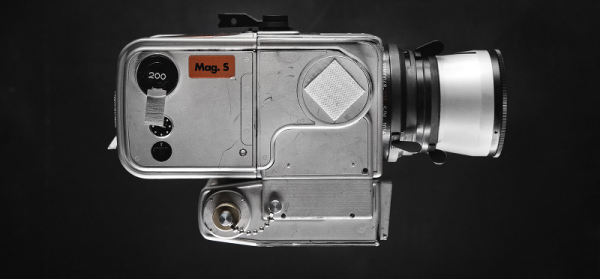
[Cole Price] describes himself as a photographer and a space nerd. We’ll give that to him since his web site clearly shows a love of cameras and a love of the NASA programs from the 1960s. [Cole] has painstakingly made replicas of cameras used in the space program including a Hasselblad 500C used on a Mercury flight and another Hasselblad used during Apollo 11. His work is on display in several venues — for example, the 500C is in the Carl Zeiss headquarters building.
[Cole’s] only made a detailed post about 500C and a teaser about the Apollo 11 camera. However, there’s a lot of detail about what NASA — and an RCA technician named [Red Williams] — did to get the camera space-ready.
It’s been fifty years since man first landed on the Moon, but despite all the incredible advancements in technology since Armstrong made that iconic first small step, we’ve yet to reach any farther into deep space than we did during the Apollo program. The giant leap that many assumed would naturally follow the Moon landing, such as a manned flyby of Venus, never came. We’ve been stuck in low Earth orbit (LEO) ever since, with a return to deep space perpetually promised to be just a few years away.
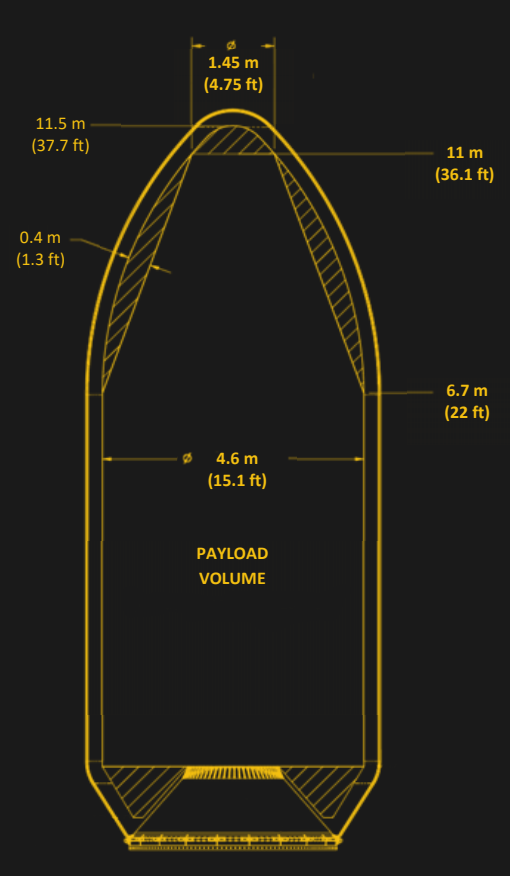
Falcon Heavy Payload Fairing
But why? The short answer is, of course, that space travel is monstrously expensive. It’s also dangerous and complex, but those issues pale in comparison to the mind-boggling bill that would be incurred by any nation that dares to send humans more than a few hundred kilometers above the surface of the Earth. If we’re going to have any chance of getting off this rock, the cost of putting a kilogram into orbit needs to get dramatically cheaper.
Luckily, we’re finally starting to see some positive development on that front. Commercial launch providers are currently slashing the cost of putting a payload into space. In its heyday, the Space Shuttle could carry 27,500 kg (60,600 lb) to LEO, at a cost of approximately $500 million per launch. Today, SpaceX’s Falcon Heavy can put 63,800 kg (140,700 lb) into the same orbit for less than $100 million. It’s still not pocket change, but you wouldn’t be completely out of line to call it revolutionary, either.
Unfortunately there’s a catch. The rockets being produced by SpaceX and other commercial companies are relatively small. The Falcon Heavy might be able to lift more than twice the mass as the Space Shuttle, but it has considerably less internal volume. That wouldn’t be a problem if we were trying to hurl lead blocks into space, but any spacecraft designed for human occupants will by necessity be fairly large and contain a considerable amount of empty space. As an example, the largest module of the International Space Station would be too long to physically fit inside the Falcon Heavy fairing, and yet it had a mass of only 15,900 kg (35,100 lb) at liftoff.
To maximize the capabilities of volume constrained boosters, there needs to be a paradigm shift in how we approach the design and construction of crewed spacecraft. Especially ones intended for long-duration missions. As it so happens, exciting research is being conducted to do exactly that. Rather than sending an assembled spacecraft into orbit, the hope is that we can eventually just send the raw materials and print it in space.
When the SpaceX Dragon spacecraft reached orbit for the first time in 2010, it was a historic achievement. But to qualify for NASA’s Commercial Orbital Transportation Services (COTS) program, the capsule also needed to demonstrate that it could return safely to Earth. Its predecessor, the Space Shuttle, had wings that let it glide home and land like a plane. But in returning to the classic capsule design of earlier spacecraft, SpaceX was forced to rely on a technique not used by American spacecraft since the 1970s: parachutes and an ocean splashdown.
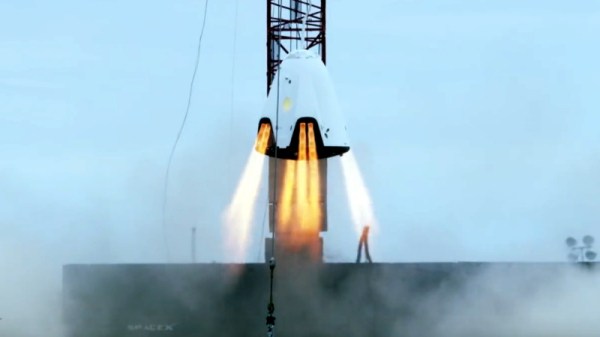
The Dragon’s descent under parachute, splashdown, and subsequent successful recovery paved the way for SpaceX to begin a series of resupply missions to the International Space Station that continue to this day. But not everyone at SpaceX was satisfied with their 21st century spacecraft having to perform such an anachronistic landing. At a post-mission press conference, CEO Elon Musk told those in attendance that eventually the Dragon would be able to make a pinpoint touchdown using thrusters and deployable landing gear:
The architecture that you observed today is obviously similar to what was employed in the Apollo era, but the next generation Dragon, the Crew Dragon, we’re actually going to be aiming for a propulsive landing with gear. We’ll still have the parachutes as a backup, but it’s going to be a precision landing, you could literally land on something the size of a helipad propulsively with gear, refuel, and take off again.
But just shy of a decade later, the violent explosion of the first space worthy Crew Dragon has become the final nail in the coffin for Elon’s dream of manned space capsules landing like helicopters. In truth, the future of this particular capability was already looking quite dim given NASA’s preference for a more pragmatic approach to returning their astronauts from space. But Crew Dragon design changes slated to be implemented in light of findings made during the accident report will all but completely remove the possibility of Dragon ever performing a propulsive landing.