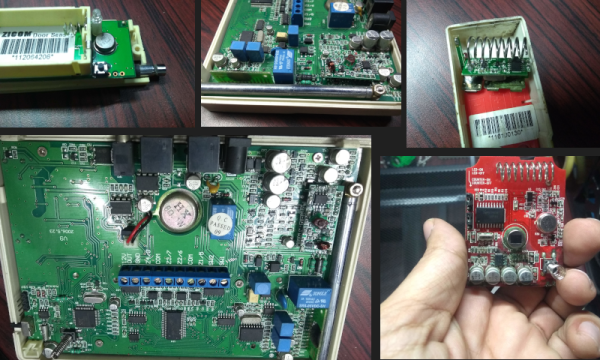
I have a home alarm system that has me wondering if I can make it better with my maker Kung-fu. Recently we had to replace our system, so I took the time to dissect the main controller, the remote sensors, and all the bits that make a home security system work.
To be precise, the subject of today’s interrogation is a Zicom brand Home Alarm that was quite famous a decade ago. It connects to a wired telephone line, takes inputs from motion, door, and gas sensors, and will make quite a racket if the system is tripped (which sometimes happened accidentally). Even though no circuits were harmed in the making of this post, I assure you that there are some interesting things that will raise an eyebrow or two. Lets take a look.
You never know what kind of wonders you’ll find on eBay, especially when you have a bunch of alerts configured to go off when weird electronic devices pop up. You may even find yourself bidding on something despite not being entirely sure what it is. Perhaps you’re a collector of unusual gadgets, or maybe it’s because you’ve committed to doing monthly teardowns for the hacker blog you work for. In any event, you sometimes find yourself in possession of an oddball device that requires closer inspection.
Case in point, this “Magnetic Wave Tester” from everyone’s favorite purveyor of high-end electronics, Nihon Kenko Zoushin Kenkyukai Corporation. The eBay listing said the device came from an estate sale and the seller didn’t know much about it, but with just a visual inspection we can make some educated guesses. When a strong enough magnetic field is present, the top section on the device will presumably blink or light up. As it has no obvious method of sensitivity adjustment or even a display to show specific values, it appears the unit must operate like an electromagnetic canary in a coal mine: if it goes off, assume the worst.
If you’re wondering what the possible use for such a gadget is, you’re not the only one. I wasn’t able to find much information about this device online, but the few mentions I found didn’t exactly fill me with confidence. It seems two groups of people are interested in this type of “Magnetic Wave Tester”: people who believe strong magnetic fields have some homeopathic properties, or those who think it will allow them to converse with ghosts. In both cases, these aren’t the kind of users who want to see a microtesla readout; they want a bright blinking light to show their friends.
So without further ado, let’s align our chakras, consult with the spirits, and see what your money gets you when you purchase a pocket-sized hokum detector.
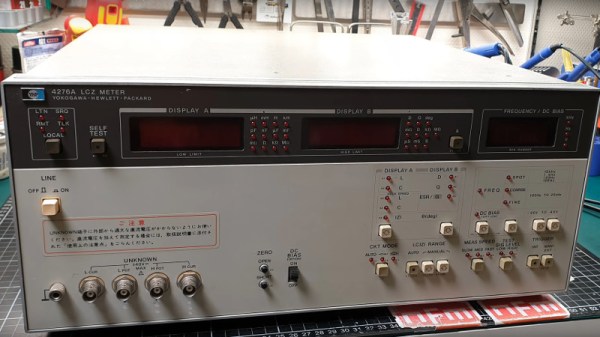
We are fantastically lucky not only in the parts that are easily available to us at reasonable cost, but also for the affordable test equipment that we can have on our benches. It was not always this way though, and [NFM] treats us to an extensive teardown and upgrade of a piece of test equipment from the days when a hacker’s bench would have been well-appointed with just a multimeter and a 10MHz ‘scope.
The Hewlett Packard 4276A LCZ meter is, or perhaps was, the king of component testers. A 19″ rack unit that would comfortably fill a shelf, it has a host of functions and a brace of red LED displays. This particular meter had clearly seen better days, and required a look inside just to clean up connectors and replace aged batteries.
In the case is a backplane board with a series of edge connectors for a PSU, CPU, and analogue boards. Aged capacitors and those batteries were replaced, and those edge connectors cleaned up again. The CPU board appears to have a Z80 at its heart, and we’re sure we spotted a 1987 date code. There are plenty of nice high-quality touches, such as the individual 7-segment digits being socketed.
An after-market option for this equipment included a DC offset board, and incredibly HP publish its full schematic and a picture of its PCB in their manual. It was thus a simple process and quick PCB ordering to knock up a modern replica, with just a few component substitutions and single resistors replacing an HP specific encapsulated resistor pack.
As a treat we get a ringside seat for the set-up and alignment of the machine. The DC offset board gives the wrong voltage, which he traces to a voltage reference with a different tolerance to the original HP part. [NFM] makes some adjustments to resistor values, and is able to pull the voltage to the correct value. Finally we see the instrument put through its paces, and along the way have a demonstration of how capacitance of a ceramic capacitor can vary with voltage close to its working voltage. Even if you never have the need for an LCZ meter or never see an HP 4276A, this should be worth a watch. And if you now have an urge to find a bench full of similar treasures, take a look at our guide to old test equipment.
We rarely take a moment to consider the beauty of the components we use in electronic designs. Too often they are simply commodities, bought in bulk on reels or in bags, stashed in a drawer until they’re needed, and then unceremoniously soldered to a board. Granted, little scraps of black plastic with silver leads don’t exactly deserve paeans sung to their great beauty – at least not until you cut them in half to reveal the beauty within.
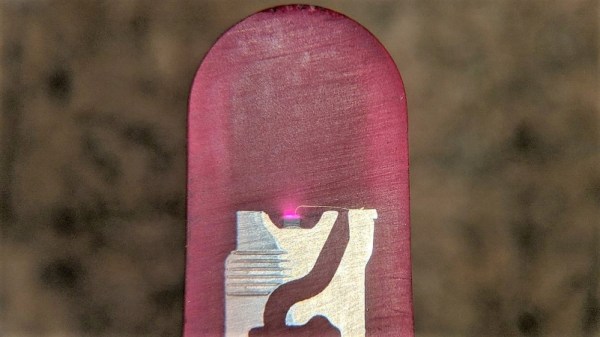
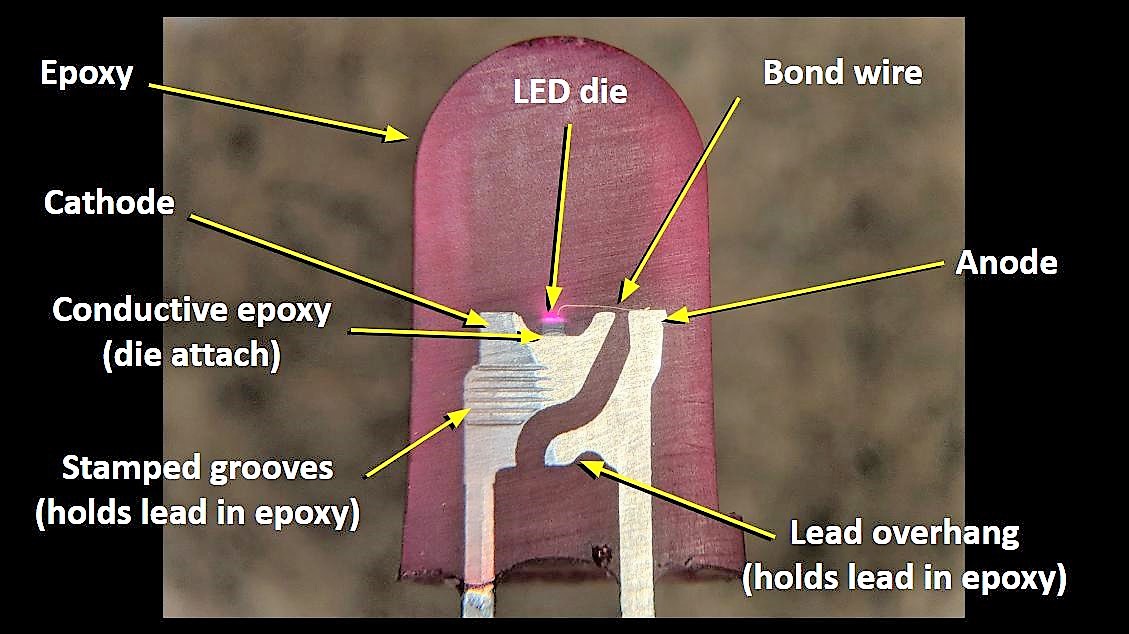
We’ve seen a little of what [Tube Time] has accomplished here; recall this lapped-down surface-mount inductor that [electronupdate] did a while back. The current work is more extensive and probably somewhat easier to accomplish because [TubeTime] focused mainly on larger through-hole components such as resistors and capacitors. It’s not clear how the sections were created, but it is clear that extreme care was taken to lap down the components with enough precision that the inner structures are clearly visible, and indeed, carefully enough that some, most notably the LED, still actually work. For our money, though, the best looking cross-sections are the capacitors, especially the electrolytic, for which [Tube Time] thoughtfully provides both radial and axial sections. The little inductor is pretty cool too. Some of the component diagrams are annotated, too, which makes for fascinating reading.
Honestly, we could look at stuff like this all day.
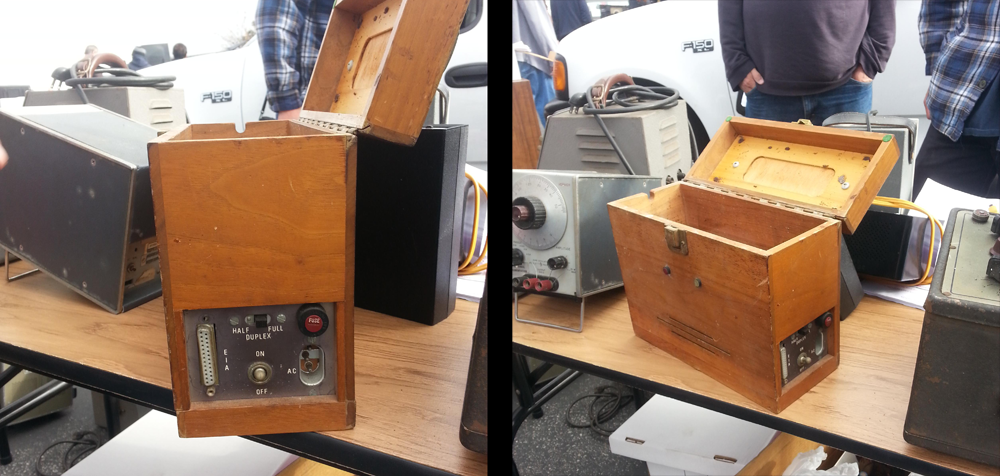
A few years ago, I was out at the W6TRW swap meet at the parking lot of Northrop Grumman in Redondo Beach, California. Tucked away between TVs shaped like polar bears and an infinite variety of cell phone chargers and wall warts was a small wooden box. There was a latch, a wooden handle, and on the side a DB-25 port. There was a switch for half duplex and full duplex. I knew what this was. This was a modem. A wooden modem. Specifically, a Livermore Data Systems acoustically coupled modem from 1965 or thereabouts.
The Livermore Data Systems Modem, where I found it. It cost me $20
The probability of knowing what an acoustically coupled modem looks like is inversely proportional to knowing what Fortnite is, so for anyone reading this who has no idea what I’m talking about, I’ll spell it out. Before there was WiFi and Ethernet and cable modems and fiber everywhere, you connected to the Internet and BBSes via phone lines. A modem turns digital data, in this case a serial connection, into analog data or sound. Oh yeah, we had phone lines, too. The phone lines and the phones in your house were owned by AT&T. Yes, you rented a phone from the phone company.
90s kids might remember plugging in a US Robotics modem into your computer, then plugging an RJ-11 jack into the modem. When this wooden modem was built, that would have been illegal. Starting with the communications act of 1934, it was illegal to attach anything to the phone in your house. This changed in 1956 with Hush-A-Phone Corp v. United States, which ruled you could mechanically attach something to a phone’s headset. (In Hush-A-Phone’s case, it was a small box that fit over a candlestick phone to give you more privacy.)
The right to attach something to AT&T’s equipment changed again in 1968 with Carterphone decision that allowed anyone to connect something electronically to AT&T’s network. This opened the door for plugging an RJ-11 phone jack directly into your computer, but it wasn’t until 1978 that the tariffs, specifications, and certifications were worked out. The acoustically coupled modem was the solution to sending data through the phone lines from 1956 until 1978. It was a hack of the legal system.
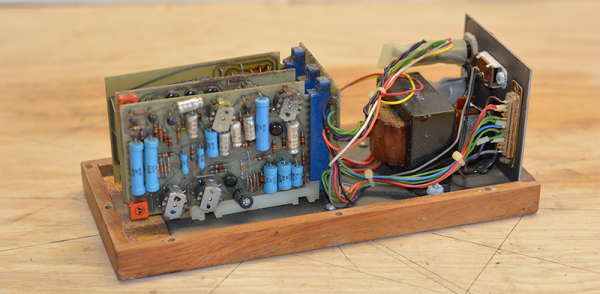
This leaves an ancient modem like the one sitting on my desk in an odd position in history. It was designed, marketed and sold before the Carterphone decision, and thus could not connect directly to AT&T’s network. It was engineered before many of the integrated chips we take for granted were rendered in silicon. The first version of this modem was introduced only a year or so after the Bell 103 modem, the first commercially available modem, and is an excellent example of what can be done with thirteen or so transistors. It’s time for the teardown, so let’s dig in.
A while ago, [Skippy] bought a cheap knock-off of the Apple USB mains charger from an AliExpress seller, for the British low, low price of 89p. Normally we’d give you a dollar conversion, but since that’s coincidentally the price of the basic McDonalds hambuger in the UK we’ll go with the hamburger as a unit of conversion. And as any self-respecting hacker would, he subjected it to a teardown and gave it a few tests.
Surprisingly though its pins were a little long it was just within the BS1363 pin spacing specification, probably due to its external dimensions copying the Apple original. The emissions test he performed might surprise readers, as it gave the little device its first pass. Radiated RF emissions were well below the test threshold, a welcome sight for anyone who has had to test a device. Sadly the same could not be said for conducted emissions, and it was happily spraying RF to all and sundry from its connections.
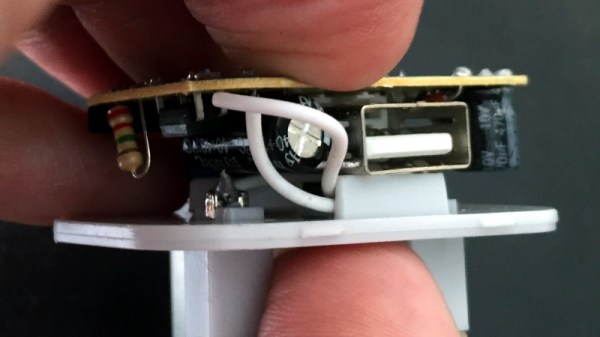
Taking a look inside revealed the usual litany of frightening safety fails. There was no insulation between the mains pins and the circuit board, and a secondary capacitor was even touching one of the pins. Meanwhile another capacitor connecting both sides of the circuit was not of the required Y rating. These and a raft of others make the device illegal for sale in Europe without further tests, but to give some numbers to it all he subjected it to a screen test applying 600 VAC common mode to its pins and checking for leakage current through the device. This it failed, and indeed it did not recover from the test.
So in this case, the price of a hamburger definitely does not get you an Apple, nor even does it get you an equivalent. But of course, you knew that, because we’ve talked about fake Apple chargers and power supplies many times before.
How complicated can a toaster be? You can get a cheap one for way under $10 that is little more than a hot wire. However, there are a few little complications. First, consumer products need to be safe — lawsuits are expensive. Second, there has to be some mechanism to hold the toast down until it is done. If you can buy one for $10 you can bet it isn’t some super toast processor running Linux in there.
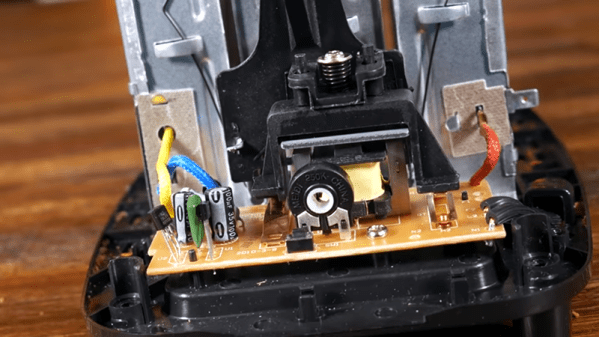
[Technology Connections] tore one down for you so you don’t have to. The circuitry is simple, and who knew there was a dedicated IC for toaster control? However, the real engineering is in the lowly little handle you pull down to start the toasting.