The B-2 Bomber: Those Who Forget History Are Doomed To Reverse Engineer It

The Drive had an interesting post recently, about someone noticed a procurement from the U. S. Air Force to reverse engineer the B-2 bomber’s Load Heat Exchanger (whatever that is). You’d think if the Air Force wanted to reverse engineer something, they’d be looking at another country’s aircraft. What can this mean?

Presumably, the original plans for the system have been lost, or maybe the company who made them is long gone and the tooling to create new ones along with it. Then again, maybe the assembly needs parts that you can no longer get. The Drive has another interesting speculation: perhaps the plans were so secret that were accidentally destroyed.

You don’t hear much about the B-2. There are only 20 left of the 21 built, at least that we know about. Original plans in the 1980s called for 132, but the end of the Cold War spelled the end for the stealth bomber. They get an overhaul every nine years. The Drive also speculates that this may be part of the Air Force’s desire to digitize spare parts and use 3D printing, but — honestly — it doesn’t sound that way to us. Especially since the fleet will retire no later than 2032, so whatever is replaced is only needed for a decade.

If you think you want to have a go, here’s the help wanted ad from the Air Force. If you read the text, it’s pretty clear they have some defective units that need replacement and it sounds like no one knows how to do it with existing materials. Not many of us get to design things that are still working nearly three decades later. Keeping a supply of parts and even know-how for something built in the 1990s isn’t trivial. Something to think about if you design something with a long service life.

The B-2 is a stealth bomber and while one did crash, it wasn’t shot down. The F-117A — the stealth fighter — was shot down against all odds, though. While the B-2 appears to be quite a plane, we prefer our bombers a little bit older. Still, you might enjoy the video below about the B-2’s chief engineer, although he doesn’t mention the Load Heat Exchanger.

Continue reading “The B-2 Bomber: Those Who Forget History Are Doomed To Reverse Engineer It”

Twisted Tea Launcher Refreshes At 104 MPH

A few weeks ago, a video went viral on social media that depicted a rather unsavory individual receiving what could be described as a “percussive reminder” of social norms courtesy of a bystander armed with a can of Twisted Tea. The video served as inspiration for many a meme, but perhaps none more technically intricate than this air cannon that launches 24 ounces of hard iced tea at better than 100 miles per hour built by [Greg Bejtlich].

It’s all fun and games until somebody brings out the weaponized bead seater.

Technically we’re looking at two different hacks here. The first is the pneumatic launcher put together using a low-cost eBay tire bead seater. These tools are designed to unleash a large volume of air into a tire so it can be properly seated onto the rim, but it doesn’t take much more than a few pieces of PVC pipe from the hardware store to turn it into an impromptu mortar. It’s even got a convenient trigger and a handle to help control the recoil. Though as you can see in the video after the break, it still ends up being a bit too energetic for [Greg] to keep a grip on.

For the projectiles, [Greg] has 3D printed a nose cone and tail fin that snap onto the 24 oz cans in hopes of making them more aerodynamically stable. The slow motion video seems to indicate they aren’t terribly effective, but they certainly look impressive. Spring-loaded control surfaces that deploy after the can leaves the muzzle could be the answer, though at some point you have to ask yourself how far you’re willing to go for an Internet meme.

It probably goes without saying that you definitely shouldn’t try firing cans of alcoholic iced tea off in your backyard. But the launcher itself might be useful for lofting antennas or hurling the occasional potato.

Continue reading “Twisted Tea Launcher Refreshes At 104 MPH”

DIY Laser Tag System Comes With All The Bells And Whistles

While VR is becoming really immersive, it still can’t compete with a game of good old laser tag to get the blood pumping and spending quality time with friends. [Xasin] has been working on a DIY laser tag system for a while now, and it has grown to include an impressive array of features and customizability.

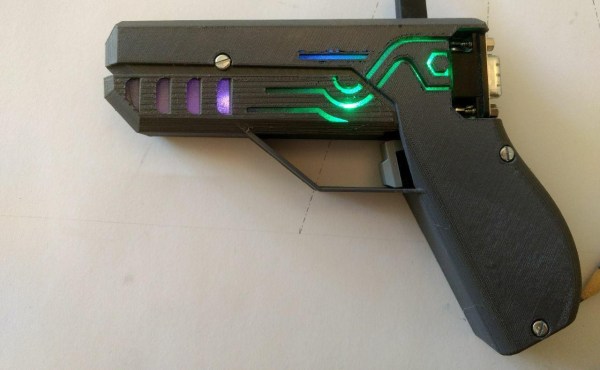
Named LZRTag, the project started back in 2018 with simple ATmega328 based prototypes on breadboards. It has since evolved to a fully-featured system with ESP32s in the 3D printed pistol communicating with a Raspberry Pi/Linux game server over MQTT. Each pistol also features an accelerometer, I2S audio amp and speaker for game sounds, and WS2812 RGP LEDs for light effects. IR Lasers are used as emitters to target wearable IR receivers with more RGB LEDs wired to the pistol.

A Ruby server on a Linux machine takes care of all the communications, game management, shot validation, and scoring. It can handle up to 255 players and is designed to be extremely customizable for game modes, weapons classes, or any other feature you would like to have. [Xasin] has also created IR beacons to add even more possibilities, such as capture the flag, safe zones, and revive zones.

We really like the flexibility of the system, and it would make an awesome group project for a hackerspace. You could also add a shock module to motivate players a bit more to avoid getting shot. If you want more gun, take a look at the laser tag rifle with a HUD we featured earlier in the year Continue reading “DIY Laser Tag System Comes With All The Bells And Whistles”

We Would Not Want To Be Stormtroopers Right Now

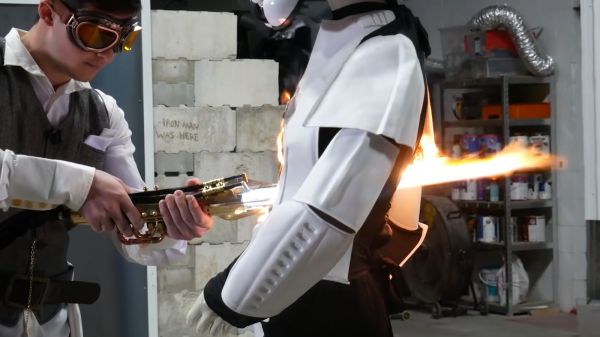
Humanity is another step closer to a fantasy-accurate lightsaber thanks to Hackaday alumnus [James Hobson] at Hacksmith. Their proto-saber cuts through (cosplay) stormtrooper armor, (foam) walls, and a (legit!) 1/4″ (6.35mm) steel plate. For so many reasons, we want to focus on the blade and handle. (Video, embedded below.)

The blade is a plasma stream designed for glassworking and burns a propane/oxygen mix with almost no residue, but the “blade” stays in a tight cylinder shape. With a custom PCB hosting a mixing controller, the blade extends and retracts like in the movies. The handle is not a technical marvel; it is an artistic wonder and if you want to see some machining eye-candy, check out the first video after the break. The second video demonstrates just how much damage you can do with a 4000° Fahrenheit tube of portable plasma.

You won’t be dueling anyone just yet, since there is no magnetic field shaping the blade like the ones [Lucas] envisioned. Unfortunately, you can’t block anything more substantial than a balloon sword since solid material will pass right through it, but it will suffer a mighty burn in the process. Lightsabers are a fantasy weapon, but the collective passion of nerds have made it as real as ever, and the Guinness folks give credibility to this build.

Continue reading “We Would Not Want To Be Stormtroopers Right Now”

Slick DIY Compound Bow Uses Coiled Springs, Toothbrush Heads

Compound bows (unlike recurve bows, their more mechanically-simple relatives) use a levering system with pulleys and spring tension to grant the user a mechanical advantage. We’re not exactly sure what to call [Zünder’s] bow design. He shared his unconventional take on a DIY bow that uses coiled springs as well as some other unique features.

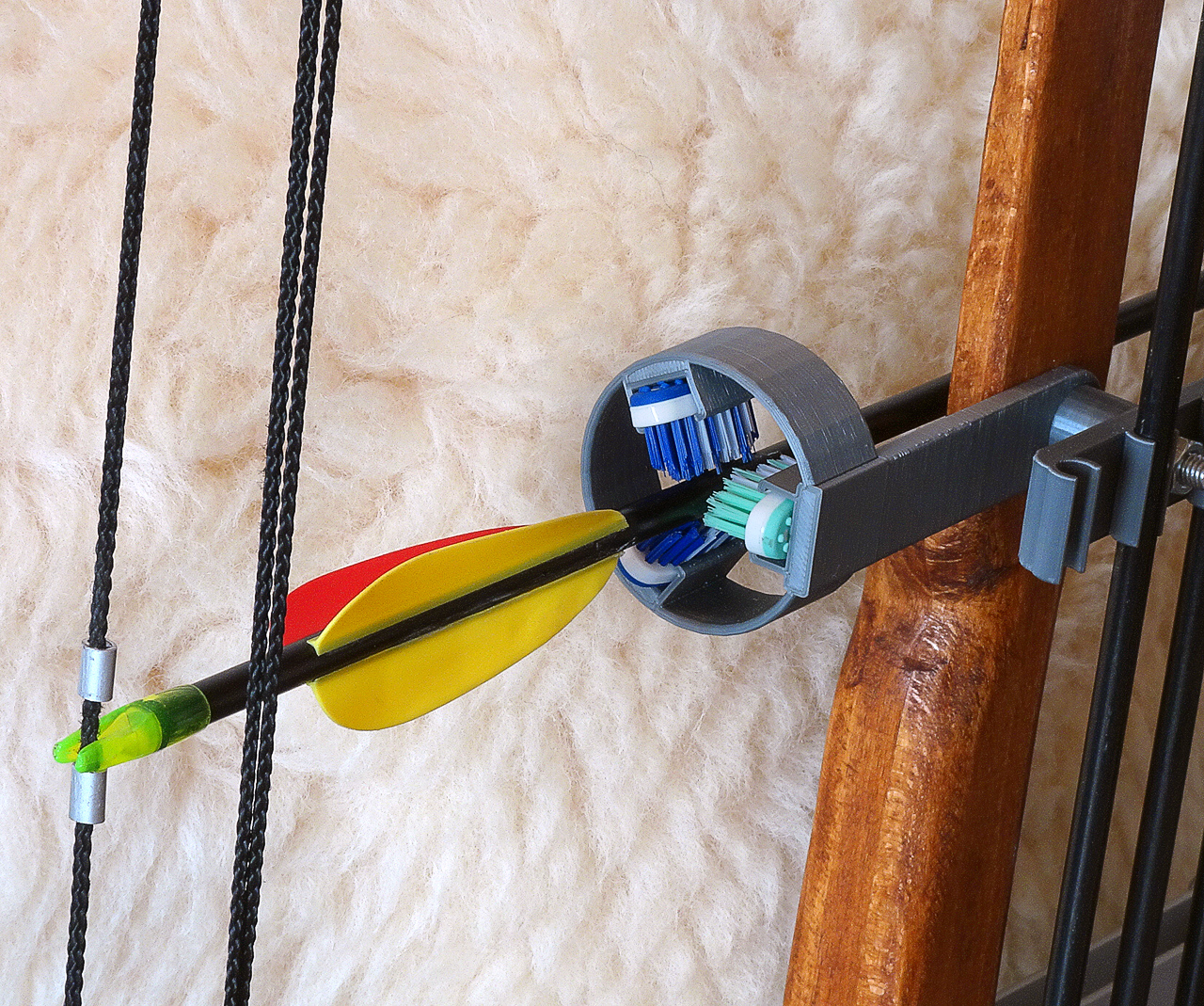
Toothbrush heads and 3D printing make an enclosed, bristle-supported arrow rest.

What we really dig about [Zünder]’s design is how easy it is to grasp how it all works. As he demonstrates using the bow, the way the levers, pulleys, and spring tension all work together is very clear. The 3D-printed quiver and arrow rest are nice added touches, and we especially love the use of three toothbrush heads to provide contained support for a nocked arrow. The ring of bristles are sturdy enough to easily support the shaft, and don’t interfere with the arrow’s fletching.

[Zünder] has a photo gallery with a few additional photos and closeups, and you can watch him demonstrate his bow in the video embedded below.

Continue reading “Slick DIY Compound Bow Uses Coiled Springs, Toothbrush Heads”

Learn About Historic Firearm Design With A 3D Printer

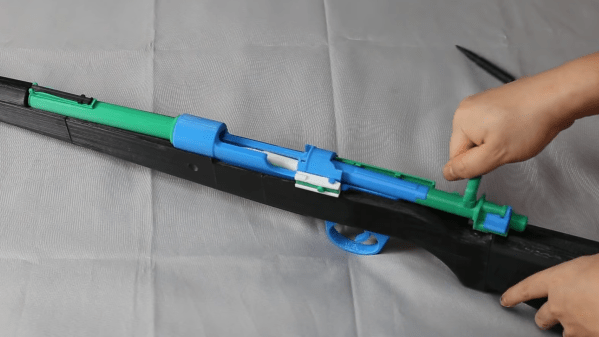
Over the last century, very little of the basic design of firearm cartridges has changed, but the mechanics of firearms themselves have undergone many upgrades. The evolution of triggers, safeties, magazines, and operating mechanisms is a fascinating field of study. Hands-on experience with these devices is rare for most people, but thanks to people like [zvc], you can 3D print accurate replicas of historical firearms and see how all the parts fit together for yourself.

[zvc] is slowly building up a library of 3D models, with nine available so far, from the Mauser C96 “Broomhandle” pistol to the modern M4 rifle. Except for springs and some fasteners, almost every single part of [zvc]’s models are 3D printed, down to the takedown pins and extractors. With the obvious exception of being able to fire a live round, it looks like all the components fit and work together like on the real firearms. None were ever designed with 3D printing in mind, so a well-tuned printer, lots of support structure, and post-processing are required to make everything work. The surface finish will be a bit rough, and some smaller and thin-walled components might be susceptible to breaking after the repeated operation or excessive force. The models are not free, but all prices are below €10.

These models do demonstrate one of the real superpowers of 3D printing: functional mock-ups and prototypes. The ability to do rapid iterative design updates and to have the latest design in hand within a few hours is invaluable in product development. [Giaco] used this extensively during the development of his kinetic driver. When you buy 3D printable models online, always make sure what possible pitfalls exist.

Making Baseballs Go Supersonic

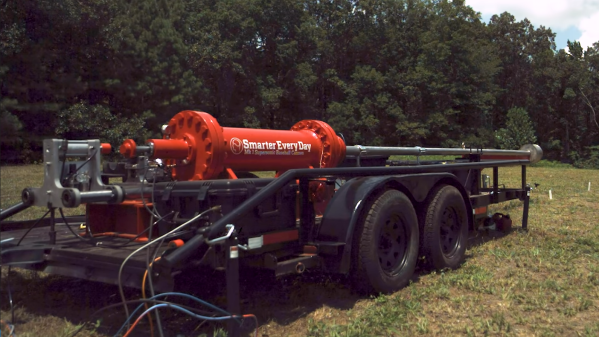
When professional engineers are giggling like kids, you know something interesting is about to happen. [Destin Sandlin] of [Smarter Every Day], [Jeremy Fielding], and a few other like-minded individuals have built a very impressive air cannon, capable of launching baseballs at supersonic velocities.

Baseball execution. Not for sensitive viewers.

The muzzleloading canon consists of a large pressure chamber and vacuum chamber stuck together, with a plug and baseball separating the two. The barrel forms part of the vacuum chamber, and is sealed off at the muzzle end with plastic tape that ruptures when fired. The firing mechanism runs the entire length of the pressure chamber, exiting out the back where it is held in place by a large pneumatic sear mechanism. When the sear is released, it “pops the cork” between the two chambers, sending high-pressure nitrogen into the vacuum chamber, forcing the ball forward. This causes the plug rod to shoot out the back of the pressure chamber, where it is stopped by a pneumatic piston. The entire thing is permanently mounted on a trailer. A professional-looking control box is used to operate the beast from behind the safety of a steel blast shield.

Be sure to watch the videos after the break with subtitles turned on. The first is the highlights reel, and the second is a very entertaining hour-long behind the scenes look. To the surprise of the builders, they were able to shoot a baseball at Mach 1.38 (1050 mph or 1690 km/h) on the very first try, with only a partially pressurized system and a leaking vacuum chamber. When impacting the thick steel target, the ball disintegrates completely, imprinting its stitches on the target. [Destin] and co recorded the results with his usual high-speed cameras, but also included a Schlieren rig that allowed them to photograph the shock waves and Mach cones generated by the speeding ball. After a few shots, the bolts were stripped out of the pneumatic piston that stops the plug rod, which is no surprise judging by how much the steel frame flexes in that area. Continue reading “Making Baseballs Go Supersonic”