Have you ever wondered what a song looks like? What it feels like in your hands?
Those odd questions have an answer that has taken shape over at [Reify], which has developed a way to turn sound waves into 3D-printed sculptures. These visualizations made manifest can be made from any audio — speeches, the ambience of a forest, classical music, a rocket launch — and rendered in coconut husk, plastic, bronze and more.
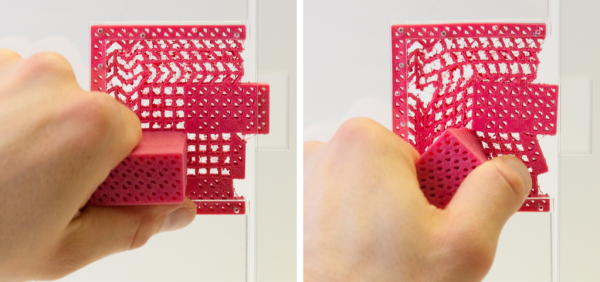
A group at the Hasso-Plattner Institute in Germany explored a curious idea: using 3D printed material not just as a material – but as a machine in itself. What does this mean? The clearest example is the one-piece door handle and latch, 3D printed on an Ultimaker 2 with pink Ninjaflex. It is fully functional but has no moving parts (besides itself) and has no assemblies. In other words, the material itself is also the mechanism.
The video (embedded below) showcases some similar concept pieces: door hinges, a pair of pliers, a pair of walker legs, and a pantograph round out the bunch. Clearly the objects aren’t designed with durability or practicality in mind – the “pliers” in particular seem a little absurd – but they do demonstrate different takes on the idea of using a one-piece item’s material properties as a functional machine in itself.
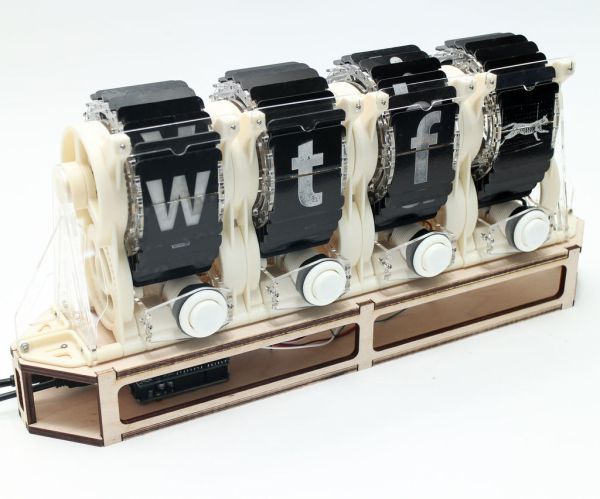
Beautifully documented, modular, and completely open-source, this split flap display project by [JON-A-TRON] uses 3D printing, laser cutting and engraving, and parts anyone can find online to make a device that looks as sharp as it is brilliantly designed. Also, it appears to be a commentary on our modern culture since this beautifully engineered, highly complex device is limited to communicating via three-letter combos and cat pictures (or cat video, if you hold the button down!) As [JON-A-TRON] puts it, “Why use high-resolution, multi-functional devices when you can get back to your industrial revolution roots?” Video is embedded below.
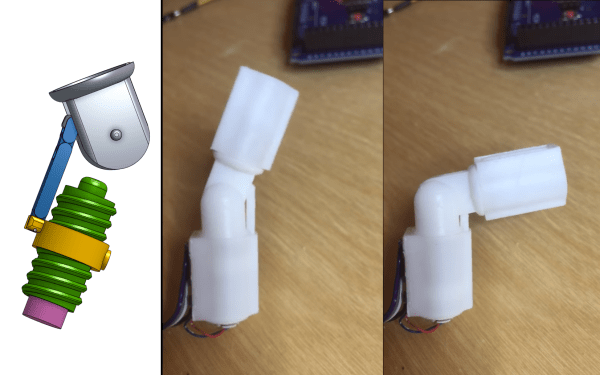
[Tim] needed very small, motorized joints for a robot. Unable to find anything to fit the bill, he designed his own tiny, robotic joints. Not only are these articulated and motorized, they are designed to be independent – each containing their own driver and microcontroller.
6mm geared motor next to LEGO [Source: Pololu]None of the photos or video really give a good sense of just how small [Tim]’s design is. The motor (purple in the 3D render above, and pictured to the left) is a sub-micro planetary geared motor with a D shaped shaft. It is 6mm in diameter and 19mm long. One of these motors is almost entirely encapsulated within the screw it drives (green), forming a type of worm gear. As the motor turns the screw, a threaded ring moves up or down – which in turn moves the articulated shaft attached to the joint. A video is embedded below that shows the joint in action.
[Tim] originally tried 3D printing the pieces on his Lulzbot but it wasn’t up to the task. He’s currently using a Form 2 with white resin, which is able to make the tiny pieces just the way he needs them.
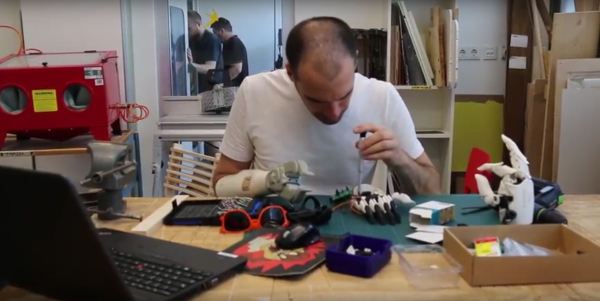
In recent years, prosthetics have seen a dramatic increase in innovation due to the rise of 3D printing. [Nicholas Huchet] — missing a hand due to a workplace accident in 2002 — spent his residency at Fab Lab Berlin designing, building, testing and sharing the files and tutorials for a prosthetic hand that costs around 700 Euros.
[Huchet] founded Bionicohand with the intent of using the technology to make prosthetic limbs available to those without reliable medical or social assistance — as well as for amputees in countries without such systems — which can cost tens of thousands of dollars. The parts took a week to print while assembly and modifications to suit [Huchet’s] arm took another four days, but the final product is functional and uses affordable myoelectric sensors, boards and servos — plus there’s always the option of using a basic 3D scanner to accommodate for existing prosthetic mounts for the individual.
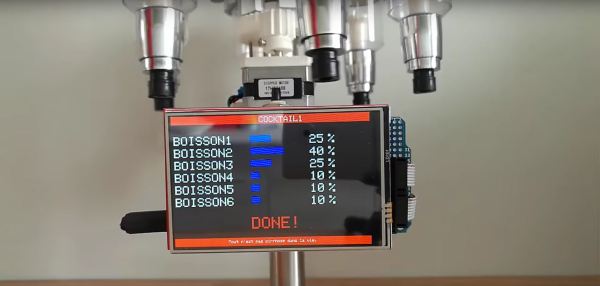
A personal bartender is hard to come by these days. What has the world come to when a maker has to build their own? [Pierre Charlier] can lend you a helping hand vis-à-vis with HardWino, an open-source cocktail maker.
The auto-bar is housed on a six-slot, rotating beverage holder, controlled by an Arduino Mega and accepts drink orders via a TFT screen. Stepper motors and L298 driver boards are supported on 3D printed parts and powered by a standard 12V DC jack. Assembling HardWino is a little involved, so [Charlier] has provided a thorough step-by-step process in the video after the break.
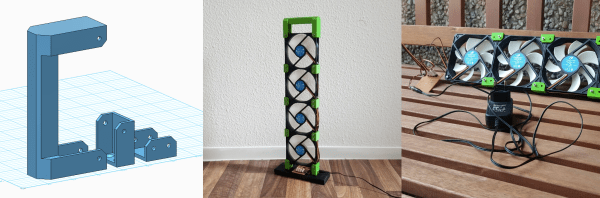
Hackaday.io contributor extraordinaire [davedarko] gets hot in the summer. We all do. But what separates him from the casual hacker is that he beat the heat by ordering four 120 mm case fans. He then 3D printed a minimalistic tower frame for the fans, and tied them all together with a ULN2004 and an ESP8266. The whole thing is controlled over the network via MQTT. That’s dedication to staying cool.
We really like the aesthetics of this design. A fan made up of fans! But from personal experience, we also know that these large case fans can push a lot of air fairly quietly. That’s important if you’re going to stand something like this up on your desk. While we’re not sure that a desk fan really needs networked individual PWM speed control, we can see the temptation.
Now that they’re individually controlled, nothing stops [davedarko] from turning this into a musical instrument, or even using the fans to transmit data. The only thing we wouldn’t do, despite the temptation to stick our fingers in the blades, is to complicate the design visually. Maybe that would finally teach the cat not to walk around on our desk.