DIY Lambo That Made The Real Lamborghini Take Notice

When you start sharing your projects with the world, you never know who might take notice. [Sterling Backus] and his son [Xander] have been building a functional Lamborghini Aventador look alike in their garage, and the real Lamborghini company caught wind of it and decided to turn it into an awesome Christmas ad.

Named the AXAS Interceptor by its creators, the car is built from scratch around a custom tubular space frame chassis. Most of the body panels are 3D printed and then skinned with carbon fibre, with a few sheet metal panels mixed in. The interior is mix of parts from other cars and aftermarket components, with 3D printing to pull everything together. The drivetrain consists of an engine from a Corvette, a transaxle from a Porsche 996, with the rest of the chassis components being either aftermarket or custom-fabricated pieces.

[Sterling] got an unexpectedcall from Lamborghini, and they arranged to secretly sneak a real Aventador into the garage in the dead of night to surprise the rest of the family, and let them borrow it for a few weeks. Lamborghini got some marketing out of it, which most people would probably agree is a pretty good deal. We would admit that we’re quite envious.

The car is driveable, but still many hours from being complete. [Sterling] admits that he is no car building professional, but we’re impressed by what he has been able to achieve so far with this ambitious project, and we’re looking forward to the finished product.

If you want to get your feet wet with your first project car, here’s how you pick one.

Continue reading “DIY Lambo That Made The Real Lamborghini Take Notice”

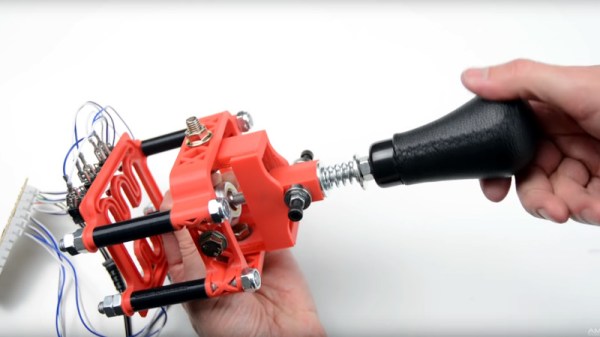
3D Printable Stick Shift For Your Racing Simulator

If you don’t get enough driving in your real life, you can top it off with some virtual driving and even build yourself a cockpit. To this end [Noctiluxx] created a very nice 3D printable stick shifter you can build yourself.

The design is adapted for 3D printing from an older aluminium version by [Willynovi] over on the X-Simulator forums. Every version uses an off-the-shelf ball joint for the main pivot, below which is a guide plate with the desired shift pattern.  Each position has a microswitch, which can be connected to a USB encoder from eBay which acts as a HID. The position is held in the Y-axis position by a clever spring-loaded cam mechanism above the ball joint, while the X-position is held by the bottom guide plate. The gear knob can be either 3D printed or the real deal of your choice.

This design is the perfect example of the power of the internet and open source. The original aluminium design is almost a decade old, but has been built and modified by a number of people over the years to get us to the easy to build version we see today. [amstudio] created an excellent video tutorial  on how to built your own, see it after the break.

For more awesome cockpits check out this one to fly an actual (FPV) aircraft, and this dazzling array of 3D printable components for your own Garmin G1000 avionics glass cockpit. Continue reading “3D Printable Stick Shift For Your Racing Simulator”

OpenDog: Adding Force Sensitive Feet

[James Bruton] OpenDog remains one of the most impressive home-built robotics projects we’ve seen here on Hackaday, and it’s a gift that just keeps on giving. This time he’s working on adding force sensing capabilities to OpenDog’s legs to allow for more dynamic movement control.

The actuators in the legs are three-phase outrunner motors that drive ball-screws via a belt. This configuration is non-backdrivable, meaning the legs cannot be moved when an external force is, which could lead to mechanical failures. He as tested other backdrivable leg configurations with other robots, but did not want to rebuild OpenDog completely. The solution [James] went with is a redesigned foot with an inbuilt switch, to confirm that the foot is touching the ground, and a load cell attached in the middle of the bottom leg segment. The load cell is bolted rigidly onto the leg segment, which allows it to sense when the leg is carrying load, without damaging the load cell itself.

Unfortunately all the serial ports on OpenDog’s main Teensy 3.6 controller are already used, so he converted the signal from the load cell to PWM, to allow it to be read by a normal GPIO pin. This works well in isolation, but when [James] switches on the motors, the PWM signal from the load sensor gets flooded by interference, making it unreadable. To solve this problem, he wants to implement a CAN bus, which will allow for more inputs and outputs and hopefully solve the interference problem. However, [James] has no experience with the CAN protocol, so learning to use it is going to be a project on its own.

OpenDog is turning into a very lengthy, time-consuming project, [James] says that the lessons learned from it have been invaluable for a number of other projects. This is something to keep in mind with everything we tackle. Choose projects were the experience gained and/or relationships developed are worth it on their own, even when the project fails in a conventional sense. This way you can never really lose.

Stronger 3D Prints — Glue Or Carbon Fiber?

[CNCKitchen], like many others, is looking to make strong 3D prints. Using a high tech PLA bio copolyester compound, he printed a bunch of hooks in two different orientations. He used several different types of glue including epoxy and superglue. You can see the video of his results, below.

In addition to the glue, he used epoxy and bulk carbon fiber, again, in two different orientations. After several days of curing, he was ready to test.

Continue reading “Stronger 3D Prints — Glue Or Carbon Fiber?”

3D Printed Pulsejet Uses Tesla Valve

For most people, a jet is a jet. But there are several different kinds of jet engines, depending on how they operate. You frequently hear about ramjets, scramjets, and even turbojets. But there is another kind — a very old kind — called a pulsejet. [Integza] shows how he made one using 3D printed parts and also has a lot of entertaining background information. You can see the video below. (Beware, there is a very little bit of off-color language and humor in the video, so you might not want to watch this one at work.)

They are not ideal from a performance standpoint, but they are easy to make. How easy? A form of pulsejet was accidentally discovered by a young Swiss boy playing with alcohol in the early 1900s. Because of their simplicity, they’ve been built by lots of different people, including rocket pioneer Robert Goddard, who mounted one to a bicycle.

Continue reading “3D Printed Pulsejet Uses Tesla Valve”

3D Printing Paper — Sort Of

There are only a few truly ancient engineered materials, and among the oldest is paper. Traditionally, paper is flat and can be bent into shapes. However, paper can be molded into for example packing material or egg cartons. [XYZAidan]  has a process that can recycle paper into 3D cardboard-like objects. You need a 3D printer, but it doesn’t actually print the paper. Instead, you use the printer to create a mold that can form paper pulp you make out of recycled paper and a blender.

[Aidan] provides seven different molds ranging from a desk tray and a dish to simple cubes and coasters. The molds are made in three parts to assist in removing the finished product.

Continue reading “3D Printing Paper — Sort Of”

Folding An Off-The-Shelf 3D Printer

Most 3D printers don’t take up a lot of space, but they can be pretty bulky and awkward to travel with. [Jón Schone] needed a compact folding 3D printer for a secret project on his YouTube channel ProperPrinting, so he decided to modify a Creality Ender 3 Pro to achieve this.

Starting with a brand new Ender 3 Pro, and his first steps were to move the display and power supply unit into the bottom frame to make space for the folding top frame. For the folding mechanism, he settled on a four bar linkage that allows the vertical frame to translate to the front of the printer as it folds down, which lets it become a really compact package with minimal wasted space. The joints consist of fitting 3D printed in carbon fibre reinforced nylon, with bolts for shafts. The entire mechanism is made adjustable for fine-tuning by using threaded rod and sliding mounting points on the extruded frame. Small brackets on each side of the frame allows the printer to snap securely into both its upright and folded positions.

All in all we think this is well-designed and beautifully executed hack, enough to make us really want to build one for ourselves. It will remain to be seen if any slop develops with repeated folding and use, especially at the snap-in end stops, but that should still be an easy fix if it happens.

We’ve previously featured [Jón]’s custom 3D printed D-sub connectors, also for his Ender 3. Also check out another folding printer, the X-printer.

Continue reading “Folding An Off-The-Shelf 3D Printer”