This Synth Is Okay

While this 3D printed synthesizer might just be okay, we’re going to say it’s better than that. Why? [oskitone] did something with a 555 timer.

The Okay synth from [oskitone] uses a completely 3D printed enclosure. Even the keys are printed. Underneath these keys is a small PCB loaded up with tact switches and small potentiometers. This board runs to another board loaded up with a 555 timer and a CD4040 frequency divider. This, in turn, goes into an LM386 amplifier. It’s more or less the simplest synth you can make.

If this synth looks familiar, you’re right. A few months ago, [oskitone] released the Hello F0 synth, a simple wooden box with 3D printed keys, a few switches, and a single 4046 PLL oscillator. It’s the simplest synth you can build, but it is something that can be extended into a real, proper synthesizer with different waveforms, LFOs, and envelope generators.

The sound of this chip is a very hard square wave with none of the subtleties of A,S,D, or R. Turn down the octave knob and it makes a great bass synth, or turn the octave knob to the middle for some great chiptune tones. All the 3D models for this synth are available on Thingiverse, so if you’d like to print your own, have at it.

You can check out the demo of the Okay synth below.

Continue reading “This Synth Is Okay”

Someone Finally Did It With A 555

[Jarunzel] needed a device that would automatically click the left button on a mouse at a pre-set interval. For regular Hackaday readers, this is an easy challenge. You could do it with an ATtiny85 using the VUSB library, a few resistors and diodes, and a bit of code that emulates a USB device that constantly sends mouse clicks over USB every few seconds. You could also do it with a Raspberry Pi Zero, using the USB gadget protocol. Now, this mouse-clicking gadget would be connected to the Internet (!), programmable with Node or whatever the kids are using these days, and would have some major blog cred. If you’re feeling adventurous, this mouse clicker gadget could be built with an STM32, Cypress PSoC, or whatever microcontroller you have in your magical bag of hacker tricks.

Then again, you could also do it with a 555 timer.

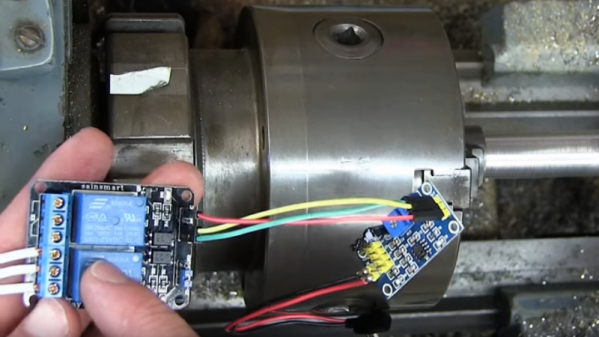
The reason [Jarunzel] couldn’t use any of the fancy hackertools for this build is because the system wouldn’t accept two mouse devices. No matter, because Maplin has a neat kit with a 555 timer and a relay. The relay is wired up across the microswitch in the mouse, and setting the values correctly makes the mouse click about once per second, with a click duration of about 100ms. Good enough.

With the kit built, wired into the mouse, a small app built to test the device, and a nice project box constructed, [Jarunzel] had exactly what he needed. There’s even a video of this mouse clicker in action. You can check out that riveting footage below.

Continue reading “Someone Finally Did It With A 555”

You Know You Can Do That With A 555

Hardly a week goes by that we don’t post a project where at least one commenter will lament that the hacker could have just used a 555. [Peter Monta] clearly gets that point of view. For a 555 design contest, he created both digital logic gates and an op amp, all using 555 chips. We can’t quite imagine the post apocalyptic world where the only surviving electronic components are 555 chips, but if that day were to come, [Peter] is your guy.

Using the internal structure of the 555, [Peter] formed a basic logic gate, an inverter, latches, and more. He also composed things like counters and seven-segment decoders. He had a very simple 4-bit CPU design in Verilog that he was going to attempt until he realized it would map into almost 400 chips (half of that if you’d use a dual 555, but still). If you built this successfully, we would probably post it, by the way.  You can see a video of the digital logic counter, below.

Continue reading “You Know You Can Do That With A 555”

Quick Hack Cleans Data From Sump Pump

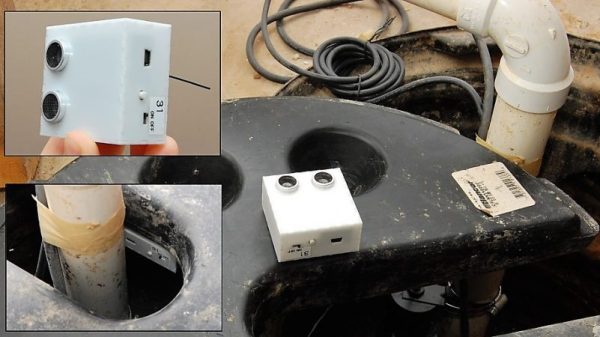
Nobody likes to monitor things as much as a hacker, even mundane things like sump pumps. And hackers love clean data too, so when [Felix]’s sump pump water level data was made useless by a new pump controller, he just knew he had to hack the controller to clean up his data.

Monitoring a sump pump might seem extreme, but as a system that often protects against catastrophic damage, the responsible homeowner strives to take care of it. [Felix] goes a bit further than the average homeowner, though, with an ultrasonic sensor to continually measure the water level in the sump and alert him to pending catastrophes. Being a belt and suspenders kind of guy, he also added a float switch to control the pump, but found that the rapid cycle time made his measurements useless. Luckily the unit used a 555 timer to control the pump’s run time after triggering, so a simple calculation of the right RC values and a little solder job let him increase the on time of the pump. The result: a dry basement and clean data.

We recently discussed the evolution of home automation if you want to know more about the systems that sensors and actuators like these can be part of. Or for a more nuts and bolts guide to networking things together, our primer on MQTT might help.

Push Button, Receive Beverage!

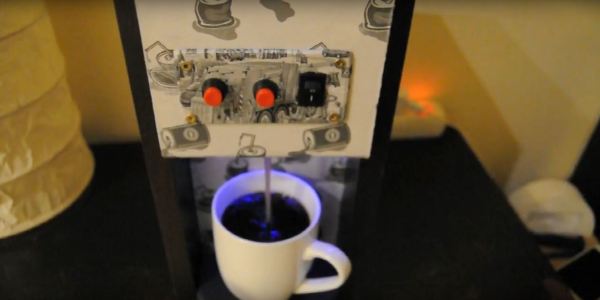
Here’s a rec-room ready hack: an automatic drink dispenser.

[truebassB]’s dispenser operates around a 555 timer, adjusted by a potentiometer. Push a button and a cup pours in a few seconds, or hold the other button to dispense as much as you want.

The dispenser is made from MDF and particle board glued together, with some LEDs and paper prints to spruce it up. Just don’t forget a small spill sink for any miscalculated pours. You needn’t fret over the internals either, as the parts are easily acquired: a pair of momentary switches, a 12V micro air pump, a brass nozzle, food-safe pvc tube,  a custom 555 timing circuit — otherwise readily available online — a toggle switch, a power supply plug plus adapter and a 12V battery.

Continue reading “Push Button, Receive Beverage!”

Blinking A Light With Ping

The Flashing Light Prize is on right now, and that means all our favorite geeks and YouTubers are aspiring to what could be done with a 555. The rules are simple: turn a light bulb on and off somehow. [Sprite_tm] is answering the call, and he’s blinking lightbulbs at the speed of light.

[Sprite]’s method of blinking a light is simple: Use an ESP32 development board to turn on a relay. At the same time, send a packet out to the Internet and through four servers spread across the globe. When the packet goes through servers in Shanghai, the Netherlands, to Hong Kong, to Germany, and finally Japan — and back again — the light bulb turns off. It’s a physical demonstration of the speed of light and the quality of undersea optical fibers.

This route is quite long, and a reasonable estimate for the one-way, great circle path from Shanghai to the Netherlands to Hong Kong to Berlin and finally to somewhere near Osaka is about 36,000 km. A round trip for this light bulb packet is 72,000 km, or about 0.2 light-seconds. There are delays, of course, from fiber and cables not going directly over the Himalayas, delays in routers, and the difference between the speed of light in a vacuum and the speed of light in glass fiber. Still, light is quick, and the light blinks at about 1Hz.

You can check out [Sprite]’s entry video for the Flashing Light Prize below.

Continue reading “Blinking A Light With Ping”

Life-Sized Pinball Drop Targets

[Bob] wanted to build a pinball-drop-style resetting target that he could use while practicing with his pistol. His first idea was to make the targets sturdy enough for use with 9 mm ammunition, and he planned to use 1/2” thick steel for the targets and 11-gauge steel tubing for the frame. However, the targets weighed 50 pounds together and that was more weight than the pneumatic actuators could lift. He ended up using 1/4” steel and thereby halving weight. The downside was that [Bob] had to switch out the nine for a .22.

Controlling everything is a 555 circuit. When triggered, it opens up a relay for one second, which trips the solenoid valve controlling the pneumatic actuators. Originally he wanted to have switches under each target, and only by dropping all four would the reset circuit be triggered. However, he built a simpler solution: a bulletproof button off to one side–effectively a fifth target–that when triggered resets the targets.

HaD have some pretty good shots in our number but we’d probably end up hitting the pneumatic actuators at least once. [Bob] did add 16-gauge steel sheeting to protect the air lines and wires from bullet splatter, which in his experience is more of a threat than a direct hit.