WiFi Fob Acquaints OLED With ESP

When you think of WiFi in projects it’s easy to get into the rut of assuming the goal is to add WiFi to something. This particular build actually brings WiFi awareness to you, in terms of sniffing what’s going on with the signals around you and displaying them for instant feedback.

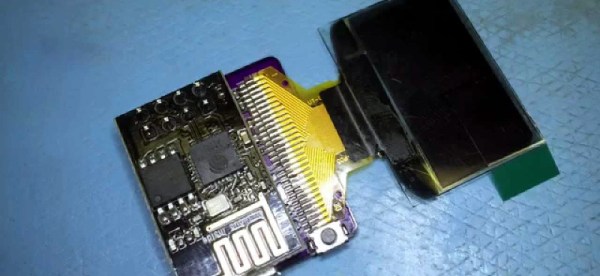
[0miker0] is working on the project as his entry in the Square Inch Project. It’s an adapter board that has a footprint for the 2×4 pin header of an ESP8266-01 module, and hosts the components and solder pads for a 128×64 OLED display. These are becoming rather ubiquitous and it’s not hard to figure out why. They’re relatively inexpensive, low-power, high-contrast, and require very few support components. From the schematic in the GitHub Repo it looks like 5 resistors and 7 caps.

The video below shows off two firmware modes so far. The first is an AP scan that reads out some information, the second is a weather-display program. Anyone who’s worked with the ESP modules knows that they have the potential to gather all kinds of data about WiFi signals — one of our favorite demos of this is when [cnlohr] used it to create a 3d light painted map of his WiFi signal strength. Chuck a rechargeable LiPo on this thing, tweak the example code for your needs, and you have a new gadget for wardriving-nouveau.
Continue reading “WiFi Fob Acquaints OLED With ESP”

Internet-Connected Box Displays Emotion, Basement Dwellers Still Unaffected

For one reason or another, Twitter has become the modern zeitgeist, chronicling the latest fashions, news, gossip, and irrelevant content that sends us spiraling towards an inevitable existential ennui. This is a Twitter mood light. It tells you what everyone else on the planet is feeling. You, of course, feel nothing. Because of the ennui.

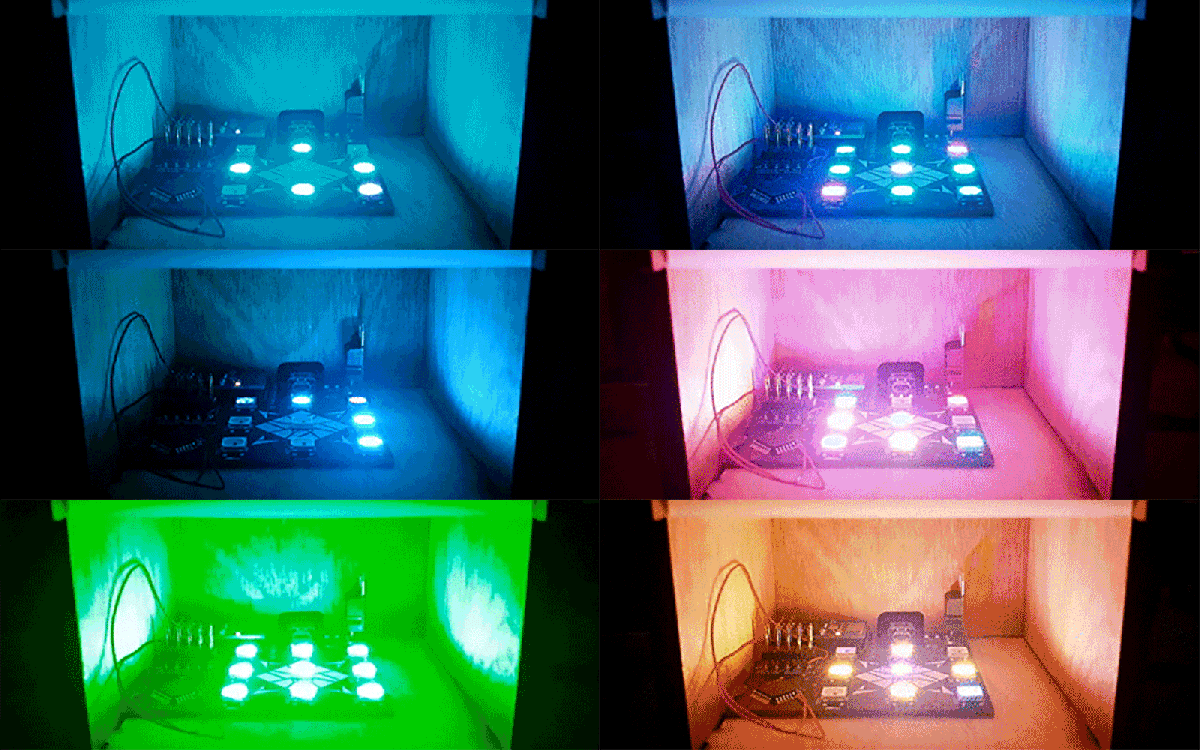
[Connor] decided it would be a good idea to audit the world’s collective mood using experimental social analytics. He’s doing that by watching millions of tweets a day and checking them against hundreds of keywords for several emotions. These emotions are graphed in real time, placed on a server, correlated and corroborated, and downloaded by a moodLight. Inside the moodLight, the emotions are translated into colors, and displayed with the help of a few RGB LEDs.

The moodLight is currently a Kickstarter campaign, with a $30 pledge getting you an assembled board with an ATMega328, an ESP8266, a few RGB LEDs, and a laser cut enclosure. After it’s assembled, the moodLight connects automagically to the analytics server for a real-time display of the emotional state of the Twitterverse. The display is updated every second, making the backend of this build just slightly more impressive than Kickstarter itself. It’s great work from [Connor], and an interesting experiment in analyzing the state of the Internet.

WiFi Power Monitor Based on ESP8266

WiFi Power Monitor

Building your own hardware to measure AC power isn’t a simple task. There’s a number of things to measure, including voltage, current, power, and power factor. The Atmel 90E24 is a single chip solution designed for this exact purpose. Connect a few components, and all the power data is available to a microcontroller over SPI.

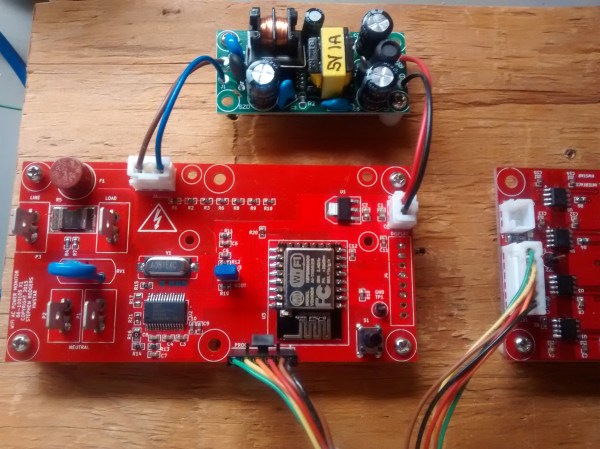
[hwstar] built a custom power monitoring board based on this IC. His AC-Emeter will give you all the measurements you’d want, and includes an ESP12 module for data collection and WiFi connectivity. Aside from the Atmel 90E24 device, a high power and low resistance resistor is needed for shunt sense current measurement. An external module is used to convert mains voltage down to 5V to power the board.

Of course, working with mains voltages can be a dangerous endeavour. Fortunately, [hwstar] provides some tips on how to prevent “equipment from being BLOWN UP” along with the open source hardware and firmware.

[via Embedded Lab]

Hackaday Links: September 27, 2015

Many moons ago, [Joe Grand] built an adapter that turns Atari 2600 joysticks to USB controllers. Now it’s open source.

Hackaday Overlord [Matt] is holding an SMT and BGA soldering workshop in San Francisco on October 4th. Teaching BGA soldering? Yes! He made a board where the BGA balls are connected to LEDs. Very, very clever.

Our ‘ol friend [Jeremey Cook] built a strandbeest out of MDF. It’s huge, heavy, about the size of a small car, and it doesn’t work. [Jeremy] has built beests before, but these were relatively small. The big MDF beest is having some problems with friction, and a tendency to shear along the joints. If anyone wants to fix this beest, give [Jeremy] a ring.

Everyone loves the Teensy, and [Paul] has released his latest design iteration. The Teensy 3.2 isn’t that much different from the Teensy 3.1; the bootloader has changed and now USB D+ and D- lines are broken out. Other than that, it’s just the latest iteration of the popular Teensy platform.

The DyIO is a pretty neat robotics controller, a semifinalist for the Hackaday Prize, and now a Kickstarter. The big win of the Kickstarter is an electronics board (with WiFi) that is able to control 24 servos for all your robotics needs.

[pighixxx] does illustrations of pinouts for popular electronics platforms. Everyone needs a hobby, I guess. He recently put together an illustration of the ESP8266. Neat stuff is hidden deep in this site.

You would not believe how much engineering goes into making snake oil. And then you need to do certifications!

[David] identified a problem, created a solution, got a patent, and is now manufacturing a product. The only problem is the name.

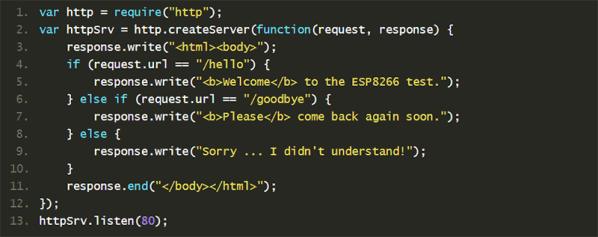
JavaScript For The ESP8266

The ESP8266 is a popular WiFi chip that provides a relatively transparent connection between the TX and RX pins of a microcontroller and a WiFi network. It was released a little more than a year ago, and since then developers and hardware hackers have turned the ESP into much more than a serial to WiFi bridge. It’s a microcontroller platform unto itself, with a real development environment and support for the scripting language Lua.

Lua is okay, but a real win would be a JavaScript interpreter for this tiny WiFi platform. It’s taken months of work, but finally there’s an open source version of JavaScript available for the ESP8266.

This build is based on the Espruino firmware, a JavaScript interpreter for microcontrollers. This interpreter runs on dozens of different microcontrollers, but being the latest, greatest, and most popular new microcontroller platform means a new solution for the ESP is very, very exciting.

Right now the JS interpreter for the ESP is in testing, with expectations high that everything will be brought over into the main branch of the Espruino firmware. There are samples of JavaScript running on the ESP available, and binaries that can be flashed onto an ESP are available here.

Thanks [Richard] for sending this one in. He’s set up an Espruino board on the ESP8266 community forum, that should eventually be filled with new examples of JavaScript running on an ESP.

Hackaday Dictionary: The ESP8266

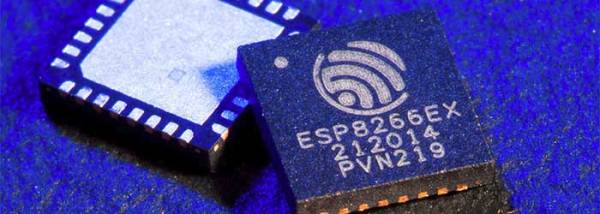
In August of 2014, something new started showing up in the markets of Shenzhen, the hi-tech area of China where the majority of the world’s electronics components are made. This is the ESP8266, a WiFi SoC (System on a Chip) that can connect to 802.11b/g/n networks on the 2.4GHz band. It can be addressed with SPI or a serial connection, and has an AT command set that makes it behave rather like an old-style modem. Basically, it has everything you would need to connect a device to a WiFi network, with the ESP8266 chip itself handling the complicated business of finding, joining and transmitting/receiving over a WiFi network.

That’s nothing particularly new in itself: WiFi connection devices like the TI CC3000 have been around for longer, and do much the same thing. The difference was the price. While the TI solution costs about $10 if you buy several thousand of them, the ESP8266 costs less than $7 for an individual board that can plug straight into an Arduino or similar. Buy the chip in bulk, and you can get it for less than $2.

The ESP8266 is more than just a WiFi dongle, though: it is a fully fledged computer in itself, with a megabyte of flash memory and a 32-bit processor that uses a RISC architecture. This can run applications, turning the ESP8266 into a standalone module that can collect and send data over the Internet. And it can do this while drawing a reasonably low amount of power: while receiving data, it typically uses just 60mA, and sending data over an 802.11n connection uses just 145mA. That means you can drive it from a small battery or other small power source, and it will keep running for a long time.

It wasn’t an easy ship to write applications for in the early days, though: it was poorly documented and required a dedicated toolchain to work with. This made it more of a challenge than many hackers were comfortable with.  That changed earlier this year, though, when the Arduino IDE (Integrated Development Environment) was ported to the chip. This meant that you could use the much easier to write Arduino functions and libraries to write code for the chip, bringing it within reach of even the most casual hacker.

Continue reading “Hackaday Dictionary: The ESP8266”

Nixie Tube Clock Isn’t Just A Clock

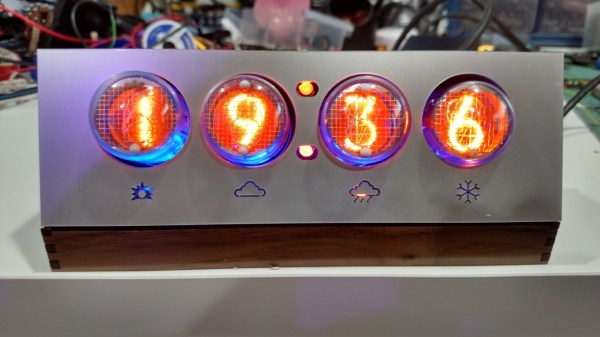
With everything that’s been happening in the news lately, [Jarek] decided it was finally time to finish up his latest project. The Internet of Things has been exploding with projects lately, and this clock that also alerts him of the weather is the latest addition. Plus it has the added bonus of using everybody’s favorite display: nixie tubes!

Of course, using high voltage for the nixies can be terror-inducing, but [Jarek] found a power supply on eBay that was able to power the tubes for not too much money. The controller is an HV5622 which can control up to 32 nixies while only using up three pins on a microcontroller which is pretty handy if you have a limited number of output pins.

The clock also has another device hidden behind all of the wires for the tubes: an ESP8266 to give it network connectivity. The clock connects to the Internet and searches for the nine-hour weather forecast. There are a few nixie lights behind the display which illuminate cutouts in the case to indicate a few different weather statuses. It’s a very polished project, and since it’s enclosed in a nice case it’s not likely to be mistaken for any movie props. Of course, other nixie projects don’t have the same comforting look.

Continue reading “Nixie Tube Clock Isn’t Just A Clock”