Lead Acid Battery Upgraded To Lithium Iron Phosphate

Lithium batteries have taken over as the primary battery chemistry from applications ranging from consumer electronics to electric vehicles and all kinds of other things in between. But the standard lithium ion battery has a few downsides, namely issues operating at temperature extremes. Lead acid solves some of these problems but has much lower energy density, and if you want to split the difference with your own battery you’ll need to build your own lithium iron phosphate (LiFePO4) pack.

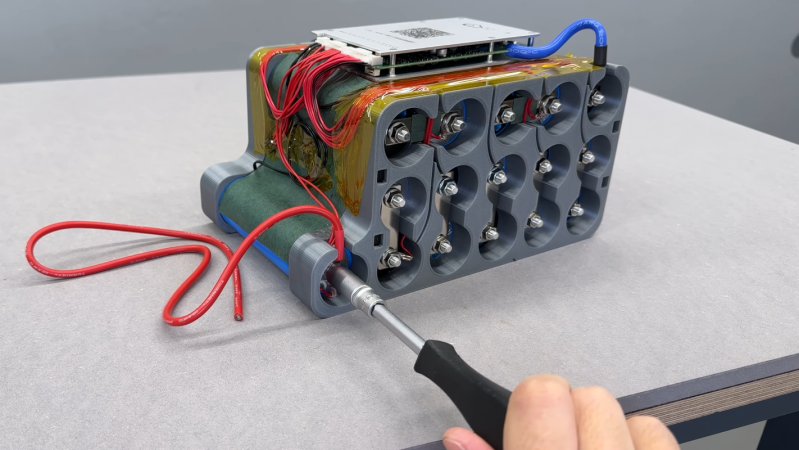
[Well Done Tips] is building this specific type of battery because the lead acid battery in his electric ATV is on the decline. He’s using cylindrical cells that resemble an 18650 battery but are much larger. Beyond the size, though, many of the design principles from building 18650 battery packs are similar, with the exception that these have screw terminals so that bus bars can be easily attached and don’t require spot welding.

With the pack assembled using 3D printed parts, a battery management system is installed with the balance wires cleverly routed through the prints and attached to the bus bars. The only problem [Well Done Tips] had was not realizing that LiFePO4 batteries’ voltages settle a bit after being fully charged, which meant that he didn’t properly calculate the final voltage of his pack and had to add a cell, bringing his original 15S1P battery up to 16S1P and the correct 54V at full charge.

LiFePO4 has a few other upsides compared to lithium ion as well, including that it delivers almost full power until it’s at about 20% charge. It’s not quite as energy dense but compared to the lead-acid battery he was using is a huge improvement, and is one of the reasons we’ve seen them taking over various other EV conversions as well.

Continue reading “Lead Acid Battery Upgraded To Lithium Iron Phosphate”
Converting An Old ATV To Electric Drive

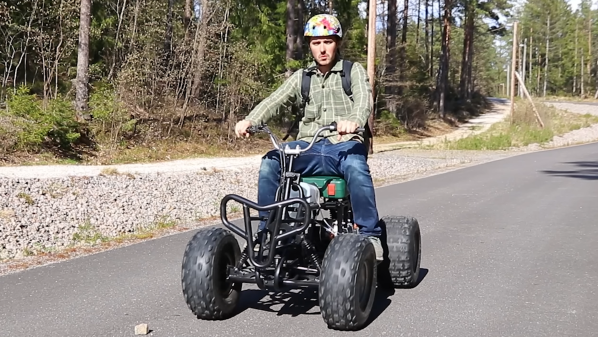
[RCLifeOn] happened upon an old petrol-powered ATV that had seen better days. He decided it was the perfect candidate for a conversion to electric drive.

First up, the chassis was stripped back and cleaned, before being given a fresh coat of paint. It then got fresh valve stems for the tires and was ready for its drivetrain conversion.

The motor of choice is a brushless type, rated for 42 kW at 120 V. [RCLifeOn] doesn’t have batteries capable of maxing out those specs, yet, but carried on with the build. The motor was mounted on the chassis, and a 3D printed hub was installed to get the sprocket on the end of the motor.

A stress test uphill killed the speed controller. This was not unexpected, as it was a cheap unit severely undersized for the application.

The first drive was rough and ready, as the speed controller wasn’t sensored, the gearing wasn’t quite right, and the chain wasn’t very tight. However, it did successfully make it around the grass, slowly. Further improvements then included a water cooling circuit for the speed controller and the addition of a battery compartment. That wasn’t enough to stop the speed controller bursting into flames during a difficult uphill climb, though.

Fundamentally, though, the project shows promise. Bigger batteries, a sensored speed controller, and appropriate gearing should make it a quick beast. 42 kW of power is a good amount for a light ATV, plus there’s the benefit of instant-on torque from an electric motor.

We’ve seen [RCLifeOn] tackle some high-powered electric builds before, like his impressive powered surfboard.  With the right parts, we’re sure he’ll have this thing ripping about at pace before long!

Continue reading “Converting An Old ATV To Electric Drive”

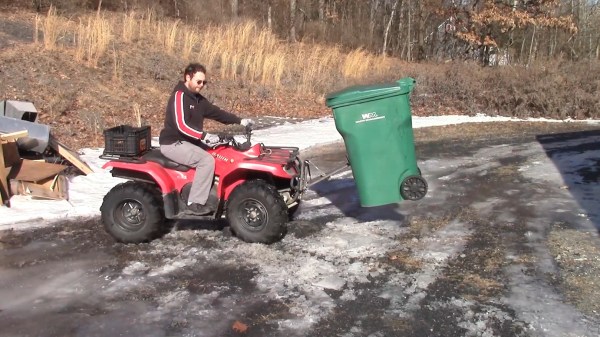
ITman496 in his ATV, using the trashcan lifter to lift a trashcan up in the air. The lifter is a contraption mounted to the front of his ATV, welded together with square tubing

Equipping An ATV With A Trashcan Lifter

[ITman496] is one of us hackers working his way around health problems, in his case, a back injury. He is eager to solve various difficulties he has to deal with, and in case of the video he made, it was about moving a large trashcan through ice-covered roads on his property. Not willing to risk his health any further and dissatisfied with the flimsy solutions for sale requiring him to do the heavy lifting, still, he designed and built a winch-powered trashcan lifter mechanism – not entirely unlike a forklift. He mounted it to his ATV, tested it, improved upon it, filming his progress along the way – and then made a video detailing the entire build for us!

Having sketched the concept on his phone, he modeled and tested it in SketchUp, then cut and welded the parts, describing a welding alignment trick along the way – using 3D-printed joints to hold the two parts-to-be-welded together for tack welds, ensuring nigh-perfect alignment. Initial testing was a success! From there, he describes a good few surprising but in retrospect expected ease-of-use improvements that didn’t crop up during simulations, like adding chamfers to the scoop, so that he doesn’t have to angle his ATV super precisely to pick the trashcan up. In the end, having used it for about a month now, he tells us it’s been working extremely well for his purposes!

Not all such garbage cans need to be taken out, thankfully – some of them go voluntarily, and you can even get smaller ones that catch stuff you throw from across the room. We’ve covered the adventures of [ITman496] before, learning lessons from a failed robot build in 2016., and adopting an ultralight plane in 2018!

Continue reading “Equipping An ATV With A Trashcan Lifter”

Lime SDR (and Pluto, Too) Sends TV

If you have experienced software defined radio (SDR) using the ubiquitous RTL SDR dongles, you are missing out on half of it. While those SDRs are inexpensive, they only receive. The next step is to transmit. [Corrosive] shows how he uses DATV Express along with a Lime SDR or a Pluto (the evaluation device from Analog Devices) to transmit video. He shows how to set it all up in the context of ham radio. An earlier video shows how to receive the signal using an SDR and some Windows software. The receiver will work with an RTL SDR or a HackRF board, too. You can see both videos, below.

The DATV Express software has plenty of options and since SDR if frequency agile, you ought to be able to use this on any frequency (within the SDR range) that you are allowed to use. At the end, he mentions that to really put these on the air you will want a filter and amplifier since the output is a bit raw and low powered.

Continue reading “Lime SDR (and Pluto, Too) Sends TV”

Robot Security Patrol Brings Skynet Closer

autonomous_atv

The students at the University of Oklahoma have put together a robot that will surely join the other drones in our future robot overlord regime. This autonomous vehicle was produced to replace human security patrols which can be both boring and dangerous. Intent on delivering surveillance to most locations, an all terrain vehicle was used as the base. It can navigate by itself through an obstacle avoidance system and communicate video and audio wirelessly. After the break we’ll take a look at the systems that make this work. Continue reading “Robot Security Patrol Brings Skynet Closer”

Autonomous ATV

[youtube=http://www.youtube.com/watch?v=Ja3ND8Pk_0M&hl=en&fs=1]

A team at UNC Charlotte has been working on an autonomous vehicle to drag a cart that has sensing equipment. Starting with a stock Honda ATV, different systems were added to give a Renesas processor control of the ATV.  A model airplane receiver was attached to the Renesas to give remote control for Phase 1 of the project. Basically they’ve turned the ATV into a giant remote controlled car.

Later revisions will incorporate LIDAR, cameras, and multiple GPS units so the ATV can autonomously traverse most terrain with a high level of accuracy. Path planning will become a large part of the project at that point.

Continue reading “Autonomous ATV”

Boxee And Apple TV

boxee

We’ve been following Boxee (not Boxxy) since its public alpha debut last Summer. We were captivated by it. Who expected a project built off of code originally intended for hacked Xboxes would be shown on NBC’s Today Show? We’ve been promised internet connected set top boxes for years, but it seems like Boxee is here to stay for two solid reasons: 1. It’s free. 2. Major content providers have finally figured out how to publish online and Boxee supports them. You can replace your network television with on demand content from Hulu, ABC, and the like.

One of the most affordable platforms currently supported by Boxee is the Apple TV. Lifehacker has a guide for installing Boxee on an Apple TV. You prepare a USB flash drive that is then used to patch the stock firmware. Once installed you can take advantage fun features like downloading torrents directly to the box.