Control Your Camera Remotely With A DS

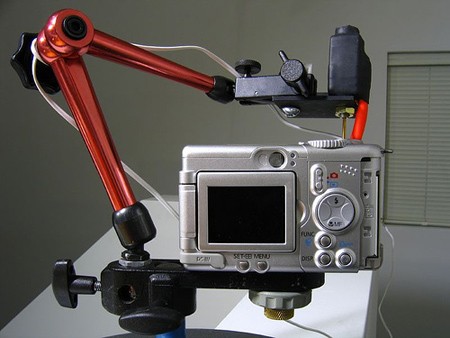
Using a custom built cable connected to the lower GBA slot and a copy of Canon’s SDK, [Steve Chapman] has come up with a very clever way of taking pictures remotely with a Nintendo DS Lite.

Currently the software supports bracket shooting as well as bulb mode. [Steve] points out that he is currently testing an audio based trigger system using the mic built into the DS and the software is still a work in progress.

While the weight saving benefits of using a DS instead of a notebook are obvious, there are things you do give up going this route. Traditionally, when you tether a camera to a computer the photos are saved directly to the computer where you can view the image on a much larger monitor. With the DS, it seems all you can do is remotely trigger the camera. Given the size and resolution of the screens maybe that’s all it can do.

[via Boing Boing Gadgets]

Peek Email Reader Teardown

[morcheeba], who you should remember from CVS camera hacking, picked up a Peek and took some pictures while tearing it down. The Peek is a $100 QWERTY device with a simple OS designed only to check email. The device is being sold by T-Mobile with a $19.95/mo data plan. There’s nothing too spectacular to see other than 16MB of flash memory and a TI OMAP processor.

[via Make]

Surveillance As Art


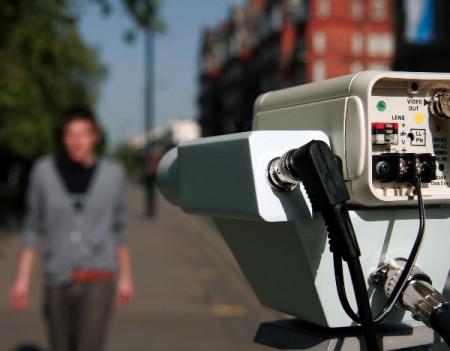
The Target Project is a graduate project from the Royal College of Arts in London. It is designed to make us question our relationship with surveillance technology and CCTV. This is a particularly meaningful demonstration for a country like Britain which is said to contain up to 4.2 million CCTV cameras or roughly 1 for every 14 people.

This project has two demonstrations on their site. The first is dubbed the RTS-2 (Racial Targeting System). This system is essentially a camera which follows faces and is able to analyze and interpret the person’s race. The second is SOLA. This system is able to quickly scan someone and calculate their body mass index then publish this information to the web. Both systems achieve their goal by blatantly pointing out a line in which more surveillance does not equate to more security. They also show the wealth of personal data that can be obtained about a person by a simple camera.

[via we make money not art]

Intervalometers And Timelapse Photography


Time lapse photography can seem out of reach for many of us who don’t have fancy cameras(or a hacked cannon point and shoot). We recently covered using a TI-83 as a timer, and now we’ve gathered a collection of DIY intervalometers to help you get clicking.

Up first, for those of you who don’t want to dismantle your camera, here are some mechanical ones that will work on any camera.

[Simplesimon] has done a fantastic job with this integrated system pictured above. He’s added an adjustable solenoid to click the shutter release. By including a second kit board to handle an RF remote, it has remote single shot capabilities too!

Continue reading “Intervalometers And Timelapse Photography” →

Arduino PhotoLab


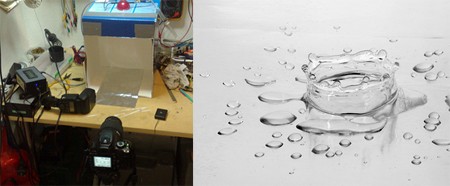
Droplet photography (link translated from French) often produces simple and beautiful images, but timing the exposure can be tricky. Snapping the photo too early or too late can cause you to miss the action, which only lasts a fraction of a second. EquinoxeFR (the people behind the Asus WL500GP audio hack) came up with a solution to this problem using a circuit with an ATmega168 running an Arduino environment. The circuit controls a syringe that contains a liquid and is triggered remotely to release a drop into a darkened chamber. A camera with the shutter open is attached to the chamber, and before the droplet hits, it crosses an IR sensor that triggers the flash to go off a few milliseconds later, capturing the unique crown shape of the impact. No schematic is available as yet, but comments at the bottom of the post suggest one will be coming soon.

Rear View Jacket


Is your popped collar so epic it emulates horse blinders? Are punk teens always skitching your coattails? Are you constantly moonwalking into power poles, trash cans, and the elderly? [Paul Coudamy]’s Hard-Wear Jacket solves all of these problems. It has a micro-camera embedded in the back of the neck and streams live video to a sleeve mounted monitor. The goal is to expand the perception of the wearer and how they interact with the environment. We know this is just a small step and doubt many people will be scrambling to never turn their neck again. It’s something interesting to contemplate though: how will people behave when brain taps allow their peripheral vision to have the same clarity as normal vision?

[via Gizmodo]