Are There Better Things To Hurl Into Orbit Than A Sports Car?

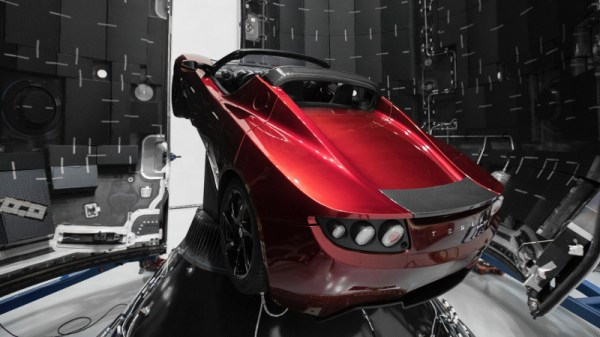
We’ve been having a lively discussion behind the scenes here at Hackaday, about SpaceX’s forthcoming launch of their first Falcon Heavy rocket. It will be carrying [Elon Musk]’s red Tesla Roadster, and should it be a successful launch, it will place the car in an elliptical orbit round the Sun that will take it to the Martian orbit at its furthest point.

On one hand, it seems possible that [Musk]’s sports car will one day be cited by historians as the exemplar of the excesses of the tech industry in the early 21st century. After all, to spend the millions of dollars required to launch the largest reusable space launch platform ever created, and then use it to hurl an electric vehicle into orbit round the Sun seems to be such a gratuitous waste of resources, an act of such complete folly as to be criminal.

Surely even given that there is a reasonable chance of a first launch ending in fiery destruction it must be worth their while canvassing the universities and research institutions of the world with the offer of a free launch, after all there must be a significant amount of science that would benefit from some cost-free launch capacity! It seems a betrayal of the famous “Why explore space” letter from the associate science director of NASA to a nun who questioned the expenditure while so many in the developing world were starving.

Testing

But on the other hand, first launches of rockets are a hazardous endeavour, as the metaphorical blue touchpaper is lit on the world’s largest firework for the first time. Satellites are expensive devices, and it would be a foolhardy owner who entrusted their craft to a launch vehicle with a good chance of a premature splashdown.

Launch of first Arianne 5. Not where you want your pricey satellite.

First launches traditionally carry a ballast rather than a payload, for example NASA have used tanks of water for this purpose in the past. SpaceX has a history of novelty payloads for their test launches; their first Dragon capsule took a wheel of cheese into space and returned it to Earth. We picture Musk looking around a big warehouse and saying, “well, we got a lot of cars!”

There is a fascinating question to be posed by the launch of the car, just what did they have to do to it to ensure that it could be qualified for launch? Satellite manufacture is an extremely exacting branch of engineering, aside from the aspect of ensuring that a payload will work it must both survive the launch intact and not jeopardise it in any way. It’s safe to say that the Roadster will not have to function while in orbit as the roads of California will be far away, but cars are not designed with either the stresses of launch or the transition to zero gravity and the vacuum of space in mind. Will a glass windscreen originally specified for a Lotus Elise on the roads of Norfolk shatter during the process and shower the inside of the craft with glass particles, for example? There must have been an extensive space qualification programme for it to pass, from vibration testing through removal of any hazards such as pressurised gases or corrosive chemicals, if only the folks at SpaceX would share some its details that would make for a fascinating story in itself.

Space Junk

So the Tesla Roadster is a huge publicity stunt on behalf of SpaceX, but it serves a purpose that would otherwise have to have been taken by an unexciting piece of ballast. It will end up as space junk, but in an orbit unlikely to bring it into contact with any other craft. If its space-suited dummy passenger won’t be providing valuable data on the suit’s performance we’d be extremely surprised, and when it is finally retrieved in a few centuries time it will make a fascinating exhibit for the Smithsonian.

Given a huge launch platform and the chance to fill it with a novelty item destined for orbit,the Hackaday team stepped into overdrive with suggestions as to what might be launched were they in charge. They varied from Douglas Adams references such as a heart of gold or a whale and a bowl of petunias should the rocket abort and the payload crash to earth, to a black monolith and a few ossified ape remains to confuse space historians. We briefly evaluated the theory that the Boring Company is in fact a hiding-in-plain-sight construction organisation for a forthcoming Evil Lair beneath the surface of Mars, before concluding that maybe after all the car is a pretty cool thing to use as ballast for a first launch.

It may be reaching towards seven decades since the first space programmes successfully sent rockets beyond the atmosphere with the aim of exploration, but while the general public has become accustomed to them as routine events they remain anything but to the engineers involved. The Falcon Heavy may not have been developed by a government, but it represents every bit as astounding an achievement as any of its predecessors. Flinging an electric vehicle into orbit round the Sun is a colossal act of showmanship and probably a waste of a good car, but it’s also more than that. In hundreds of years time the IoT devices, apps, 3D printers, quadcopters or whatever else we toil over will be long forgotten. But there will be a car orbiting the Sun that remains a memorial to the SpaceX engineers who made its launch possible, assuming it doesn’t blow up before it gets there. What at first seemed frivolous becomes very cool indeed.
Boost Tube Replacement Through 3D Printing

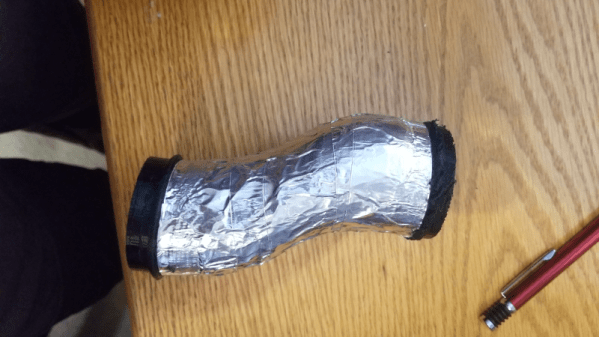
[Sam] is the lucky owner of a 1990 VW Corrado G60. To the uninitiated, that’s the souped-up, go fast version with the fancy supercharger on top. While performing some mods to the air intake (car-speak for “hacks”), there came a need for a custom tube to eliminate the original silencer box. With available options costing up to $400, suddenly 3D printing a replacement seemed like a better answer.

3D printing intake parts for a supercharged vehicle has some unique challenges. The intake must be able to take the boost pressures seen by the engine, in this case up to around 10 psi. There must be no air leaks at all as this risks confusing the sensors that measure how much air is entering the engine. Lastly, the tube must be able to withstand the hot, and often oily environment under the hood.

The first attempt was completed with TPU filament, which unfortunately did not hold pressure. A followup with PLA fared better, but was unable to withstand the heat present in the engine bay. After some experimentation, a successful print was made in PETG which was more robust. In the final design, [Sam] applied a rubber coating and then some aluminum tape, to both help seal any micro-holes in the 3D printed surface as well as help protect against heat.

After over a month of testing, [Sam]’s data logs indicate the tube is performing well and holding boost. It goes to show that with some perseverance and iterative design, 3D printed parts can often save the day.

Perhaps you’re inspired by this hack but need to jack up your car to work on it? Never fear, you can 3D print those too.

Slimline Proximity Fob Makes Life Easier

Modern cars these days tend to come with proximity keys, which allow the driver to unlock and start the vehicle without having to remove the key from one’s pocket. While this is a great usability upgrade, for some reason key fobs continue to be bulky plastic monstrosities that when stuffed into a pocket can easily ruin the lines of a well-chosen outfit. This wasn’t good enough so [Patrick] decided to sort it out.

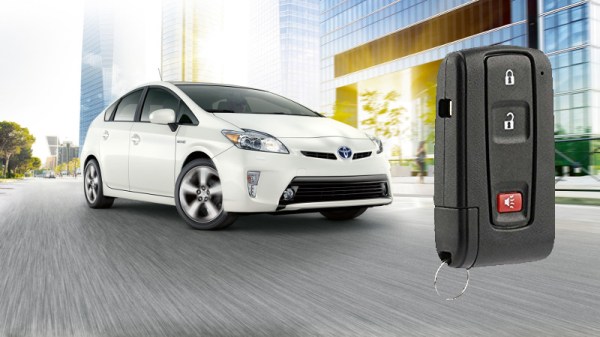
Starting with a Prius key, the first step was to disassemble the already broken key fob and separate out the PCB from the case and battery holder. With those removed, a coin cell was soldered to some wires connected to the PCB. As a substitute for the original case, a plastic card was cut up and the PCB inserted within, allowing the setup to fit neatly in a wallet’s card pocket. Lashings of tape bring the project home.

Unsurprisingly, it works, and works well. It raises the question why key fobs are so large and ungainly, taking up so much precious pocket space. We’d love to see even slimmer takes on this with 3D printed enclosures or even completely redesigned PCBs. Give it a go, and hit up the tip line. Else, check out how key fobs are routinely hacked to steal cars.

Road Apology/Gratitude Emitter Car LED Sign

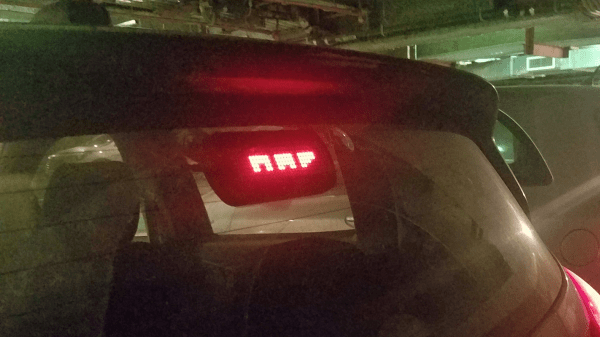
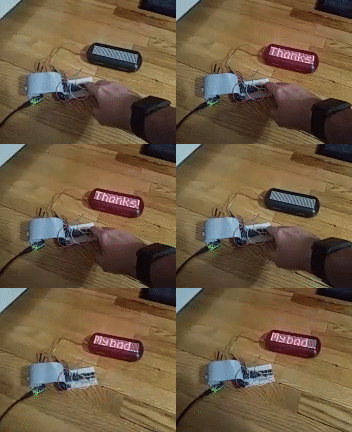
Sometimes, when you’re driving, a simple wave when someone lets you in can go unnoticed and sometimes you make a mistake and a simple wave just isn’t enough. [Noapparentfunction] came up with a nice project to say ‘Thanks’ and ‘My Bad’ to his fellow drivers.

The display uses four Max 7219 LED matrix displays, so the total resolution is 32 by 8. [Noapparentfunction] came up with an inspired idea: using a glasses case to hold the LED matrices and Raspberry Pi. It’s easy to get into if necessary, stays closed, and provides a nice finished look. Having little knowledge of electronics and no programming skills, [Noapparentfunction] had to rely on cutting and pasting Python code as well as connecting a mess of wires together, but the end result works, and that’s what matters.

A network cable runs from the glasses case suction cupped to the rear window to another project box under the dashboard. There, the network cable is connected to two buttons and the power. No network information is passed, the cable is just a convenient collection of wires with which to send signals. Each of the buttons shows a different message on the display.

Depending on where you live, this might not be legal, and we’re sure many of our readers (as well as your author) could come up with some different messages to display. However, this is a cool idea and despite [Noapparentfunction]’s admitted limitations, is a nice looking finished product. Also, its name is Road Apology Gratitude Emitter. Here are some other car mod articles: This one adds some lighting to the foot well and glove compartment and this one on the heinousness of aftermarket car alarms.

Samy Kamkar: Reverse Engineering For A Secure Future

Show of hands: how many of you have parked your car in the driveway, walked up to your house, and pressed your car’s key fob button thinking it would open the front door? We’ve probably all done it and felt a little dopey as a result, but when you think about it, it would be tremendously convenient, especially with grocery bags dangling off each arm and the mail clenched between your teeth. After all, we’re living in the future —  shouldn’t your house be smart enough to know when you’re home?

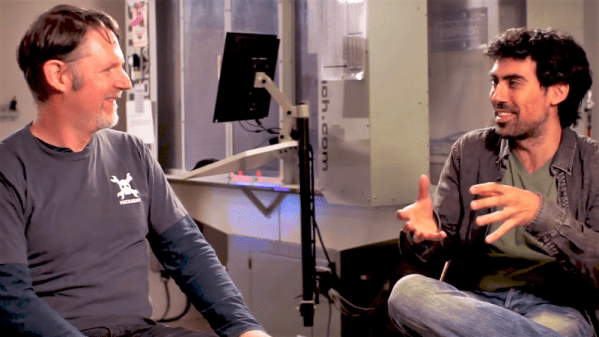
Reverse engineer par excellence Samy Kamkar might think so, but given his recent experiences with cars smart enough to know when you’re standing outside them, he’d probably have some reservations. Samy dropped by the 2017 Hackaday Superconference in November to discuss the finer points of exploiting security flaws in passive car entry systems, and also sat down with our own Elliot Williams after his talk for a one-on-one interview. Samy has some interesting insights on vehicle cybersecurity, but the practical knowledge he’s gained while exploring the limits of these systems teach some powerful lessons about being a real-world reverse engineer.

Continue reading “Samy Kamkar: Reverse Engineering For A Secure Future” →

Turn A Car Into A Game Controller

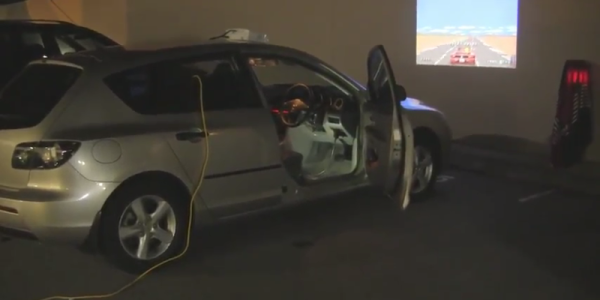
The CAN bus has become a staple of automotive engineering since it was introduced in the late ’80s, but in parallel with the spread of electronic devices almost every single piece of equipment inside a car has been put on the CAN bus. While there are opinions on whether or not this is a good thing, the reality is that enough data is gathered on this bus to turn an unmodified modern car into a video game controller with just a little bit of code.

The core of [Scott]’s project is a laptop and a Python program that scrapes information about the car from the car’s CAN bus, including positions of the pedals and the steering wheel. This information can be accessed by plugging an adapter into the OBD-II port (a standard for all cars made after 1995). From there, the laptop parses the CAN data into keyboard and mouse commands for your video game of choice.

This is an interesting investigation into the nitty-gritty of the CAN bus, but also a less dangerous demonstration of all of the data available from the car than some other cases we’ve seen. At least [Scott]’s Mazda (presumably) lacks any wireless attack vectors!

Continue reading “Turn A Car Into A Game Controller” →

Camping In A…. Corolla?

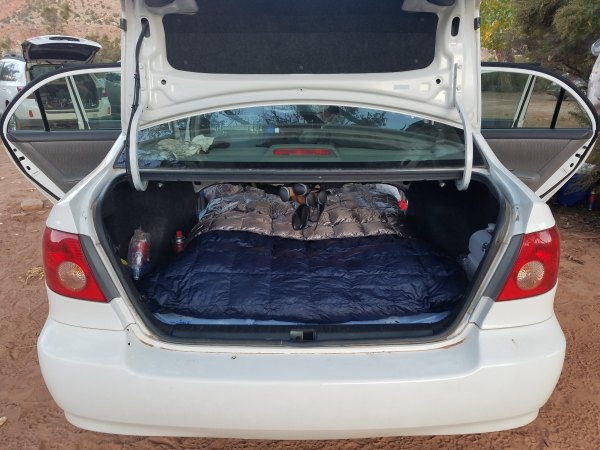
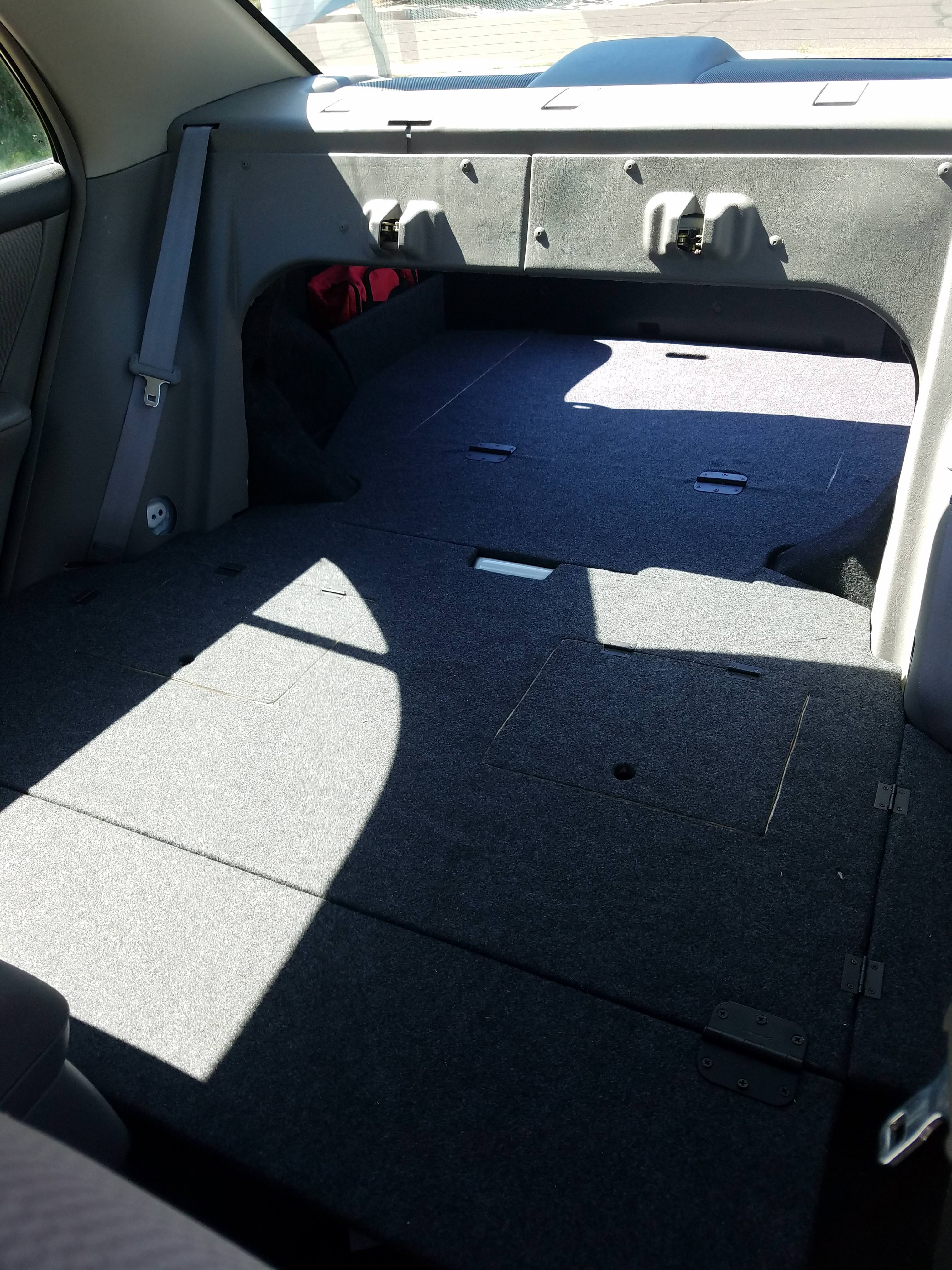
A weekend away camping in the wilds can do wonders for one’s sanity, and the joy of spending it in a recently converted camping vehicle adds to the delight. In a twist on the conventional camper, redditor [Gongfucius] and his wife have converted their 2005 Toyota Corolla into the perfect getaway vehicle for two.

To make enough room, the rear seating had to go, and removing it was deceptively easy. [Gongfucius] was able to build and fit a platform peppered with storage hatches that could snap into place and cover the trunk and backseat — covering it with felt for added comfort. A mattress was cut to size out of five inch memory foam and his wife sewed fitted coverings to them. More storage nooks in the trunk keep necessities at hand.

Continue reading “Camping In A…. Corolla?” →