Firework Ignitors And Controllers Roundup

fireworks ignitor

With the 4th of July around the corner, we thought it would be a good idea to give a controller wrap up and show you how to make some ignitors. Last year we covered a microcontroller based fireworks launcher. If you like the idea of a controller but don’t want to run all the wire, we have the wireless fireworks controller. Adding a little twist to the wireless scene are cell phone triggered fireworks. Maybe controllers are not your cup of tea, you could try to microwave your fireworks. After the break we show you how to make ignitors from a diode and a match.

Continue reading “Firework Ignitors And Controllers Roundup”

EVIC Engine

evic

The EVIC is a computer controlled internal combustion engine, utilizing a cam less solenoid actuated valve system. In addition to intake and exhaust valve control, the processor also handles ignition timing. With dynamic valve timing, it is possible to make an engine more efficient. Where a classic combustion engine would wastefully burn fuel, the EVIC can skip power cycles which are not needed. By increasing the valve duration, the CPU enables easy starting. The latest is the EVIC Mk3 which adds an exhaust valve sensor, and 3:1 solenoid leverage. There is a photo gallery with several EVIC engines. The Mk2 Twin is demonstrated in the video embedded below.

Continue reading “EVIC Engine”

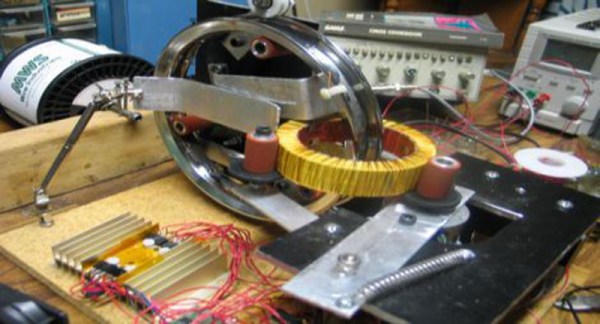
Homemade Toroid Winder

[eclipsed78], built an automatic toroid winder (Internet Archive). The drum splits in order to load the toroid. Then wire is wound on the drum, much like any other coil would be wound. The drum rotates as a slider pulls the wire off the drum, while revolving in and out of the toroid. A side tension keeps the slack out of the wire during operation. The winding coil is stepped as the drum rotates, in order to control the turns ratio. [eclipsed78] created a stepper driver from a schematic, so he could drive the motors. You can watch the winder in operation  as a series of videos. The first of which is embedded below. If you have ever needed to wind a massive toroidal transformer, this is the project for you.

Continue reading “Homemade Toroid Winder”

MIDI Sequencer/controller

lenonluks

Reader, [Lennon Luks] made a really slick  MIDI sequencer/controller for his senior design project while studying at Western Carolina University. It has a grid of 64 LED buttons, 8 knobs, and a display with navigation buttons that allow him to sequence tracks with or without a computer. The controller is based off an ATmega644 and is programmed in C. [Lennon] clearly explains the inner workings of the project in detail on his website and has included a good number of pictures. [Lennon] made a nice video of the project which can be seen after the jump.

Continue reading “MIDI Sequencer/controller”

Atari Xbox 360 Controller

3600

It’s amazing what [Ben Heckendorn] can manage to crank out in just five hours. This time it’s a wireless Xbox 360 controller stuffed inside an Atari 2600 controller. The guts are from a Guitar Hero 3 controller. It’s a fairly compact board and [Ben] used thin ATA wire for the connections. While it doesn’t have all the buttons of a true Xbox controller, this 3600 controller has enough to make it useful in arcade games. The joystick portion was reused without any modification. Things like the guide button and ring of light are located underneath.

Controller Button Marquee

controller_marque

[Ben Heck] posted an interesting one-off project he built many months ago. Video game developer Infinity Ward approached him to build a large display that indicated what buttons on a controller were being pressed. They were planning on using it during player testing by recording the board and the monitor at the same time. They could then compare the two to see if there was any disconnect between the players input and the onscreen action. Infinity Ward is the developer behind games like Call of Duty 4.

[Ben] piggy-backed the switch connections and added an external port. He used a pair of octal buffer ICs to replicate the signals and activate the LEDs. The whole board is powered by the same 3.3V line that’s used by accessories like the chat pad. The triggers have three LEDs each and are lit using a resistor ladder. [Ben] comments that since this is a newer Xbox 360 controller, the active-low button scheme makes it fairly easy to work with. There is a video of the board embedded below. Continue reading “Controller Button Marquee”

Access Controller Demo

[youtube=http://www.youtube.com/watch?v=deeQhm9JmV4&fmt=18]

Embedded above is a review/demo of [Ben Heck]’s Access Controller. The controller is designed for one handed use and has reconfigurable/hackable modules. The reviewer is [BawNeY] a one-handed Major League Gamer. When using a standard controller, he cradles it on his lap, steering with one hand, and hitting the trigger with his elbow. The new controller looks a lot easier to use.