Flux And Solder Paste Dispenser Looks Good While Doing It

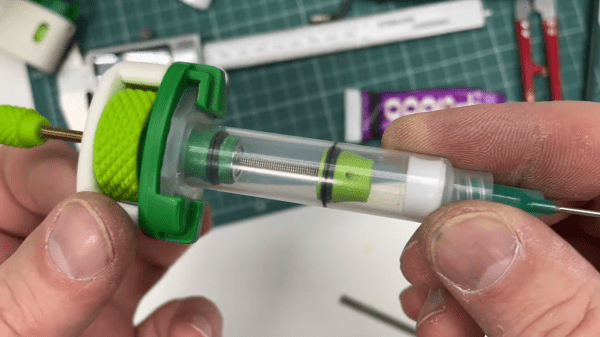
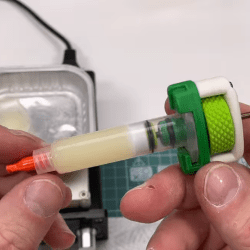
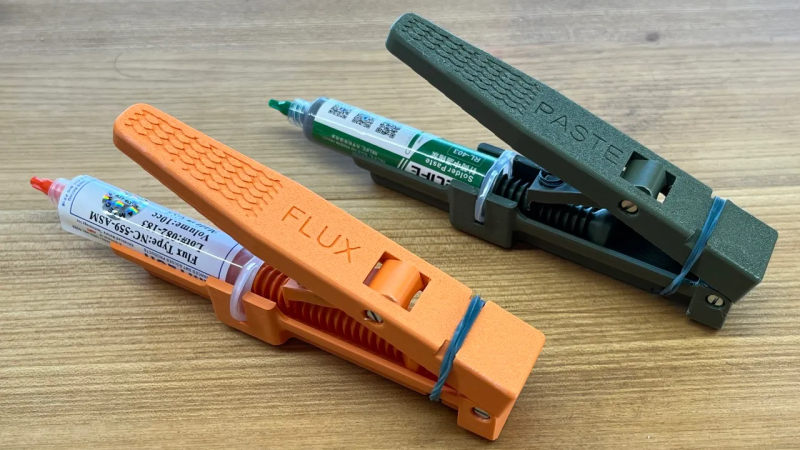
Syringes are pretty ergonomic, but when manually dispensing flux and solder paste it doesn’t take long before one wants a better way. [Elektroarzt]’s flux and solder paste dispenser design uses 3D-printed parts and minimal hardware (mostly M3x20 screws, and an optional spring) to improve handling and control.
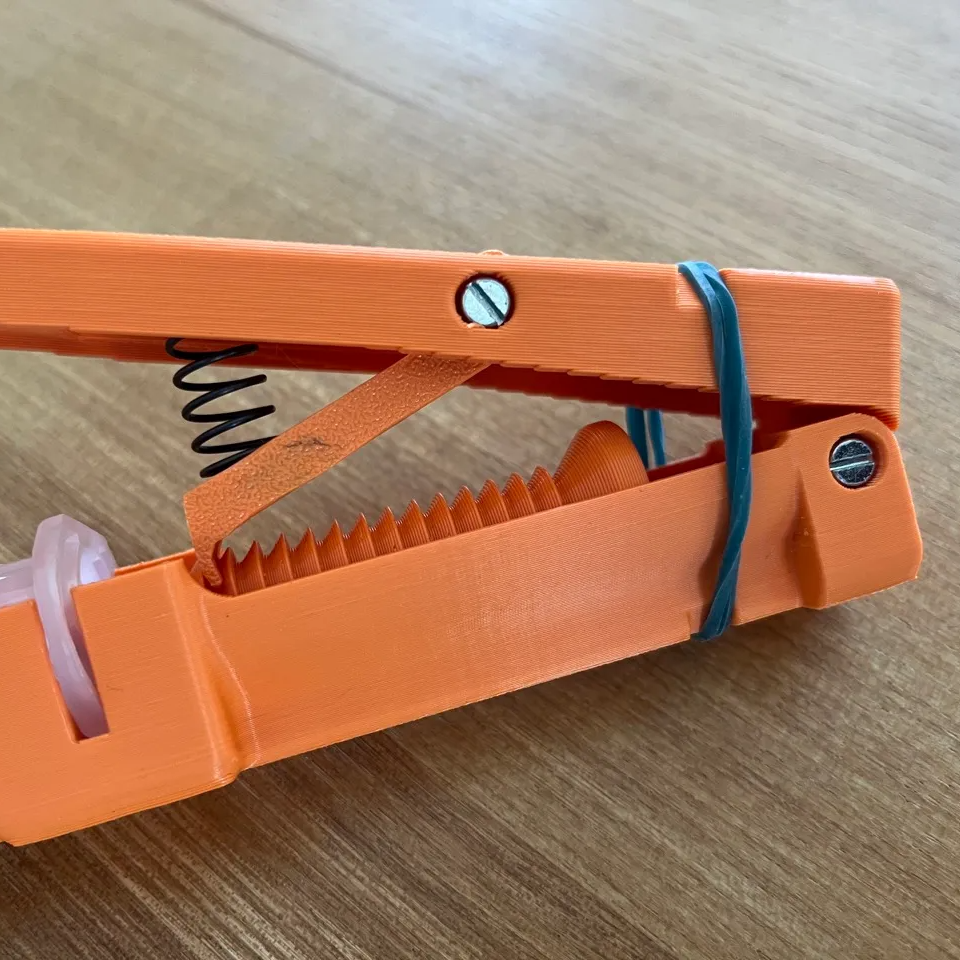
The operating principle is very similar to how a hot glue gun feeds a stick of glue.

How does it work? The ratcheting lever mechanism is similar to that of a hot glue gun, where an arm slips into notches in a rod when pressed down, driving it forward and never backward. In the process, a larger lever movement is translated into a shorter plunger travel, enhancing control.

The types of syringes this tool is meant to be used with have a plunger tip or piston (the rubber stopper-looking part, in contact with the liquid) inside the loaded syringe, but no plunger shaft attached to it. This is common with syringes meant to be loaded into tools or machines, and [Elektroarzt]’s tool can be used with any such syringe in a 10 cc size.

It’s an attractive design, and we like the way syringes top-load as well as the way the tool is made to lay flat on a tabletop, with the lever pointed up.

Want truly fine-grained control over your extrusions? Then check out this dispenser which really lets one dial in small amounts. You can also go motorized, and let a small PCB and stepper motor do the work.

Dark lab setup with scientific looking drink dispenser

Scared For A Drink?

Halloween is about tricks and treats, but who wouldn’t fancy a bit to drink with that? [John Sutley] decided to complete his Halloween party with a drink dispenser looking as though it was dumped by a backstreet laboratory. It’s not only an impressive looking separating funnel, it even runs on an Arduino. The setup combines lab glassware, servo motors, and an industrial control panel straight from a process plant.

The power management appeared the most challenging part. The three servos drew more current than one Arduino could handle. [John] overcame voltage sag, brownouts, and ghostly resets. A healthy 1000 µF capacitor across the 5-volt rail fixed it. With a bit of PWM control and some C++, [John] managed to finish up his interactive bar system where guests could seal their own doom by pressing simple buttons.

This combines the thrill of Halloween with ‘the ghost in the machine’. Going past the question whether you should ever drink from a test tube – what color would you pick? Lingonberry juice or aqua regia, who could tell? From this video, we wouldn’t trust the bartender on it – but build it yourself and see what it brings you!

Continue reading “Scared For A Drink?”

Building A Semi-Auto Cookie Dough Gun

Are you a chocolate chip cookie connoisseur? Do you want to eat more cookies than you probably should at the push of a button? Don’t worry, [Startup Chuck] has got you covered with his semi-automatic cookie dough dispenser.

[Startup Chuck] tries several ways of dispensing dough, some of which more explosive than others. Turns out that a homemade pneumatic extruder doesn’t exactly rhyme with “safety”. The other methods are more promising dough though, and an empty caulk tube sourced from Amazon and a motorized caulking gun demonstrate a less dangerous, more effective way to dispense dough.

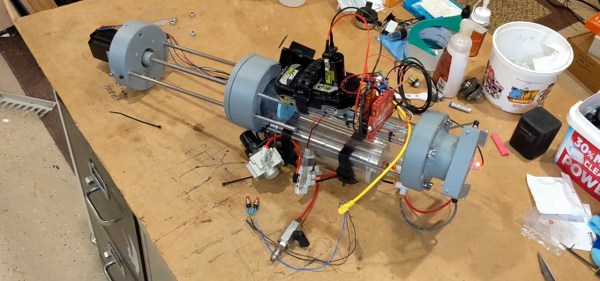
Inspired by this approach, he started development of a servo-driven extruder. It uses store-bought dough cylinders in a sleek metal and acrylic contraption that is then treated with the requisite big mess of wires any good project has. As the dough is extruded, an optical sensor detects how far the dough has moved and it uses sufficiently violent pneumatics to slice the dough, which has the fun side effect of launching pucks of cookie dough at the user.

If you like the idea of edible extrusions, but aren’t so concerned about the rapid-fire element of this project, the concept isn’t unlike some of the food printers we’ve covered.

Continue reading “Building A Semi-Auto Cookie Dough Gun”

Helmke-Part-Counter Dispensing Parts

Dispense 60 Bolts In 2.3 Seconds

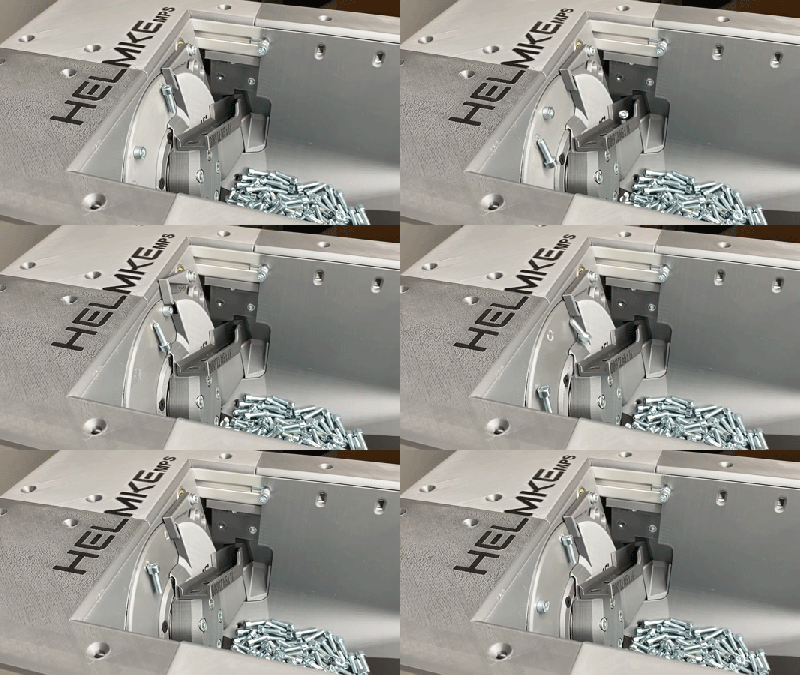
We’ve covered a number of projects that assist makers who need to fill orders for their small businesses, or kitting. [Helmke] has sorted thousands of pieces of hardware that they include with 3D printed parts sold online. They have been developing an alternative, a modular system for sorting and packaging specific quantities of parts.

Animated GIF of Helmke-Part-Counter Sorting Parts

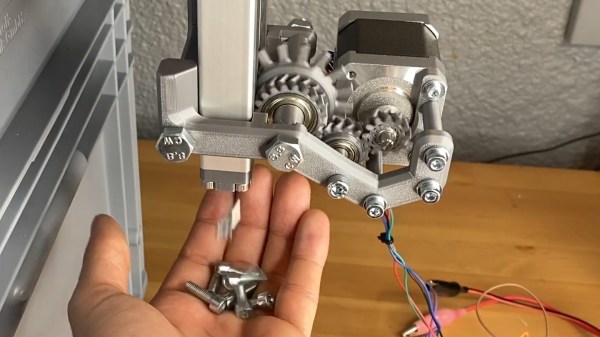
After the break, check out the latest video from their small but growing channel for a very clear walk-through of the counting system they’ve been iterating on. The 2nd video in the series explores solenoids, Geneva drives, and ultimately a sprocket to dispense a variable number of bolts from the sorting machine. The approach gives consistent results, easily to vary quantities, and is fast! These videos are also rich with lots of small details you might want to explore on your own like magnetic part feeding, discussions of different sensors for detecting and counting parts, 3D printed gear box designs, and we love the use of stackable crates for project enclosures.

We hope to see more videos from [Helmke] in the series as the project matures for deeper dives into the existing mechanisms and new features they develop next. Hungry for more? We’ve brought you everything from cutting and stripping wire, to SMD tape, to resistors, to laser-cut parts. Continue reading “Dispense 60 Bolts In 2.3 Seconds”

A wooden scary face dispensing candy through its mouth

Automatic Candy Dispenser Takes The Hard Work Out Of Halloween

Halloween may be behind us, but we couldn’t resist showing you [Mellow]’s latest project: an automatic candy dispenser that takes the hard work out of serving trick-or-treaters. It’s a cool build that might serve as an inspiration for next year’s Halloween project, or perhaps for a different occasion altogether: think birthday parties or Valentine’s Day. After all, when’s a bad time to give sweet treats to someone you love?

The basic concept is a scary face, made of wood, that disgorges a set amount of candy through its mouth after you press its nose. The dispensing mechanism is made from 3D printed mechanical parts as well as a piece of drain pipe. Candy is stored in the pipe, with a servo-operated flap releasing a set amount each time the nose is pressed. [Mellow] cleverly designed the flap to be somewhat flexible, so that it wouldn’t crush any candy bars that got stuck between it and the pipe.

A Wemos D1 Mini reads out the nose switch and drives the candy-dispensing servo, as well as a further two servos that swivel the eyes left and right for an additional visual effect. The original idea was to have the eyes swiveling all the time, but because the mechanism turned out to be quite loud [Mellow] changed the code to only move them during the candy-dispensing process.

We’ve seen several designs for automated candy dispensers over the years, ranging from a Jack-o-Lantern that holds enough candy to feed a small city, to a beautifully over-engineered machine more suitable as a Valentine’s Day gift.

Continue reading “Automatic Candy Dispenser Takes The Hard Work Out Of Halloween”

DIY Mechanical Flux Dispenser Syringe Has Fine Control

[Perinski]’s design for a mechanical flux dispenser uses some common hardware and a few 3D printed parts to create a syringe with fine control over just how much of the thick stuff gets deposited. The design is slick, and there’s a full parts list to accompany the printed pieces. [Perinski] even has some useful tips on how to most effectively get flux into 5 mL syringes without making a mess, which is a welcome bit of advice.

There is also a separate companion design for a magnetic syringe cap. Not only does it have an O-ring to keep things sealed and clean, but the tip of the cap has a magnet embedded into it, so that it can be stowed somewhere safe while the dispenser is in use, and doesn’t clutter the workspace.

This is all a very interesting departure from the design of most syringe dispensers for goopy materials, which tend to depend on some kind of pneumatic action. Even so, we’ve also seen that it’s possible to have a compact DIY pneumatic dispenser that doesn’t require a bulky compressor.

If you can’t quite figure out how the ergonomics of [Perinski]’s design are intended to work one-handed, you’re not alone. One holds the syringe in their hand, and turns the large dial in small increments with a thumb to control extrusion. [Perinski] demonstrates it close-up around the 4:50 mark, but if you have a few minutes it is worth watching the entire video, embedded below.

Continue reading “DIY Mechanical Flux Dispenser Syringe Has Fine Control”

Solder Paste Dispenser Without Giant Compressor

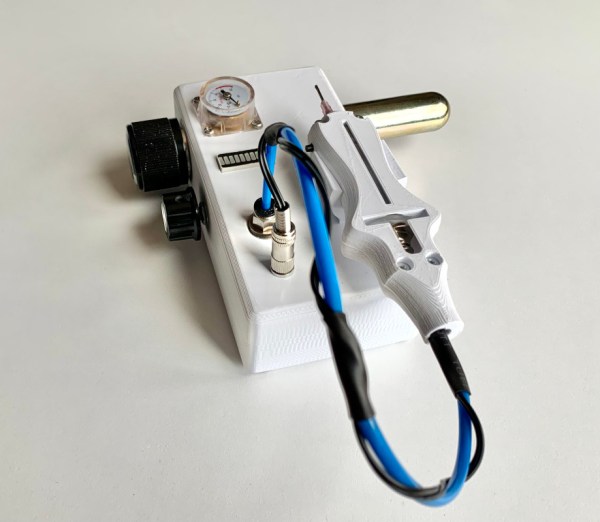
We have certainly all had our moments with solder paste. Some of us hate it; it’s sticky and gooey, and it gets everywhere. That is, unless you have a solder paste dispenser. The trouble with these is that they typically require the use of an air compressor, which can be cumbersome to haul around in certain situations. If you need a solder paste dispenser that fits conveniently where air compressors won’t, take a look at this small one from [Nuri Engineer] called the solderocket.

This design foregoes the traditional compressor in favor of pressurized carbon dioxide canisters. These are common enough and used for things like rapidly inflating bicycle tires, but for this more delicate procedure the pressurized gas needs to be handled more daintily. A rotary knob is attached to the canister to regulate pressure, and a second knob attached to a microcontroller adjusts the amount of time the air pressure is applied to the solder paste. With this small compact setup, any type of paste can be delivered to a PCB without needing to use messy stencils or needing larger hardware like a compressor.

This could be just the tool that you need if you regularly work with surface-mount components. Of course there are other methods of dispensing solder paste that don’t require any compressed gas of any kind, but as long as something is around that gets the job done, we can’t really argue with either method.