Quick Tip Improves Seven-Segment LED Visibility

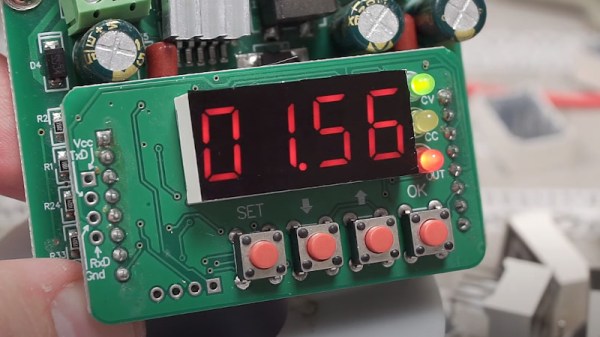
We’re suckers for a nice seven-segment LED display around these parts, and judging by how often they seem to pop up in the projects that come our way, it seems the community is rather fond of them as well. But though they’re cheap, easy to work with, and give off that all important retro vibe, they certainly aren’t perfect. For one thing, their visibility can be pretty poor in some lighting conditions, especially if you’re trying to photograph them for documentation purposes.
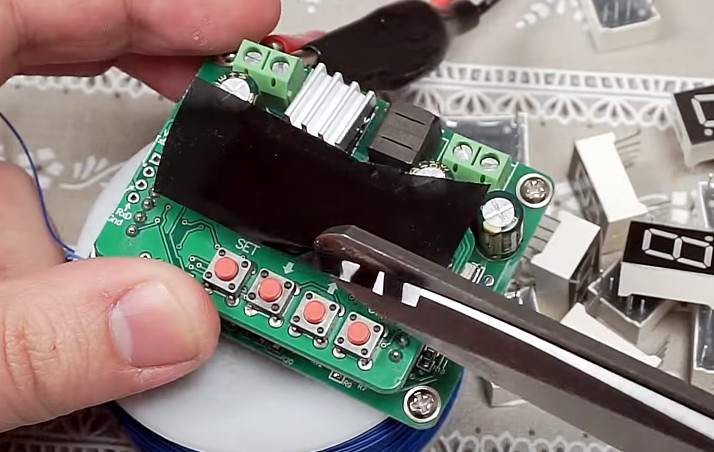
The tint film can be cut to size once applied.

If this is a problem you’ve run into recently, [Hugatry] has a simple tip that might save you some aggravation. With a scrap piece of automotive window tint material, it’s easy to cut a custom filter that you can apply directly to the face of the display. As seen in the video, the improvement is quite dramatic. The digits were barely visible before, but with the added contrast provided by the tint, they stand bright and beautiful against the newly darkened background.

[Hugatry] used 5% tint film for this demonstration since it was what he already had on hand, but you might want to experiment with different values depending on the ambient light levels where you’re most likely to be reading the display. The stuff is certainly cheap enough to play around with — a quick check seems to show that for $10 USD you can get enough film to cover a few hundred displays. Which, depending on the project, isn’t nearly as overkill as you might think.

Continue reading “Quick Tip Improves Seven-Segment LED Visibility”
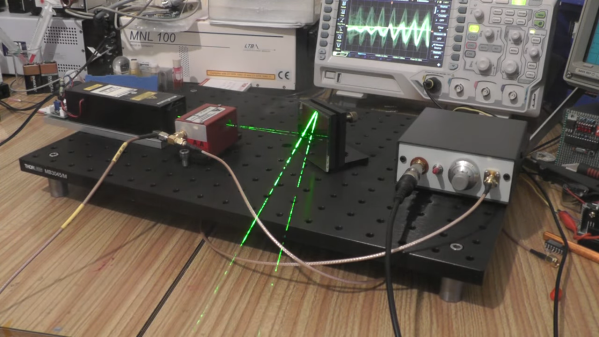
An acousto-optic tunable filter and laser

Acousto-Optic Filter Uses Sound To Bend Light

We all know that light and sound are wave phenomena, but of very different kinds. Light is electromechanical in nature, while sound is mechanical. Light can travel through a vacuum, while sound needs some sort of medium to transmit it. So it would seem that it might be difficult to use sound to modify light, but with the right equipment, it’s actually pretty easy.

Easy, perhaps, if you’re used to slinging lasers around and terms like “acousto-optic tunable filter” fall trippingly from your tongue, as is the case for [Les Wright]. An AOTF is a device that takes a radio frequency input and applies it to a piezoelectric transducer that’s bonded to a crystal of tellurium oxide. The RF signal excites the transducer, which vibrates the TeO2 crystal and sets up a standing wave within it. The alternating bands of compressed and expanded material within the crystal act like a diffraction grating. Change the excitation frequency, and the filter’s frequency changes too.

To explore the way sound can bend light, [Les] picked up a commercial AOTF from the surplus market. Sadly, it didn’t come with the RF driver, but no matter — a few quick eBay purchases put the needed RF generator and power amplifier on his bench. The modules went into an enclosure to make the driver more of an instrument and less of a one-off, with a nice multi-turn pot and vernier knob for precise filter adjustment. It’s really kind of cool to watch the output beam change colors at the twist of a knob, and cooler still to realize how it all works.

We’ve been seeing a lot of [Les]’ optics projects lately, from homemade TEA lasers to blasting the Bayer filter off a digital camera, each as impressive as the last! Continue reading “Acousto-Optic Filter Uses Sound To Bend Light”

Laser Focus Made Easier With IR Filter

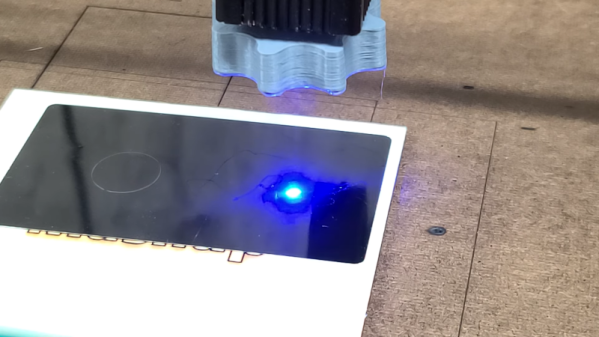
If you’ve used a diode laser engraver or cutter, you know that focus is critical. You’d think it would be relatively simple to get a sharp focus, but it isn’t that simple. [Makers Mashup] shows in a video how to use an adjustable IR filter to cut out all the light bleed to get a sharp image to make focusing simpler.

The filter he shows adjusts from 530nm to 750nm and is made to screw into a 72mm lens, but it works fine with your eyeballs, too. [Makers Mashup] says he’ll eventually make a stand for it so he can look through it with both hands free.

Continue reading “Laser Focus Made Easier With IR Filter”

How Researchers Used Salt To Give Masks An Edge Against Pathogens

Masks are proven tools against airborne diseases, but pathogens — like the COVID-19 virus — can collect in a mask and survive which complicates handling and disposal. [Ilaria Rubino], a researcher at the University of Alberta, recently received an award for her work showing how treating a mask’s main filtration layer with a solution of mostly salt and water (plus a surfactant to help the wetting process) can help a mask inactivate pathogens on contact, thereby making masks potentially re-usable. Such masks are usually intended as single-use, and in clinical settings used masks are handled and disposed of as biohazard waste, because they can contain active pathogens. This salt treatment gives a mask a kind of self-cleaning ability.

Analysis showing homogenous salt coating (red and green) on the surface of fibers. NaCl is shown here, but other salts work as well.

How exactly does salt help? The very fine salt coating deposited on the fibers of a mask’s filtration layer first dissolves on contact with airborne pathogens, then undergoes evaporation-induced recrystallization. Pathogens caught in the filter are therefore exposed to an increasingly-high concentration saline solution and are then physically damaged. There is a bit of a trick to getting the salt deposited evenly on the polypropylene filter fibers, since the synthetic fibers are naturally hydrophobic, but a wetting process takes care of that.

The salt coating on the fibers is very fine, doesn’t affect breathability of the mask, and has been shown to be effective even in harsh environments. The research paper states that “salt coatings retained the pathogen inactivation capability at harsh environmental conditions (37 °C and a relative humidity of 70%, 80% and 90%).”

Again, the salt treatment doesn’t affect the mask’s ability to filter pathogens, but it does inactivate trapped pathogens, giving masks a kind of self-cleaning ability. Interested in the nuts and bolts of how researchers created the salt-treated filters? The Methods section of the paper linked at the head of this post (as well as the Methods section in this earlier paper on the same topic) has all the ingredients, part numbers, and measurements. While you’re at it, maybe brush up on commercially-available masks and what’s inside them.

Trick From 1903 Makes An Old Monochrome TV Spit Some Colours

Its safe to say that colour television is taken for granted nowadays. Consumed by the modern marketing jargon of colour dynamic range, colour space accuracy and depth, it is easy to overlook the humble beginnings of image reproduction when simply reconstructing an image with the slightest hint of colour required some serious ingenuity and earned you a well deserved pat on the back!

[anfractuosus] revisited an old gem of a technique, first patented in 1903 and used it to successful make an old monochrome TV produce a colour image. The idea in essence, is actually similar to what cheap image sensors and LCDs still use today. Rather than relying on true RGB colour generation by individually integrating colour sources as AMOLED does, we take an easier route: Produce a simpler monochrome image where each colour pixel is physically represented by four monochrome sub-pixels, one for each colour component. Now light up each of the sub-pixels according to the colour information of your image and rely on an external colour filter array to combine and spit out the correct colours.

He first used some image processing to convert a standard colour video into the aforementioned monochrome sub-pixel representation. Next, a Bayer colour filter array was printed on some acetate sheets using an inkjet printer (the original inventors used potato starch!), which when overlaid on top of the monochrome monitor, magically result in colour output.

There are some problems associated with this technique, mainly to do with the difficulty in measuring the size of the TV pixels and then producing and perfectly aligning a filter sheet for it. You should check out how [anfractuosus] went about solving those issues.

So now you know a bit more about colour image generation, but how about colour TV transmission? Check out an earlier piece to learn more.

Continue reading “Trick From 1903 Makes An Old Monochrome TV Spit Some Colours”

CNC Plasma Cutter Filter Gets The Slag Out

No matter what kind of tools and materials you use in your shop, chances are pretty good that some process is going to release something that you don’t want to breathe. Table saw? Better deal with that wood dust. 3D-printer? We’ve discussed fume control ad nauseam. Soldering? It’s best not to inhale those flux fumes. But perhaps nowhere is fume extraction more important than in the metal shop, where vaporized bits of metal can wreak respiratory havoc.

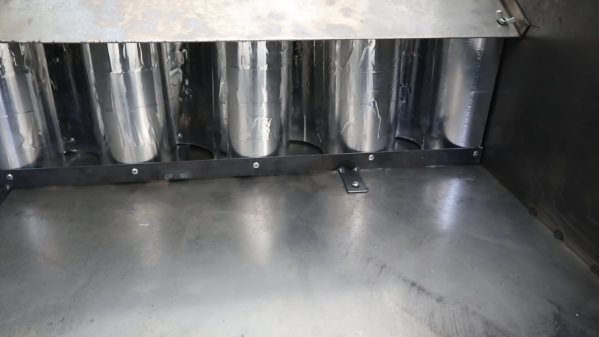
Reducing such risks was [Shane Wighton]’s rationale behind this no-clean plasma cutter filter. Rather than a water table to collect cutting dross, his CNC plasma cutter is fitted with a downdraft table to suck it away. The vivid display of sparks shooting out of the downdraft fans belied its ineffectiveness, though. [Shane]’s idea is based on the cyclonic principle common to woodshop dust collectors and stupidly expensive vacuum cleaners alike. Plastic pipe sections, split in half lengthwise and covered in aluminum tape to make them less likely to catch on fire from the hot sparks, are set vertically in the air path. The pipes are arranged in a series of nested “S” shapes, offering a tortuous path to the spark-laden air as it exits the downdraft.

The video below shows that most of the entrained solids slow down and drop to the bottom of the filter; some still pass through, but testing with adhesive sheets shows the metal particles in the exhaust are much reduced. We like the design, especially the fact that there’s nothing to clog or greatly restrict the airflow.

Looking for more on CNC plasma cutter builds? We’ve got you covered, from just the basics to next-level.

Continue reading “CNC Plasma Cutter Filter Gets The Slag Out”

Hacked Protective Gear Keeps Doctor Safe In The Hot Zone

It’s rarely a wise idea to put a plastic bag over one’s head, but when the choice is between that and possibly being exposed to a dangerous virus, you do what you have to. So you might as well do it right and build a field-expedient positive pressure hood.

We’ve all been keeping tabs on the continuing coronavirus outbreak in China, but nobody is following as closely as our many friends in China. Hackaday contributor [Naomi Wu] is in from Shenzhen, posting regularly from the quarantined zone, and she found this little gem of ingenuity from a [Doctor Cui] in one of the hospitals in Wuhan. Quarantines and travel restrictions have put personal protective equipment like masks and gowns in limited supply, with the more advanced gear needed by those deal most closely with coronavirus patients difficult to come by.

There’s no build information, but from the pictures we can guess at what [Dr. Cui] came up with. The boxy bit is an AirPro Car, a HEPA filter meant to clean the cabin air in a motor vehicle. He glued on a USB battery pack to power it, used a scrap of plastic and some silicone adhesive to adapt a heat-moisture exchange filter from a mechanical ventilator to the AirPro’s outlet, and stuck the tube into a plastic bag sealed around his neck. The filter provides dry, positive pressure air to keep the bag from fogging up, and to keep [Dr. Cui] from asphyxiating. Plus he’s protected from droplet contact, which is a big plus over simple paper masks.

With the news always so dark, it’s heartening to see stories of ingenuity like this. We wish [Dr. Cui] and all our friends in China the best during this outbreak.