IoTP: The Internet Of Toilet Paper

Our first impression of this IoT toilet paper roll was that somebody was pulling our leg. Watching the infomercial-esque video below is alternately hilarious and horrifying, but it leaves you with the unmistakable feeling that this is all a joke, and a pretty good one at that.  Right up until you get to the big Kimberly-Clark logo at the end, that is, and you realize that the international paper concern must be looking at this seriously.

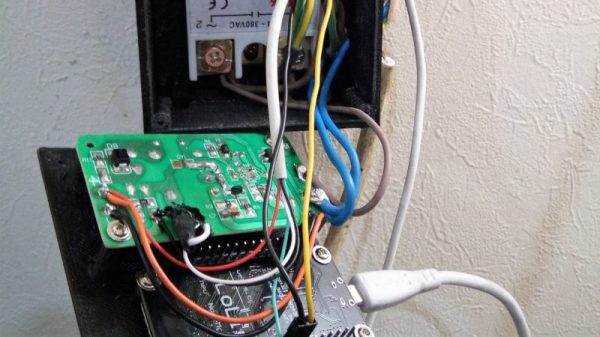
When you read [zvizvi]’s Instructables post, you find out that this project is indeed a legitimate attempt to meld an Amazon Dash button with your toilet paper dispenser. For his proof-of-concept build, [zvizvi] started with a gag “talking TP” roll off eBay, designed to play back a voice clip when the paper is used. It had all the right guts, and being just the size for a Wemos Mini and an accelerometer for motion detection was a bonus. The smart spindle can tally the amount of paper used, so you’ll never be caught without a square to spare. And of course, critical TP usage parameters are uploaded to a cloud server, so that more toilet paper can be rushed to your door when you’re getting low.

The whole idea, including justification based on monitoring TP use as a proxy for bowel health, seems ridiculous, but we suspect there may be some brilliance here. Joke if you will, but in the end it’s probably better than an Internet of Farts.

Continue reading “IoTP: The Internet Of Toilet Paper”

Dumb Box? Make It Really Smart!

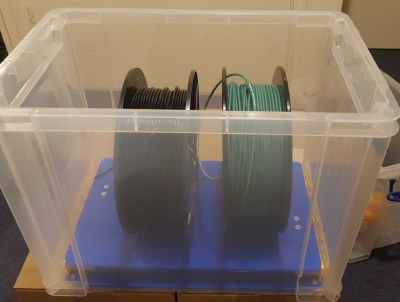
[Stephen Harrison]’s Really Smart Box is a great concept, it’s simultaneously a simple idea while at the same time being super clever. The Really Smart Box isn’t really a box; it’s a drop-in platform that can be made any size, intended to turn any dumb storage box into one that helps manage and track levels and usage of any sort of stock or consumable.

It does this by measuring the weight of the stuff piled on top of it, while also monitoring temperature and humidity. The platform communicates this information wirelessly to a back end, allowing decisions to be made about stock levels, usage, and monitoring of storage conditions. It’s clearly best applied to consumables or other stock that comes and goes. The Really Smart Box platform is battery-powered, but spends most of its time asleep to maximize battery life. The prototype uses the SigFox IoT framework for the wireless data, which we have seen before in a wireless swimming pool monitor.

This is still just a prototype and there are bugs to iron out, but it works and [Stephen] intends to set-and-forget the prototype into the Cambridge Makespace with the task of storing and monitoring 3D printer filament. A brief demo video is embedded below.

Continue reading “Dumb Box? Make It Really Smart!”

IoT Garage Door Opener From Scrap

[Hans Nielsen] has a couple roommates, and his garage has become a catch-all for various items. And like any good hacker’s garage, it boasts an IoT controlled garage door opener. It had a problem though, it used a Particle Photon – a popular IoT board that required internet access and a web server to operate. So [Hans] raided his roommate’s spare parts bin and set-forth to rebuild it!

One of his main goals was to make something that did not require internet access to operate. Anyone connected to the local WiFi should be able to open and close the door via a web interface, and he would give our good friend [Linus Torvalds] a call to make it happen. The key component in the build is the C.H.I.P SBC that made the news a while back for being ridiculously cheap.

Be sure to check out [Han’s] blog if you’re at all interested in working with the C.H.I.P. He does a fantastic job of documenting the ins and outs of getting a project like this working.

Repair Job Fixes Compressor, Gets It Online

We’ll never cease to be amazed at the things people try to put on the Internet of Things. Some are no-brainers, like thermostats, security cameras, and garage door openers. Others, like washing machines and refrigerators, are a little on the iffy side, but you can still make a case for them. But an IoT air compressor? What’s the justification for such a thing?

As it turns out, [Boris van Galvin] had a pretty decent reason for his compressor hacks, and it appears that the IoT aspect was one of those “why not?” things. Having suffered the second failure of his compressor’s mechanical pressure switch in a year, and unwilling to throw good money after the $120 that went into replacing the first contactor, [Boris] looked for a cheaper and more interesting way to control the compressor. An ESP8266 dev board made interfacing the analog pressure sensor a snap, and while he was at it, [Boris] added a web interface with a nice graphical air pressure gauge and some on-off controls. Now he can set the pressure using his phone and switch it off in the middle of the night without going outside. That’s an IoT win right there.

No air compressor? No worries — build your own from an old fridge. The non-IoT kind, preferably.

The Internet Of Jack-O’-Lanterns

As the candy rush fades, the Halloween hacks continue pouring in. [Jeremy S Cook] has taken a few fundamental concepts and dressed them up inside the smartest pumpkin on the block.

This pumpkin has a WEMOS D1 Mini ESP8266 brain, LED eyes in place of a candle for illumination, and a small USB power bank for power. The code [Cook] is using is a modified sketch by YouTuber [Innovative Tom], which creates a server on your network — don’t forget to insert your network credentials! — that enable control of the LEDs from your computer or smart phone.

[Cook] has wired the LEDs to the relevant pins on the D1 Mini, zip-tied the battery and board together and stuff them in a plastic bag to keep them dry. Stick that into the pumpkin, hot glue the LEDs in place, and test it out!

Continue reading “The Internet Of Jack-O’-Lanterns”

Review: IoT Data Logging Services With MQTT

For the last few months, I had been using Sparkfun’s Phant server as a data logger for a small science project. Unfortunately, they’ve had some serious technical issues and have discontinued the service. Phant was good while it lasted: it was easy to use, free, and allowed me to download the data in a CSV format. It shared data with analog.io, which at the time was a good solution for data visualization.

While I could continue using Phant since it is an open-source project and Sparkfun kindly releases the source code for the server on Github, I thought it might be better to do some research, see what’s out there. I decided to write a minimal implementation for each platform as an interesting way to get a feel for each. To that end, I connected a DHT11 temperature/humidity sensor to a NodeMCU board to act as a simple data source.

Continue reading “Review: IoT Data Logging Services With MQTT”

Don’t Miss The Bus: A One-Day Build

Sometimes the most satisfying hacks are those that spring from a situation where resources are limited, either by choice or by chance. Constraints tend to stir the creative juices.

Serial Hackaday poster [limpkin] limited himself to a one-day build with what he had on hand for this bus-route countdown timer. Full points for actually building something useful, and extra credit for making something to keep his wife from being late for work.

The principle is simple: scrape a web page to find out how much time is left before either of two busses leaves his wife’s stop, and display the number of minutes left on a huge LED display. The parts bin gave up everything needed, including an ESP8266, a boost converter, a charge controller, and the display and driver. We’re skeptical that the PCB was fabricated the same day; looks like [limpkin] is only counting the design and coding time in his 10-hour build. Still, it’s a testament to what’s possible with a deep inventory and the skills to put it to use.

Check out some of [limpkin]’s other hacks, like this Formula-E race car PCB or his adventures in laundry larceny. Oh, and he also used to write for Hackaday.