How Does Starlink Work Anyway?

No matter what you think of Elon Musk, it’s hard to deny that he takes the dictum “There’s no such thing as bad publicity” to heart. From hurling sports cars into orbit to solar-powered roof destroyers, there’s little that Mr. Musk can’t turn into a net positive for at least one of his many ventures, not to mention his image.

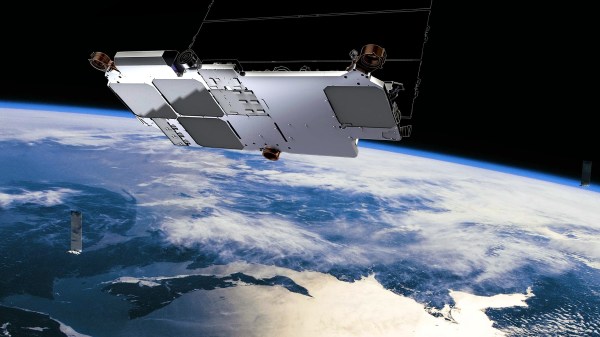
Elon may have gotten in over his head, though. His plan to use his SpaceX rockets to fill the sky with thousands of satellites dedicated to providing cheap Internet access ran afoul of the astronomy community, which has decried the impact of the Starlink satellites on observations, both in the optical wavelengths and further down the spectrum in the radio bands. And that’s with only a tiny fraction of the planned constellation deployed; once fully built-out, they fear Starlink will ruin Earth-based observation forever.

What exactly the final Starlink constellation will look like and what impact it would have on observations depend greatly on the degree to which it can withstand regulatory efforts and market forces. Assuming it does survive and gets built out into a system that more or less resembles the current plan, what exactly will Starlink do? And more importantly, how will it accomplish its stated goals?
Continue reading “How Does Starlink Work Anyway?”

Star Wars Themed Laser Badge: All That Is Missing Is The Pew Pew Sound Effect

In the quest to advance the art of the electronic badge, the boundaries of what is possible to manufacture in small quantities are continually tested. Full-colour PCBs, injection moulding, custom keyboards, and other wow factor techniques have all been tried, leading to some extremely impressive creations. With all this innovation then it’s sometimes easy to forget that clever design and a really good idea can produce an exceptional badge with far more mundane materials.

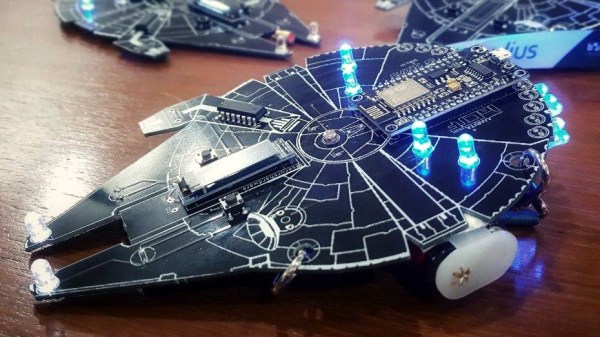
The 10th InCTF cybersecurity contest held at Amrita, Kerala, India, had a Star Wars themed badge designed by Team bi0s for the event. It takes the form of a Millennium Falcon-shaped PCB, with a NodeMCU ESP8266 board mounted on it, a shift register, small OLED display, and the usual array of buttons and LEDs. The fun doesn’t stop there though, because it also packs a light-dependent resistor and a laser pointer diode that forms part of one of its games. Power for this ensemble comes courtesy of a set of AA cells on its underside.

They took a novel approach to the badge’s firmware, with a range of different firmwares for different functions instead of all functions contained in one. These could be loaded through means of a web-based OTA updater. Aside from a firmware for serial exploits there was an Asteroids game, a Conway’s Game Of Life, and for us the star of the show: a Millennium Cannon laser-tag game using that laser. With this, attendees could “shoot” others’ LDRs, with three “hits” putting their opponent’s badge out of action for a couple of minutes.

Unusually this badge is a through-hole design as a soldering teaching aid, but its aesthetics do not suffer for that. We like its design and we especially like the laser game, we look forward to whatever next Team bi0s produce in the way of badges.

This isn’t the first badge packing a laser we’ve seen, at last year’s Def Con there was a laser synth badge. No laser tag battles though.

Laser Etches Solar Absorbing Material

Having a laser cutter these days isn’t a big deal. But [Chunlei Guo], a professor at the University of Rochester, has a powerful femto-second pulse laser and used it to create what might be the perfect solar absorber. You can see a video about the work, below.

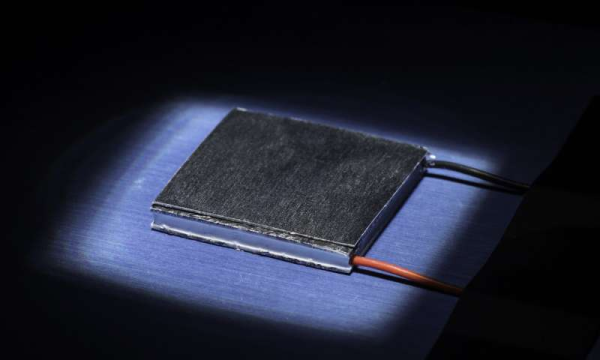
It stands to reason that white materials reflect most light and therefore absorb less energy than black materials — this is part of what makes a radiometer work. Tungsten, in particular, is a good metal for absorbing solar power, but this new laser treatment — which builds nanostructures on the surface of the metal — increases efficiency by 130% compared to untreated tungsten.

Continue reading “Laser Etches Solar Absorbing Material”

Array Of Useless Machines Is Useless

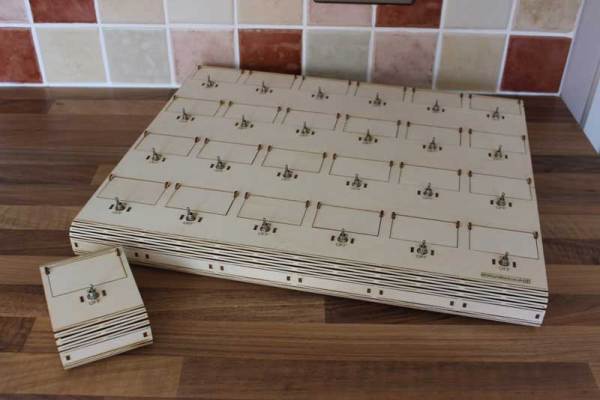
What’s the collective noun for a group of useless machines? A passel of useless machines? A failure? A waste? A 404?  Whatever you want to call it, [Martin Raynsford] has produced one here with this collection of 24 useless machines arranged into a 5 by 6 array. He produced it for an event at a hackerspace to amuse visitors, and it certainly seems to do the job in the video after the break.

[Martin] built the case by modifying the design of his Useless Machine kit, stretching out the case to hold multiple mechanisms. The original plan was to use a 6 by 6 matrix, but that wouldn’t fit into the laser cutter, so it ended up with 24 mechanisms in a 5 by 6 array. All of those are driven by 2 AAA batteries, and the mechanisms are efficient enough that it survived a full day of button flipping before it began to run out of juice.

Continue reading “Array Of Useless Machines Is Useless”

Burning Things With Big Lasers In The Name Of Security

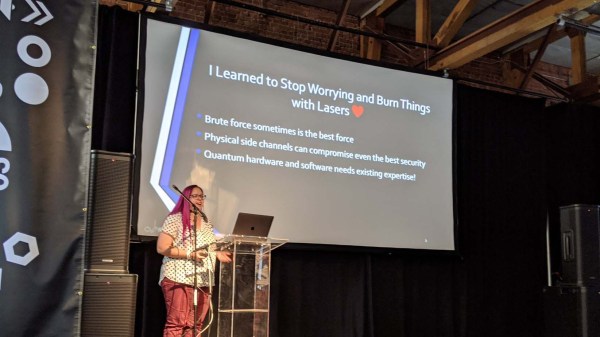
Several fields of quantum research have made their transition from research labs into commercial products, accompanied by grandiose claims. Are they as good as they say? We need people like Dr. Sarah Kaiser to independently test those claims, looking for flaws in implementation. At the 2019 Hackaday Superconference she shared her research on attacking commercially available quantum key distribution (QKD) hardware.

Don’t be scared away when you see the term “quantum” in the title. Her talk is very easy to follow along, requiring almost no prior knowledge of quantum research terminology. In fact, that’s the point. Dr. Kaiser’s personal ambition is to make quantum computing an inviting and accessible topic for everyone, not just elite cliques of researchers in ivory towers. You should hear her out in the video below, and by following along with the presentation slide deck (.PPTX).

Quantum Key Distribution

So why is QKD is so enticing? Unlike existing methods, the theoretical foundation is secure against any attacker constrained by the speed of light and the laws of physics.

Generally speaking, if your attacker is not bound by those things, we have a much bigger problem.

But as we know well, there’s always a difference between the theoretical foundation and the actual implementation of cryptography. That difference is where exploits like side-channel attacks thrive, so she started investigating components of a laser QKD system.

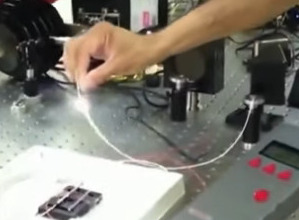
As a self-professed “Crazy Laser Lady”, part of this investigation examined how components held up to big lasers delivering power far outside normal operating range. This turned up exciting effects like a fiber fuse (~17:30 in the video) which is actually a plasma fire propagating through the fiber optic. It looks cool, but it’s destructive and useless for covert attacks. More productive results came when lasers were used to carefully degrade select components to make the system vulnerable.
If you want to learn more from Dr. Kaiser about quantum key distribution, she has a book chapter on the topic. (Free online access available, but with limitations.) This is not the first attempt to hack quantum key distribution, and we doubt it would be the last. Every generation of products will improve tolerance to attacks, and we’ll need researchers like our Crazy Laser Lady to find the reality behind advertised claims.

Continue reading “Burning Things With Big Lasers In The Name Of Security”

A Beginner’s Guide To X-Ray Crystallography

In graduate school, I had a seminar course where one of the sections was about X-ray crystallography. I was excited, because being able to discern the three-dimensional structure of macromolecules just by shining X-rays on them seemed like magic to me. And thanks to a lackluster professor, after the section it remained just as much of a mystery.

If only I’d had [Steve Mould] as a teacher back then. His latest video does an outstanding job explaining X-ray crystallography by scaling up the problem considerably, using the longer wavelength of light and a macroscopic target. He begins with a review of diffraction patterns, those alternating light and dark bands of constructive and destructive interference that result when light shines on two closely spaced slits — the famous “Double-Slit Experiment” that showed light behaves both as a particle and as a wave and provided our first glimpse of quantum mechanics. [Steve] then doubled down on the double-slit, placing another pair of slits in the path of the first. This revealed a grid of spots rather than alternating bands, with the angle between axes dependent on the angle of the slit pairs to each other.


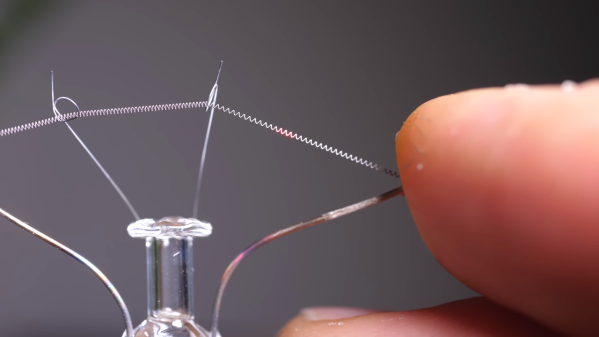
To complete the demonstration, [Steve] then used diffraction to image the helical tungsten filament of an incandescent light bulb. Shining a laser through the helix resulted in a pattern bearing a striking resemblance to what’s probably the most famous X-ray crystallogram ever: [Rosalind Franklin]’s portrait of DNA. It all makes perfect sense, and it’s easy to see how the process works when scaled down both in terms of the target size and the wavelength of light used to probe it.

Hats off to [Steve] for making something that’s ordinarily complex so easily understandable, and for filling in a long-standing gap in my knowledge.

Continue reading “A Beginner’s Guide To X-Ray Crystallography”

Node-RED Laser Shooting Gallery Goes Anywhere

When you think of a shooting gallery, you might envision a line of tin cans set up along a split-rail fence, or a few rows of ducks or bottles lined up at a carnival. But what do these have in common? You, standing in one spot, and shooting in the same general direction. You’re exposed! If those targets could shoot back, you’d be dead within seconds. Wouldn’t it be more fun if the targets were all around you in 360°? We think so, too.

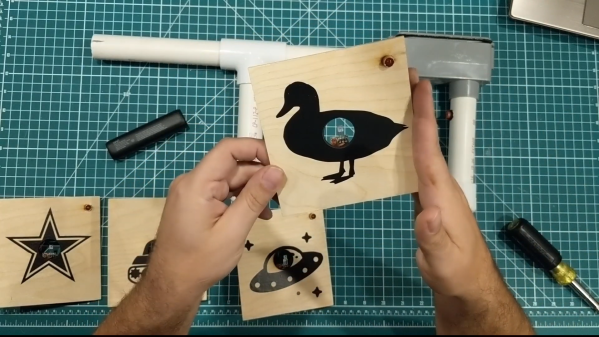
So how could you possibly set up a shooting gallery this way? [Another Maker] already solved that problem for you with ESP32s and Node-RED (YouTube). Each target has an ESP32, a laser sensor, and an LED that lights up when the target is ready, and turns off once it’s been hit. They all make an enticing ‘shoot me’ sound that goes with their graphics, and a second mp3 plays upon direct hit.

The PVC gun houses an ESP8266, a laser module at the end of the barrel, and runs on a cylindrical USB battery slipped down in the secondary grip. [Another Maker] can spread the targets out far and wide, as long as they all stay in range of the localized WiFi access point.

The best part is that the Node-RED system is target-agnostic — it doesn’t care how many you have or how they’re made, and it can juggle up to 250 of them. Because of the way the target objects are programmed, it would be quite easy to add actuators that make them drop down or fall backward when hit. You could also implement [Another Maker]’s fantastic suggestion of hitting arcade buttons with NERF darts instead. Charge those lasers and fire at the break button to see the demo and walk-through video.

If you plan to knock the targets down or over in your implementation, you’ll want an easy way to reset them. Here’s a scrap-built shooting gallery that uses a windshield wiper motor to set ’em back up.