The Unreasonable Power Density Of Lithium-Ion

We’re all used to it by now, but I’d just like to reflect on how insanely power-packed lithium ion batteries are, and everything that’s afforded us. I’m trying to think of a gadget, a hobby, or nearly anything in my house that’s not touched by the battery chemistry.

I’m looking at my portable wireless keyboard in front of me, with a LiPo pack inside. Oddly enough, I’m charging it with a LiPo-based power bank, simply because the cable to the nearest USB-C adapter is too short. A gaming console, cell phone, and a DSLR camera are all within arms reach and powered with lithium.

It’s not just consumer stuff either. I fly FPV quads and airplanes for fun when I can, and of course those are made entirely possible by the combination of smaller brushless DC motors and their drivers, and the high-power-density LiPo packs that power them. For field recharging, I have a huge self-made LiIon pack that can keep them all in the air all day. These days, LiPo and LiIon tech is the heart of hacker projects big and small. Heck, we even powered this year’s Hackaday Supercon badge with a LiPo that allowed it to run all weekend on a charge for many folks, where in the past swapping out AAs during the event was commonplace.

The application that still blows my mind is that we recently got a solar installation on our roof, which means a huge LiFePO battery in the basement. And while it’s one thing to power noisy little quads on the battery tech, it somehow seems another to power our entire house, for multiple hours per day, from a battery. Granted it’s not a couple of AAA cells in a little black plastic box, but it’s simply amazing to run a washing machine, the fridge, the stove, and even the heating off of what amounts to a battery pack.

Of course, I’m aware of the costs of producing the cells, both in terms of money and the environmental damage. It’s not a free lunch, and I’m looking forward to both cleaner and cheaper energy storage chemistries in the future. But for now, I’m still in awe of the many options that lithium-based battery chemistry has brought us. May your pillows remain non-spicy!
Calculator Battery Mod Lets You Go The Distance

Disposable batteries seem so 1990s. Sure, it’s nice to be able to spend a couple of bucks at the drugstore and get a flashlight or TV remote back in the game, but when the device is a daily driver, rechargeable batteries sure seem to make more financial sense. Unfortunately, what makes sense to the end user doesn’t always make sense to manufacturers, so rolling your own rechargeable calculator battery pack might be your best option.

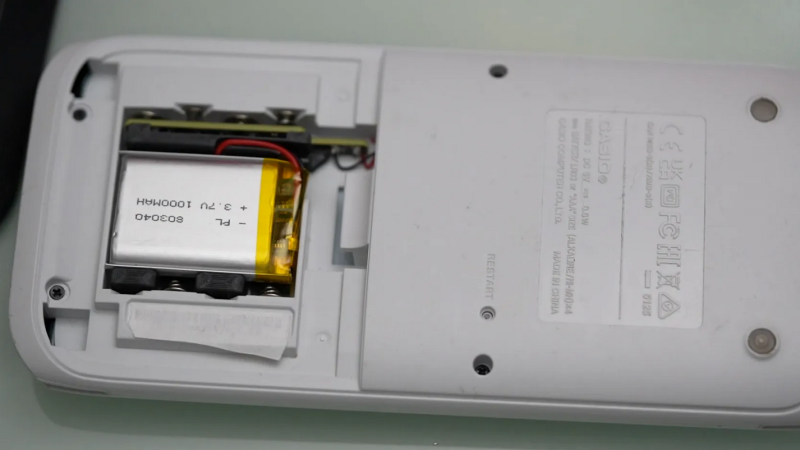
This slick hack comes to us from [Magmabow], who uses a Casio FXCG50 calculator, a known battery hog. With regular use, it goes through a set of four alkaline AA batteries every couple of months, which adds up quickly. In search of a visually clean build, [Magmabow] based the build around the biggest LiPo pillow-pack he could find that would fit inside the empty battery compartment, and planned to tap into the calculator’s existing USB port for charging. A custom PCB provides charging control and boosts the nominal 3.7-volt output of the battery to the 5-ish volts the calculator wants to see. The PCB design is quite clever; it spans across the battery compartment, with its output feeding directly into the spring contacts normally used for the AAs. A 3D-printed insert keeps the LiPo and the PCB in place inside the battery compartment.

Almost no modifications to the calculator are needed, other than a couple of bodge wires to connect the battery pack to the calculator’s USB port. The downside is that the calculator’s battery status indicator won’t work anymore since the controller will just shut the 5-volt output down when the LiPo is discharged. It seems like there might be a simple fix for that, but implementing it on such a small PCB could be quite a challenge, in which case a calculator with a little more room to work with might be nice. Continue reading “Calculator Battery Mod Lets You Go The Distance”

Upgrading At Least One Component Of A TI Calculator

Even though Texas Instruments were the first company to produce an integrated circuit and a microprocessor, their success as a company in the 60s and 70s was not guaranteed. At the time there wasn’t much demand for previously non-existent products like these, so to drive some business they built the first hand-held calculator, a venture that they are still famous for today. Since then, though, they’ve become a bit of a punchline for producing calculators with decades-old technology but with modern price tags, so while this business model was quite successful if you want a calculator with a few modern features you’ll have to take a DIY approach like this calculator retrofitted with a LiPo battery.

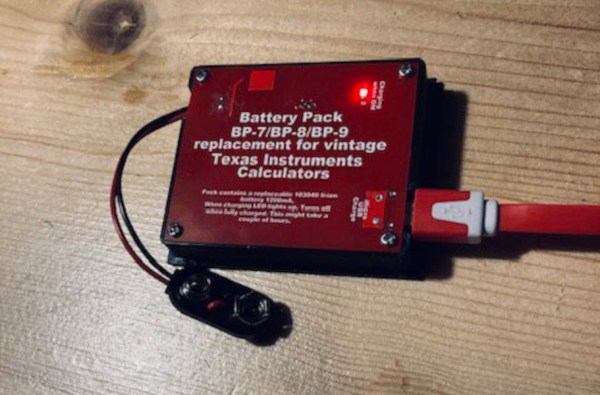
The modern battery pack, with a lithium polymer battery at its core, includes all of the circuitry needed to integrate it seamlessly into the TI-59 calculator, which is all available on the project’s GitHub page. This calculator originally used a 9V battery, so the new battery pack includes a boost converter to match the 3.7V from the new battery to the needs of the old calculator. It doesn’t stop there, though. The pack is rechargeable from an included USB-C port, has a built-in charge controller, and is housed in its own custom-built case that fits neatly into the calculator where the old battery would sit.

While this wouldn’t be a drop-in replacement for more modern calculators like the TI-83/84 and TI-89, a new case and a different boost converter would solve the problem of the AAA batteries dying during exams. It might make the calculators non-compliant with various standardized testing requirements, though (which TI was also instrumental in developing) so you may want to verify with your testing standard of choice before modifying a calculator you need for an exam. But if all the rules are off, why not add Wi-Fi to it too?

LiPo Replacement Keeps Portable Scanner In The Action

If there’s anything people hate more than being locked into a printer manufacturer’s replacement cartridges, it’s proprietary batteries. Cordless power tools are the obvious example in this space, but there are other devices that insist on crappy battery packs that are expensive to replace when they eventually die.

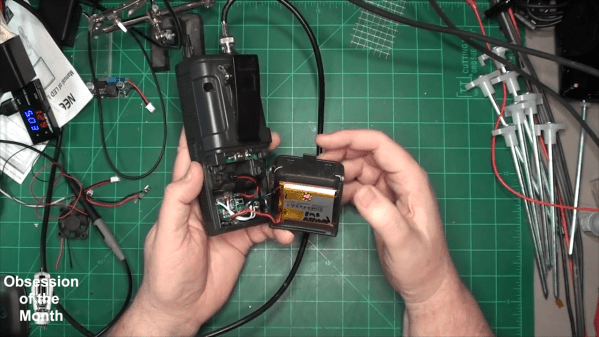
One such device is the Uniden Bearcat BC296D portable scanner that [Robert Guildig] found for a song at a thrift store, which he recently gave a custom LiPo battery upgrade. It came equipped with a nickel-cadmium battery pack, which even under the best of circumstances has a very limited battery life. Using regular AA batteries wasn’t an option, but luckily the space vacated by the OEM battery pack left a lot of room for mods. Those include a small module with BMS functions and a DC-DC converter, a 2,400 mAh 4.2 V LiPo pillow pack, and a new barrel connector for charging. With the BMS set for six volts and connected right to the old battery pack socket, the scanner can now run for seven hours on a one-hour charge. As a bonus, the LiPo pack should last a few times longer than the NiCd packs, and be pretty cheap to replace when it finally goes too. There’s a video after the hop with all the details.

If you’re looking at a similar battery replacement project, you might want to check out [Arya]’s guide to everything you need to know about lithium-ion circuitry.

Continue reading “LiPo Replacement Keeps Portable Scanner In The Action”

Fail Of The Week: Car Starter Motors Aren’t The Best Fit For EBikes

A lot of what real engineering is all about is designing to the limits of your materials, with a healthy margin for error. On the other hand, seat-of-the-pants engineering often takes the opposite tack — working with the materials you have and finding their limits after the fact. While the former is more rigorous and better suited to anything where life and limb are on the line, there’s something to be said for the flexibility that informal engineering offers.

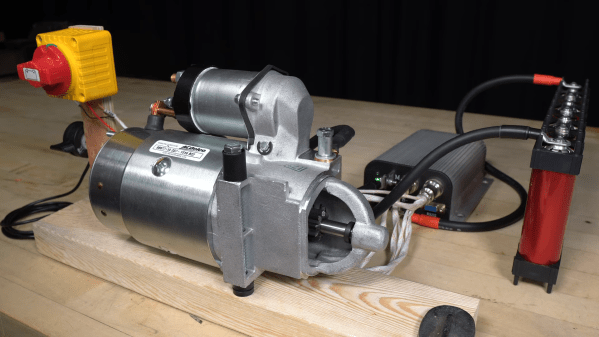
[Austin Blake]’s latest eBike is a case study in informal engineering. [Austin] started out wondering if a starter motor from a car engine would make a decent electric bike motor. Our first instinct before watching the video below was to answer that question with a resounding “No!” Yes, starter motors seem like a natural for the job, delivering high torque in a compact package. But starting a car engine is the very definition of a low-duty-cycle application, since it should only take a second or two of cranking to get an engine started. Pressing a motor designed for such a task into continuous duty seems like, well, a non-starter.

And to be fair, [Austin] fully acknowledges this from the start. He even retrofits the motor, wisely replacing the shaft bushings with proper bearings in an attempt to get a better duty cycle. And it works, at least for a while — with the motor, a homebrew battery, and an ESC mounted to a bike frame, the bike was actually pretty peppy. But bearings aren’t the only thing limiting a starter motor to intermittent duty operation. The short drive really heated up the motor, and even with a few ventilation holes knocked in the motor housing, it eventually released the Magic Smoke. The video has all the gory details.

As always, we like to stress that “Fail of the Week” is not necessarily a badge of shame. We appreciate it whenever someone shows us the way not to go, as [Austin] did here. And let’s keep in mind that he’s had success with this approach before, albeit with a much, much bigger starter motor.

Continue reading “Fail Of The Week: Car Starter Motors Aren’t The Best Fit For EBikes”

Building A Solar Powered Game Boy Pocket

Light has always been a key part of the classic Game Boy experience. Some of us have fond memories of riding along in the back seat of a car at night, pausing and unpausing the game as the street lights overhead briefly give enough light to see the unlit display. The availability of third party IPS displays for these classic handhelds has largely eradicated this problem today, but as you might expect, the increased power requirements of the more modern screen reduces the system’s runtime.

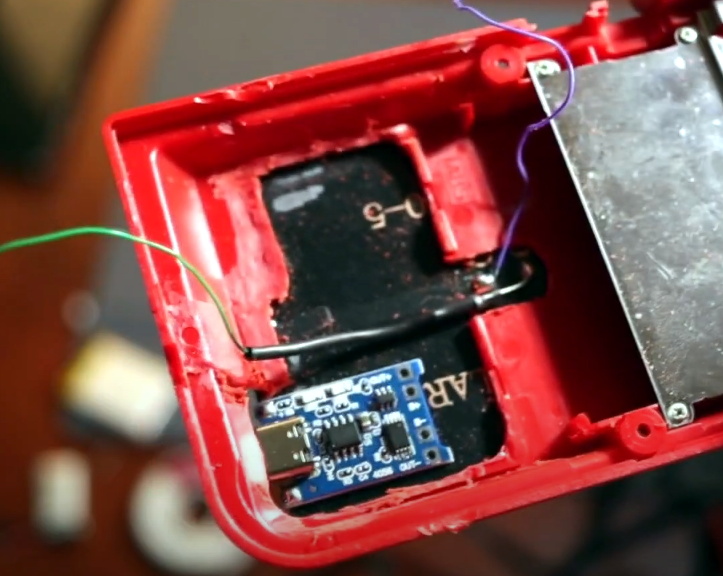
Installing the USB-C charge controller.

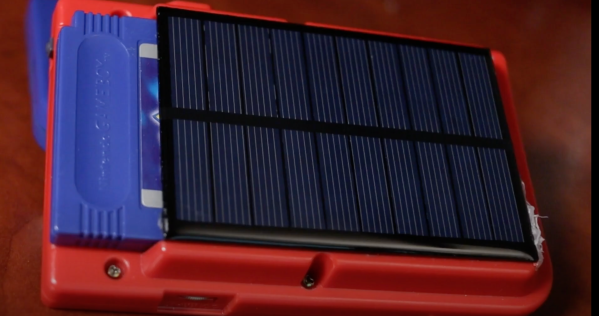
As part of their examination into energy production, the [Houston Museum of Natural Science] set out to see if they could improve things by adding a solar panel to the back of a Game Boy Pocket that had already been modified with an IPS display. The Pocket version of the Game Boy was selected as it has a nice flat back that made it easy to attach a solar panel, and in fact the panel sourced for this mod is so well dimensioned, it almost looks like the device came that way.

In the video below, you can see the modification starts by cutting away a large section of the Game Boy’s rear panel to fit the 1000 mAh LiPo battery. The solar panel is then affixed over the back with super glue. A diode is soldered onto the solar cell, and then wired into a charge controller that came with USB-C input. The placement of the charge controller ended up being trickier than expected, but with a little hot glue, it works just fine. Overall this is a simple mod but a brilliant idea.

This isn’t the first solar-powered handheld game system we’ve seen, but it’s nice to see the idea revisited and expanded on, particularly regarding ergonomics. In addition, we love the incredible detail of narration that’s given as this hack slowly takes shape. Video after the break.

Continue reading “Building A Solar Powered Game Boy Pocket”

Electric BMX With Friction Drive

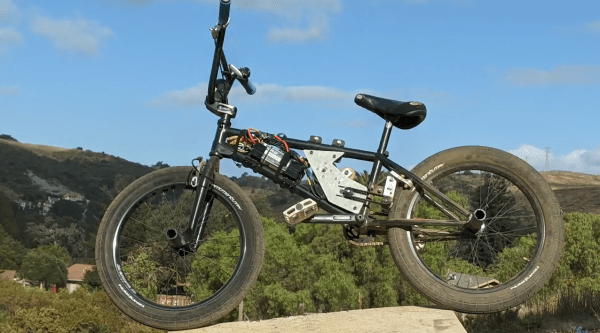
Electric bikes have increased in popularity dramatically over the past few years, and while you can easily buy one from a reputable bicycle manufacturer, most of us around here might be inclined to at least buy a kit and strap it to a bike we already have. There aren’t kits available for every bike geometry, though, so if you want an electric BMX bike you might want to try out something custom like [Shea Nyquist] did with his latest build. (Video, embedded below.)

BMX frames have a smaller front triangle than most bikes, so his build needed to be extremely compact. To that end, it uses two small-sized motors connected together with a belt, which together power a friction drive which clamps against the rear tire to spin it directly. This keeps the weight distribution of the bike more balanced as well when compared to a hub drive, where the motor is installed in the rear wheel. It also uses a more compact lithium polymer battery pack instead of the typical 18650 lithium ion packs most e-bikes use, and although it only has a range of around three miles it’s more than enough charge to propel it around a skate park.

The build boasts impressive numbers too, at 2.5 kW peak power per motor. This puts it in electric motorcycle territory, and it’s indeed fast despite its small stature. For a true high speed e-bike experience, though, you’ll need a slightly larger frame and motor even if it means tossing safety out of the window. Continue reading “Electric BMX With Friction Drive”