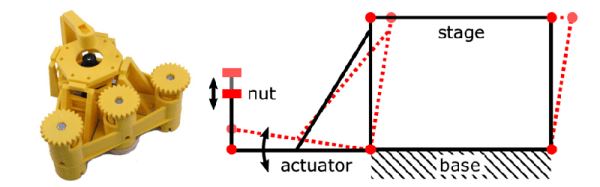
Exploiting the flexibility of plastic, a group of researchers has created a 3D printable microscope with sub-micron accuracy. By bending the supports of the microscope stage, they can manipulate a sample with surprising precision. Coupled with commonly available M3 bolts and stepper motors with gear reduction, they have reported a precision of up to 50nm in translational movement. We’ve seen functionality derived from flexibility before but not at this scale. And while it’s not a scanning electron microscope, 50nm is the size of a small virus (no, not that kind of virus).
OpenFlexure has a viewing area of 8x8x4mm, which is impressive when the supports only flex 6°. But, if 256 mm3 isn’t enough for you, fret not: the designs are all Open Source and are modeled in OpenSCAD just begging for modification. With only one file for printing, no support material, a wonderful assembly guide and a focus on PLA and ABS, OpenFlexure is clearly designed for ease of manufacturing. Optics are equally interesting. Using a Raspberry Pi Camera Module with the lens reversed, they achieve a resolution where one pixel corresponds to 120nm.
The group hopes that their microscopes will reach low-resource parts of the world, and it seem that the design has already started to spread. If you’d like to make one for yourself, you can find all the necessary files up on GitHub.
Continue reading “This 3D Printed Microscope Bends For 50nm Precision”
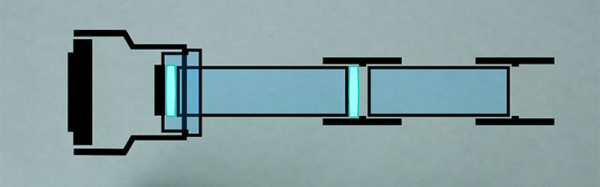
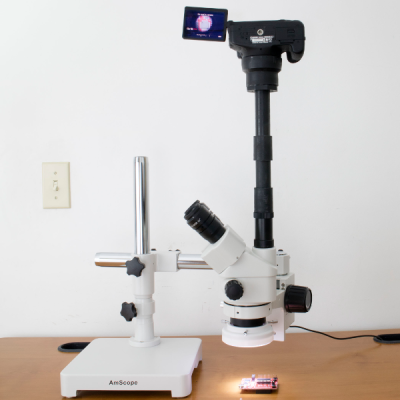 The virtues of PVC pipe are many and varied. It’s readily available in all manner of shapes and sizes, and there’s a wide variety of couplers, adapters, solvents and glues to go with it. Best of all, you can heat it to a point where it becomes soft and pliable, allowing one to get a custom fit where necessary. [Brian] demonstrates this in using a heat gun to warm up a reducer to friction fit the DSLR lens mount. Beyond that, the mount uses a pair of lenses sourced from jeweller’s loupes to bring the image into focus on the camera’s sensor, mounted tidily inside the PVC couplers.