A Baby Grand Gets MIDI

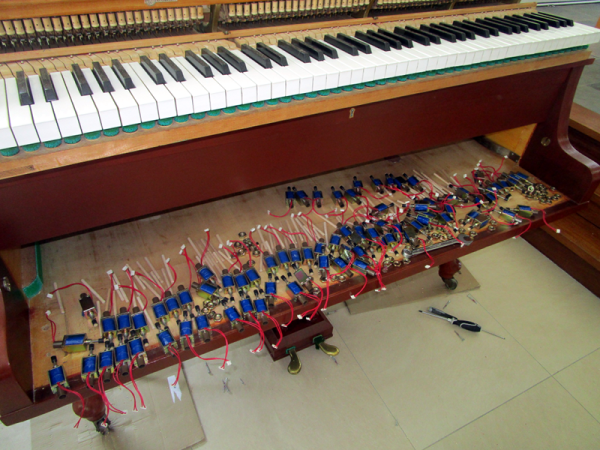
Like a lot of people, [Jacques] doesn’t think a big hunk of plastic light enough to carry under your arm is a piano, even if it does have 88 keys. A piano is supposed to be a hefty piece of furniture that you have to buy people pizza to help you move. So he bought a used baby grand piano. It wasn’t in very good shape, though, so while restoring it, he also added MIDI to it. You can see the finished result in the video below.

At $100, the price was right, although it cost more to move it. Between water damage, moth attacks, and storage in a garage, the piano — an old Zimmerman — needed a lot of tender loving care. When it came to MIDI, [Jacques] found a used Disklavier — a very expensive piece of kit — but it didn’t fit the Zimmerman or another piano at hand. The solenoids and optical sensors are set up for a particular piano, so what can you do? Easy! Rebuild the bar that holds the solenoids and sensors.

Continue reading “A Baby Grand Gets MIDI”

Wurlitzer Note Visualizer Gets A 2020-Spec Replica

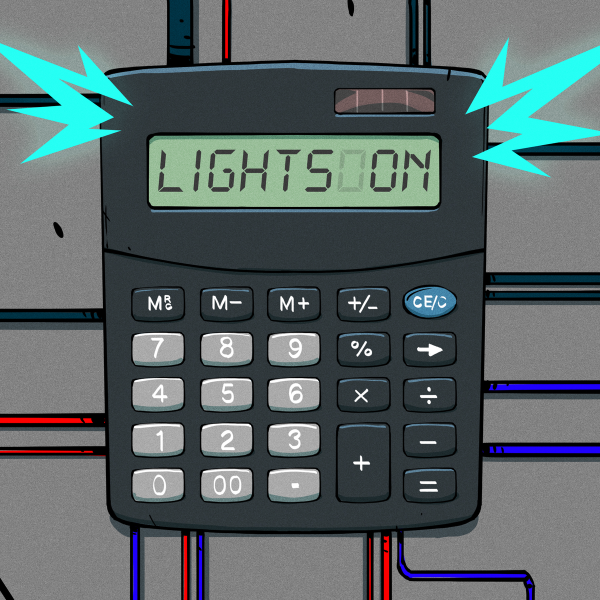
Way back in the 1970s, when smog laws were choking American V8s and the oil crisis was in full swing, Wurlitzer released their Key Note Visualizer. Intended as a teaching aid, the device lit up keys on a keyboard graphic, allowing an organ player to visually demonstrate their performance to a class. [Guy Dupont] set out to replicate this hardware, but with a modern twist.

The build consists of an ESP-32, which accepts MIDI data over Bluetooth Low Energy. This is then used to light up a series of RGB LEDs on a musical staff and a keyboard graphic, corresponding to the notes being played. The LEDs used are the old-school four-wire type, rather than more modern data-driven types. They’re placed in 3D-printed holders which serve to stop the light from each LED bleeding into adjacent areas. The faceplate is made of acrylic, stencilled with that classic orange paint and with vinyl decals applied for the markings. It’s all wrapped up in a walnut case, which [Guy] CNC machined himself.

It’s a tidy build that faithfully recreates the 1970s aesthetic of the original. We plaintively wish that manufacturers would release more electronics in walnut enclosures, though ask politely that they leave cheap veneer in the past where it belongs.

Of course, if you like your musical displays more abstract than instructional, try this giant oscilloscope visualisation on for size. Video after the break.

Continue reading “Wurlitzer Note Visualizer Gets A 2020-Spec Replica”

Less Rock, More Roll: A MIDI Barrel Piano

Strolling around a park, pedestrian zone, or tourist area in any bigger city is rarely complete without encountering the sound of a barrel organ — the perfect instrument if arm stamina and steady rotation speed are your kind of musical skills. Its less-encountered cousin, and predecessor of self-playing pianos, is the barrel piano, which follows the same playing principle: a hand-operated crank rotates a barrel, and either pins located on that barrel, or punched paper rolls encode the strings it should pluck in order to play its programmed song. [gabbapeople] thought optocouplers would be the perfect alternative here, and built a MIDI barrel piano with them.

Keeping the classic, hand-operated wheel-cranking, a 3D-printed gear mechanism rolls a paper sheet over a plexiglas fixture, but instead of having holes punched into it, [gabbapeople]’s piano has simple markings printed on them. Those markings are read by a set of Octoliner modules mounted next to each other, connected to an Arduino. The Octoliner itself has eight pairs of IR LEDs and phototransistors arranged in a row, and is normally used to build line-following robots, so reading note markings is certainly a clever alternative use for it.

Each LED/transistor pair represents a dedicated note, and to prevent false positives from neighboring lines, [gabbapeople] 3D printed little collars to isolate each of the pairs. Once the signals are read by the Arduino, they’re turned into MIDI messages to send via USB to a computer running any type of software synthesizer. And if your hands do get tired, you can also crank it with a power drill, as shown in the video after the break, along with a few playback demonstrations.

It’s always fun to see a modern twist added to old-school instruments, especially the ones that aren’t your typical MIDI controllers, like a harp, a full-scale church organ, or of course the magnificently named hurdy-gurdy. And for more of [gabbapeople]’s work, check out his split-flip weather display.

Continue reading “Less Rock, More Roll: A MIDI Barrel Piano”

A 50W Speaker Made Of Light Bulbs

When we think of a speaker, we are likely to imagine a paper cone with a coil of wire somewhere at the bottom of it suspended in a magnetic field. It’s a hundred-plus-year-old technology that has been nearly perfected. The moving coil is not however the only means of turning an electrical current into a sound. A number of components will make a sound when exposed to audio, including to the surprise of [Eric], the humble incandescent light bulb. He discovered when making an addressable driver for them that he could hear the PWM frequency when they lit up, so he set about harnessing the effect for use as a speaker.

Using an ESP32 board and with a few false starts due to cheap components, he started with MIDI files and ended up with PWM frequencies. It’s an interesting journey into creating multiple PWM channels from an ESP32, and he details some of his problems along the way. The result is the set of singing light bulbs that can be seen in the video below the break, which he freely admits is probably the most awful 50 W speaker that he could have made. That however is not the point of such an experiment, and we applaud him for doing it.

For more MIDI-based tomfoolery, take a look at the PCB Tesla coil.

Continue reading “A 50W Speaker Made Of Light Bulbs”

Raspberry Pi Plays A MIDI Tune Wherever You May Roam

MIDI controller keyboards are great because they let you control any synthesizer you plug them into. The only downside: you need a synthesizer to turn MIDI notes into actual sounds, slightly complicating some summer night campfire serenading. Not for [Geordie] though, who decided to build the nanoPi, a portable, MIDI instrument housing a Raspberry Pi.

Using a Korg nanoKEY2 USB MIDI controller as base for the device, [Geordie] took it apart and added a Raspberry Pi Zero W, a power bank to, well, power it, and a USB hub to connect a likewise added USB audio interface, as well as the controller itself. As the nanoKEY2 has a naturally slim shape, none of this would ever fit in it, so he designed and 3D printed a frame to extend its height. Rather than wiring everything up internally, he decided to route the power and data cable to the outside and connect them back to the device itself, allowing him to use both the power bank and the controller itself separately if needed.

On the software side, the Pi is running your common open source software synthesizer, Fluidsynth. To control Fluidsynth itself — for example to change the instrument — [Geordie] actually uses the Termius SSH client on his phone, allowing him also to shut down the Pi that way. While Fluidsynth’s built-in MIDI router could alternatively remap the nanoKEY2’s additional buttons, it appears the functionality is limited to messages of the same type, so the buttons’ Control Change messages couldn’t be remapped to the required Program Change messages. Well, there’s always the option to fit some extra buttons if needed. Or maybe you could do something clever in software.

As you may have noticed, the nanoPi doesn’t include any speaker — and considering its size, that’s probably for the best. So while it’s not a fully standalone instrument, it’s a nice, compact device to use with your headphones anywhere you go. And thanks to its flexible wiring, you could also attach any other USB MIDI controller to it, such as this little woodwind one, or the one that plays every pop song ever.

Continue reading “Raspberry Pi Plays A MIDI Tune Wherever You May Roam”

Arduino Drums Bring The Noise, No MIDI Required

When looking through existing Arduino drum kit projects, [joekutz] noticed that most of them just used the microcontroller as an input for an existing MIDI device. That’s fine if you’re just looking to build your own hardware interface, but he wondered if it would be possible to forgo the MIDI device completely and actually generate the audio internally.

To be sure, this is a lot to ask of an 8-bit microcontroller, which is probably why nobody does it this way. But [joekutz] wasn’t giving up without a fight. One of the trickiest aspects was storing the samples: the 8-bit, 11.025 KHz mono WAV files ultimately had to be converted into C data arrays with a custom Python script.

Unfortunately, since the samples are essentially part of the drum’s source code, he says distributing the firmware is something of a problem. Though it sounds as though there might be a solution to this soon for those who want to play along at home.

But don’t get the impression that this project is just software. Check out the custom impact sensors lovingly crafted from popsicle sticks and metal cut from soda cans, which have been mated with sections cut out of old DVD-Rs. Actually getting the beats out of the Arduino required the addition of a R2R DAC circuit and a TDA2822 amplifier. In the video after the break, you can hear the results for yourself.

[joekutz] is no stranger to homebrew electronic instruments. When we last heard from him, he was turning a very pink keyboard into his own personal circuit bending playground.

Continue reading “Arduino Drums Bring The Noise, No MIDI Required”

Rocking Out On A Limb With LE STRUM

It’s hard to imagine 80s Synth-pop without the keytar, and yet this majestic Centaur of a musical instrument rarely gets much love, and their players are often the target of ridicule. It almost seems as if being hung around the neck should be a privilege solely reserved for stringed instruments. Well, [midierror] has at least that part somewhat right then, with the Full On MIDI Leg that is guaranteed to make every keytarist look like a prestigious cellist in comparison.

What looks like the 1987 movie Mannequin taking a dark, Mengelesque turn, is as awesome as it is bizarre, thanks to building the concept of the LE STRUM into, well, a leg. LE STRUM itself is an open source MIDI instrument built by [Jason Hotchkiss], who describes it as “a cross between a Stylophone and an Omnichord”. It consists of a set of buttons to select different combinations of chords, that can than be strummed by scratching an attached stylus over an array of contact pads. However, [midierror], who also distributes a pre-assembled version of the LE STRUM, uses strings instead of contact pads, and a pick for the actual strumming, turning this into a close-enough string instrument.

The only thing missing now is a functioning knee joint, and maybe some inspiration from this MIDI-controlled concertina, and we’d be ready to revolutionize the accordion world with the, uhm, kneetar? And since it’s built around a PIC16, this thigh-slapper won’t even cost you an ARM, just the leg — but enough already with these toe-curling puns.

Continue reading “Rocking Out On A Limb With LE STRUM”