Analog Siren For Psychedelic Soundscapes

For better or worse, there are a few instruments that have been pigeonholed into specific genres of popular music. For example, banjos are often heard in bluegrass or folk, harmonicas in blues, and a sick horn section will take many of us immediately to third wave ska. Similarly, there are certain styles of synthesizers tied to various genres and if you’re a fan a certain sub-genre of reggae you’ll be familiar with the dub siren. This unique analog synth has a few tricks up its sleeve and [Jakub] shows us how he built his.

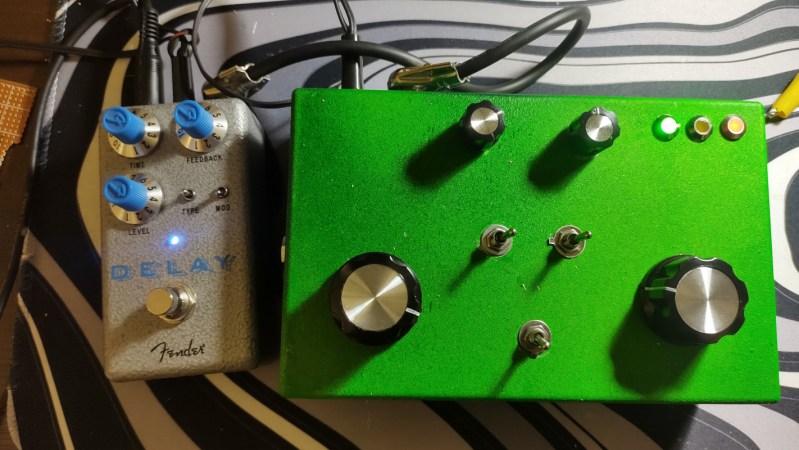
He’s calling this build the Sirenotron, and its based on the venerable 555 timer It also features an LFO built on an LM358, with triangle and square wave modes, plus an additional “acid mode” for the square wave which adds a single capacitor to the circuit but makes a big difference in the sound. Like any siren synth, there are potentiometers to control pitch and the pulse rate of the siren as well and another switch controls whether it is outputting sound or not. He’s also included the ability to control it with a foot pedal so he can use it while playing the bass guitar during live shows.

[Jakub] has gone through several prototypes before getting to this stage, and not only uses it when playing dub but also creates psychedelic soundscapes in a side project of his where it also fits right in. He’s also made the schematics available for anyone who wants to reproduce it or build on his design.

We’re always interested in a unique synthesizer build around here, and some of our favorites include this synth built from Sega Genesis parts and this one controlled more like a woodwind instrument.

Continue reading “Analog Siren For Psychedelic Soundscapes”

Simple MIDI Sample Player Runs On ESP32

[Jakub] is a musician, and found himself in need of a simple way to trigger samples via MIDI when on stage. So many commercial solutions exist, but most were overkill for the job or too messy and complicated to justify their use in a live environment. Thus, [Jakub] worked up Samplotron to do exactly the job needed with a minimum of fuss.

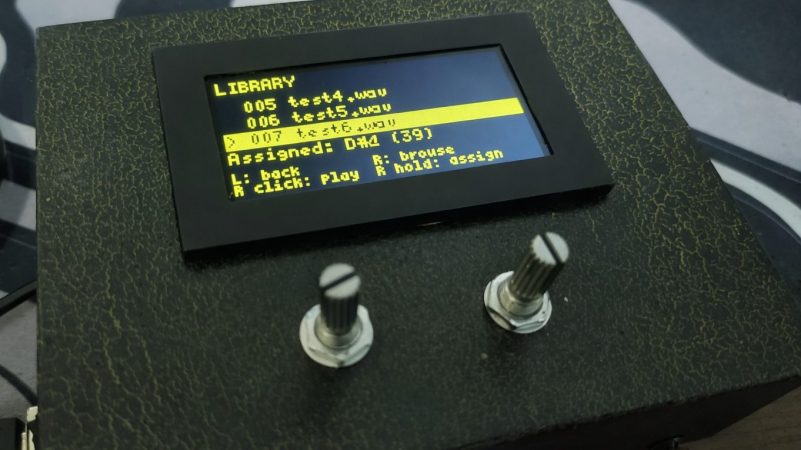
The project is based around the ESP32. It’s effectively a lightweight hardware sampler that can trigger sounds on command via MIDI. Sample data is loaded from an SD card, which also stores the device configuration. The Samplotron plays back mono 16-bit WAV files at 44,100 Hz, delivering audio via an ES8388 audio codec module connected via I2S. Two encoders are used to control the device, with a menu system presented via an SSD1309 OLED screen. Samples can be loaded and managed via this interface, and it allows tweaks to be made to volume levels and one-shot/loop playback as needed. MIDI input to the device is simply handled via the onboard UART functionality of the ESP32 itself.

It’s a neat little bit of music hardware that does exactly what [Jakub] needs and nothing more. We’ve featured similar builds before, like this neat RP2040 soundboard. If you’re building rad custom hardware for your own musical adventures, we’d love to know all about it. 

Inside A Dutch Street Organ: The Art Of Mechanical Music-Making

[James]’ Mechanical Organ of Dutch origin has been around longer than he has, but thanks to being rebuilt over the years and lovingly cared for, it delivers its unique performances just as well as it did back in the day. Even better, we’re treated to a good look at how it works.

The organ produces music by playing notes on embedded instruments, which are themselves operated by air pressure, with note arrangements read off what amounts to a very long punch card. [James] gives a great tour of this fantastic machine, so check it out in the video embedded below along with a couple of its performances.

Continue reading “Inside A Dutch Street Organ: The Art Of Mechanical Music-Making”

Playing YouTube From The Command Line

Generally, one opens a web browser or an app to use YouTube. However, if you’re looking to just listen to the audio, you can actually do that right from the terminal. You just need Shellbeats from [lalo-space].

Shellbeats is primarily intended for playing music from YouTube, and is well equipped for this task. It allows searching YouTube directly from the terminal, as well as streaming tracks or entire playlists from the command line interface. You can also make and edit playlists from within the tool, and even download the whole lot as MP3s if so desired. It’s all keyboard-operated and nicely lightweight. The overall experience isn’t dissimilar from operating a simple LCD-based MP3 player from 20 years ago.

There’s plenty of other fun stuff you can do in the terminal, too, as we’ve explored previously. If you’re working on your own media player hacks, be sure to notify us on the tipsline!

Companion MIDI Pedal Helps Roland Groovebox Along

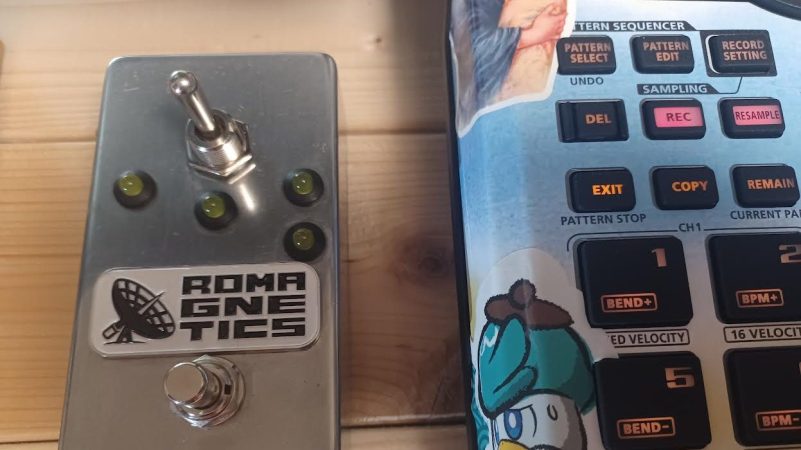
The Roland SP-404 Mk2 is a popular groovebox that can deliver a great beat if you know how to use it. If you’re seeking greater control than is available out of the box, though, you might like to try a custom pedal built by [Romain Dereu].

The concept is simple enough—[Romain] whipped up a bespoke MIDI device to specifically control various features of the SP-404. It’s based on an Arduino Nano, though it could also be built with an Arduino Uno if so desired. The microcontroller sends the requisite MIDI messages out via its serial UART. The microcontroller is built into a pedal-style enclosure with a big toggle switch and a foot switch. This enables the triggering of various pads on the SP-404, with modes selected via the toggle.

It’s a simple build that opens up new possibilities when playing with the SP-404. If you’ve ever wanted a custom device to spit out some specific MIDI commands to control the synths or drum machines in your performance rig, this project is a great example of how easy this is to achieve. Meanwhile, if you’re whipping your own custom MIDI gear at home, we always love to see it land on our tipsline!

Streaming Music To Cassette

In almost every measurable way, a lossless digital audio file is superior to any analog media. This doesn’t mean that analog audio isn’t valuable though; plenty of people appreciate the compression, ambiance, and other side-effects of listening to a vinyl record or a cassette tape despite the technical limitations. To combine the audio technology of the modern world with these pleasant effects of old analog media, [Julius] built a cassette-based media streamer.

The music playback device takes input from a Bluetooth stream of some sort, converts the digital stream to analog, combines the stereo signal into a mono signal, and then records it to a cassette tape. The tape is then looped through to a playback device which outputs the sound to a single speaker. This has the effect of functioning as a tape delay device, and [Julius] did add input and output jacks to use it as such, but in its default state it has the effect of taking modern streaming through a real analog device and adding the compression and saturation that cassette tapes are known for.

The design of the device is impressive as well, showing off the tape loop and cassette front-and-center with a fluorescent vu meter on the side and a metal case. Getting all of this to work well together wasn’t entirely smooth, either, as [Julius] had to sort out a number of issues with the electronics to keep various electric noises out of the audio signal. Retro analog music players are having a bit of a resurgence right now, whether that’s as a revolt against licensed streaming services or as a way to experience music in unique ways, and our own [Kristina Panos] recently went down an interesting rabbit hole with one specific type of retro audio player.

Continue reading “Streaming Music To Cassette”

Extremely Rare Electric Piano Restoration

Not only are pianos beautiful musical instruments that have stood the test of many centuries of time, they’re also incredible machines. Unfortunately, all machines wear out over time, which means it’s often not feasible to restore every old piano we might come across. But a few are worth the trouble, and [Emma] had just such a unique machine roll into her shop recently.

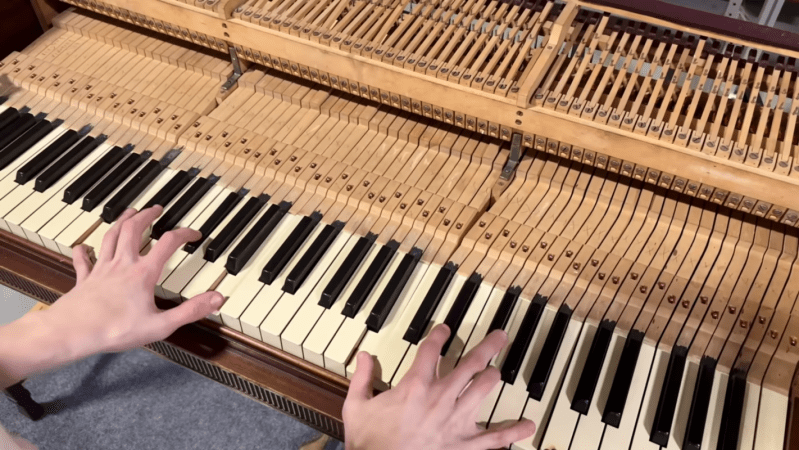
What makes this instrument so unique is that it’s among the first electric pianos to be created, and one of only three known of this particular model that survive to the present day. This is a Vivi-Tone Clavier piano which dates to the early 1930s. In an earlier video she discusses more details of its inner workings, but essentially it uses electromagnetic pickups like a guitar to detect vibrations in plucked metal reeds.

To begin the restoration, [Emma] removes the action and then lifts out all of the keys from the key bed. This instrument is almost a century old so it was quite dirty and needed to be cleaned. The key pins are lubricated, then the keys are adjusted so that they all return after being pressed. From there the keys are all adjusted so that they are square and even with each other. With the keys mostly in order, her attention turns to the action where all of the plucking mechanisms can be filed, and other adjustments made. The last step was perhaps the most tedious, which is “tuning” the piano by adjusting the pluckers so that all of the keys produce a similar amount or volume of sound, and then adding some solder to the reeds that were slightly out of tune.

With all of those steps completed, the piano is back in working order, although [Emma] notes that since these machines were so rare and produced so long ago there’s no real way to know if the restoration sounds like what it would have when it was new. This is actually a similar problem we’ve seen before on this build that hoped to model the sound of another electric instrument from this era called the Luminaphone.

Continue reading “Extremely Rare Electric Piano Restoration”