Keeping Magnetized Marbles From Stopping The Music

Take a couple of thousand steel balls, add a large wooden gear with neodymium magnets embedded in it, and what do you get? Either the beginnings of a wonderful kinetic music machine, or a mess of balls all stuck together and clogging up the works.

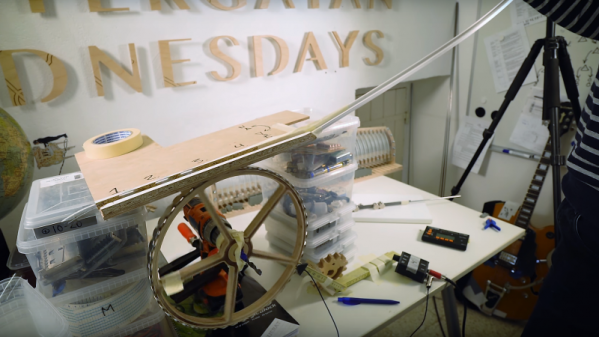
The latter was the case for [Martin], and he needed to find a way to demagnetize steel balls in a continuous process if his “Marble Machine X” were to see the light of day. You may recall [Martin] as a member of the band Wintergatan and the inventor of the original Marble Machine, a remarkable one-man band that makes music by dropping steel balls on various instruments. As fabulous a contraption as the original Marble Machine was, it was strictly a studio instrument, too fragile for touring.

Marble Machine X is a complete reimagining of the original, intended to be robust enough to go on a world tour. [Martin] completely redesigned the lift mechanism, using magnets to grip the balls from the return bin and feed them up to a complicated divider. But during the lift, the balls became magnetized enough to stick together and no longer roll into the divider. The video below shows [Martin]’s solution: a degausser using magnets of alternating polarity spinning slowly under the sticky marbles. As a side note, it’s interesting and entertaining to watch a musician procrastinate while debugging a mechanical problem.

We can’t wait to see Marble Machine X in action, but until it’s done we’ll just settle for [Martin]’s other musical hacks, like his paper-tape programmed music box or this mashup of a synthesizer and a violin.

Continue reading “Keeping Magnetized Marbles From Stopping The Music”

Putting The Pi In Piano

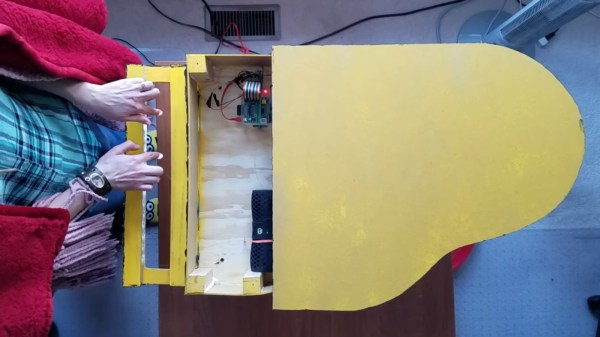
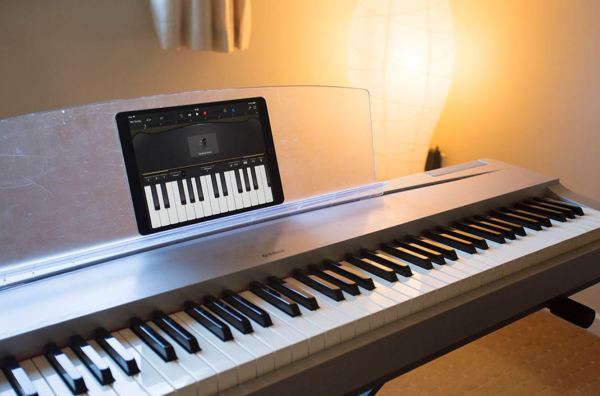
Working on a PhD in composition, [Stephen Coyle] spends a fair bit of time at his electric keyboard. Setting himself up to work can be a bit of a task, so he felt he could improve the process and make it easy as Pi.

Finding it an odious task indeed to use notation software, connecting his laptop to his keyboard is a must — avoiding a warren of wires in the move is a similar priority. And, what if he could take advantage of the iPad’s unique offerings too? Well, a Raspberry Pi Zero W running Ravelox — an RTP MIDI protocol — makes  his music available on his network to record on whichever device he pleases.

Continue reading “Putting The Pi In Piano”

Strumbot: The Guitar That Strums Itself

[Clare] isn’t the most musically inclined person, but she can strum a guitar. Thanks to a little help from an Arduino, she doesn’t even have to do that.

She built the strumbot, which handles the strumming hand duties of playing the guitar. While [Claire] does believe in her strumbot, she didn’t want to drill holes in her guitar, so hot glue and double-sided foam tape were the order of the day.

The business end of the strumbot is a micro servo. The servo moves two chopsticks and draws the pick across the strings. The tiny servo surprisingly does a great job getting the strings ringing. The only downside is the noise from the plastic gears when it’s really rocking out.

Strumbot’s user interface is a 3D-printed case with three buttons and three LEDs. Each button activates a different strum pattern in the Arduino’s programming. The LEDs indicate the currently active pattern. Everything is powered by a USB power pack, making this a self-contained hack.

[Clare] was able to code up some complex strum patterns, but the strumbot is still a bit limited in that it only holds three patterns. It’s good enough for her rendition of “Call Me Maybe”, which you can see in the video after the break. Sure, this is a simple project, not nearly as complex as some of the robotic guitar mods we’ve seen in the past. Still, it’s just the ticket for a fun evening or weekend project – especially if you’re introducing the Arduino to young coders. Music, hacking, and modding – what more could you ask for?

Continue reading “Strumbot: The Guitar That Strums Itself”

The Majesty Of Saturn’s Rings Lighting Your Abode

[Modustrial Maker] is at it again with another seriously cool LED visualizer. This time around, he’s built pair of pendant lights inspired by the rings of Saturn.

The rings are made mostly of walnut plywood using a circle router jig to make the cut easier. If you are inspired to make these for yourself, [Modustrial Maker] is clear — the order in which you cut out the pieces of the rings is absolutely critical. The pieces are glued together — with any edges sanded smooth — and edgebanding applied using a hot air gun due to the curved surface before staining. Duplicate for the second (or more if you so choose!) rings. Be forewarned — a little geometry will be needed to find anchor points that will keep the rings properly balanced.

[Modustrial Maker] suggests an off-the shelf LED controller to handle the visualizations and lighting effects, but he used an Arduino Mega clone as the brains — code available here, a MonkeyJack MAX9814 electret mic, and a four-channel RF remote/transceiver to control the different modes. Pulsing along to the music, these rings make for sleek lighting indeed.

Continue reading “The Majesty Of Saturn’s Rings Lighting Your Abode”

The Tiniest Of 555 Pianos

The 555 timer is one of that special club of integrated circuits that has achieved silicon immortality. Despite its advanced age and having had its functionality replicated and superceded in almost every way, it remains in production and is still extremely popular because it’s simply so useful. If you are of A Certain Age a 555 might well have been the first integrated circuit you touched, and in turn there is a very good chance that your project with it would have been a simple electric organ.

If you’d like to relive that project, perhaps [Alexander Ryzhkov] has the answer with his 555 piano. It’s an entry in our coin cell challenge, and thus uses a CMOS low voltage 555 rather than the power-hungry original, but it’s every bit the classic 555 oscillator with a switchable resistor ladder you know and love.

Physically the piano is a tiny PCB with surface-mount components and physical buttons rather than the stylus organs of yore, but as you can see in the video below the break it remains playable. We said it was tiny, but some might also use tinny.

Continue reading “The Tiniest Of 555 Pianos”

FrankenKorg: The Modern Remote Keyboard

On a dreary night in November, [Smecher] collected the instruments of electronic life around him to infuse a musical spark into FrankenKorg — a resurrected keytar.

This hack is a “re-braining” of a RK-100 Korg Keytar, replacing the original circuits with an ATMega32 — the original functionality and appearance are preserved allowing any restored version of the original boards to be seamlessly re-integrated. In light of that, the original boards were ditched after a brief investigation, and a haphazard building process on a protoboard began. Three LS138 3-8 demuxers that accompany the ATMega handle scanning the keys since there weren’t enough pins on the ATMega alone for all the Korg’s features. Check out [Smecher]’s breakdown of his process in the video after the break!

Continue reading “FrankenKorg: The Modern Remote Keyboard”

Casein, Cello, Carrotinet, And Copper Oxide, Science Grab Bag

One of our favorite turnips, oops, citizen scientists [The Thought Emporium], has released his second Grab Bag video which can also be seen after the break. [The Thought Emporium] dips into a lot of different disciplines as most of us are prone to do. Maybe one of his passions will get your creative juices flowing and inspire your next project. Or maybe it will convince some clever folks to take better notes so they can share with the rest of the world.

Have you ever read a recipe and thought, “What if I did the complete opposite?” In chemistry lab books that’s frowned upon but it worked for the Reverse Crystal Garden. Casein proteins make cheese, glue, paint, and more so [The Thought Emporium] gave us a great resource for making our own and demonstrated a flexible conductive gel made from that resource. Since high school, [The Thought Emporium] has learned considerably more about acoustics and style as evidence by his updated cello. Maybe pulling old projects out of the closet and giving them the benefit of experience could revitalize some of our forgotten endeavors.

If any of these subjects whet your whistle, consider growing gorgeous metal crystals, mixing up some conductive paint or learning the magnetic cello. Remember to keep your lab journal tidy and share on Hackday.io.

Continue reading “Casein, Cello, Carrotinet, And Copper Oxide, Science Grab Bag”