FrankenKorg: The Modern Remote Keyboard

On a dreary night in November, [Smecher] collected the instruments of electronic life around him to infuse a musical spark into FrankenKorg — a resurrected keytar.

This hack is a “re-braining” of a RK-100 Korg Keytar, replacing the original circuits with an ATMega32 — the original functionality and appearance are preserved allowing any restored version of the original boards to be seamlessly re-integrated. In light of that, the original boards were ditched after a brief investigation, and a haphazard building process on a protoboard began. Three LS138 3-8 demuxers that accompany the ATMega handle scanning the keys since there weren’t enough pins on the ATMega alone for all the Korg’s features. Check out [Smecher]’s breakdown of his process in the video after the break!

Continue reading “FrankenKorg: The Modern Remote Keyboard”

Casein, Cello, Carrotinet, And Copper Oxide, Science Grab Bag

One of our favorite turnips, oops, citizen scientists [The Thought Emporium], has released his second Grab Bag video which can also be seen after the break. [The Thought Emporium] dips into a lot of different disciplines as most of us are prone to do. Maybe one of his passions will get your creative juices flowing and inspire your next project. Or maybe it will convince some clever folks to take better notes so they can share with the rest of the world.

Have you ever read a recipe and thought, “What if I did the complete opposite?” In chemistry lab books that’s frowned upon but it worked for the Reverse Crystal Garden. Casein proteins make cheese, glue, paint, and more so [The Thought Emporium] gave us a great resource for making our own and demonstrated a flexible conductive gel made from that resource. Since high school, [The Thought Emporium] has learned considerably more about acoustics and style as evidence by his updated cello. Maybe pulling old projects out of the closet and giving them the benefit of experience could revitalize some of our forgotten endeavors.

If any of these subjects whet your whistle, consider growing gorgeous metal crystals, mixing up some conductive paint or learning the magnetic cello. Remember to keep your lab journal tidy and share on Hackday.io.

Continue reading “Casein, Cello, Carrotinet, And Copper Oxide, Science Grab Bag”

Bear McCreary's floppy music for Revolt

Floppy Drive Music By Emmy Winning Composer

We’ve featured a lot of awesome music made using floppy drives before, but this is the first time we’ve seen it used as the main instrument in a movie score, and by Emmy winning composer [Bear McCreary]. The movie, in this case is alien invasion film, Revolt, but you’ve surely heard Bear’s amazing work in the reimagined Battlestar Galactica series, The Walking Dead, Terminator: The Sarah Connor Chronicles (my favorite of his), or the one for which he won an Emmy, Da Vinci’s Demons wherein the main theme sounds the same backwards as forwards, to name just a few. So when someone of [Bear]’s abilities makes use of floppy drives, we listen.

[Bear] works with a team, and what they learned was that it’s a clicking sound which the drives make that we hear. It’s just so fast that it doesn’t come across as clicks. The speed at which the clicks are made determines the pitch. And so to control the sound, they control the floppy drives’ speed. They also found that older floppy drives had more of the type of sound they were looking for than newer ones, as if floppy drives weren’t getting hard to find as is. In the end, their floppy orchestra came out to around twelve drives. And the result is awesome, so be sure to check it out in the video below.

Continue reading “Floppy Drive Music By Emmy Winning Composer”

Key-tar Lets You Jam At The Hackerspace

We’ve seen our share of stepper motors making music, but [Tanner Tech’s] key-tar takes it to a whole new level. Incorporating an acoustic drum to accentuate the stepper motor sounds and a preamp to feed a guitar amplifier, the key-tar is a fully playable instrument.

Moving the stepper via an Arduino at different speeds creates different notes. The user interface is an old PC keyboard. Apparently, [Tanner] recycled most of the parts in his model. The stepper came from an old printer and the keyboard was a dumpster rescue.

Continue reading “Key-tar Lets You Jam At The Hackerspace”

A Passive Mixer’s Adventure Through Product Development

The year was 2014, and KORG’s volca line of pint-sized synthesizers were the latest craze in the music world. Cheap synths and drum machines were suddenly a reality, all in a backpack-friendly form factor. Now practically anyone could become an electronic music sensation!

I attended a jam with friends from my record label, and as was the style at the time, we all showed up with our latest and greatest gear. There was the microKORG, a MiniNova, and a couple of guitars, but all attention was on the volcas, which were just so much fun to pick up and play with.

There was just one problem. Like any game-changing low-cost hardware, sacrifices had been made. The volcas used 3.5mm jacks for audio and sync pulses, and the initial lineup came with a bassline, lead, and drum synth. Syncing was easy, by daisy chaining cables between the boxes, but if you wanted to record or mix, you’d generally need to stack adapters to get your signals in a more typical 6.5mm TS format used by other music hardware.

After mucking around, I did some research on what other people were doing. Most were suffering just like we were, trying to patch these little machines into full-sized mixing desks. It seemed like overkill — when you just want to muck around, it’s a bit much to drag out a 24 channel powered mixer. I wanted a way to hook up 3 of these machines to a single set of headphones and just groove out.

To solve this problem, we needed a mixer to match the philosophy of the volcas; simple, accessible, and compact. It didn’t need to be gold-plated or capable of amazing sonic feats, it just had to take a few 3.5mm audio sources, and mix them down for a pair of headphones.

I’d heard of people using headphone splitters with mixed results, and it got me thinking about passive mixing. Suddenly it all seemed so clear — I could probably get away with a bunch of potentiometers and some passives and call it a day! With a friend desperate to get their hands on a solution, I decided to mock up a prototype and took it round to the studio to try out.

Continue reading “A Passive Mixer’s Adventure Through Product Development”

MIDISWAY Promises To Step Up Your Live Show

If you like to read with gentle music playing, do yourself a favor and start the video while you’re reading about [Hugo Swift]’s MIDISWAY. The song is Promises, also by [SWIFT], which has piano phrases modulated during the actual playing, not in post-production.

The MIDISWAY is a stage-worthy looking box to sit atop your keys and pulse a happy little LED. The pulsing corresponds to the amount of pitch bending being sent to your instrument over a MIDI DIN connector. This modulation is generated by an Arduino and meant to recreate the effect of analog recording devices like an off-center vinyl or a tape that wasn’t tracking perfectly.

While recording fidelity keeps inching closer to perfect recreation, it takes an engineer like [Hugo Swift] to decide that a step backward is worth a few days of hacking. Now that you know what the MIDISWAY is supposed to do, listen closely at 2:24 in the video when the piano starts. The effect is subtle but hard to miss when you know what to listen for.

MIDI projects abound at Hackaday like this MIDI → USB converter for getting MIDI out of your keyboard once you’ve modulated it with a MIDISWAY. Maybe you are more interested in a MIDI fighter for controlling your DAW. MIDI is a robust and time-tested protocol which started in the early 1980s and will be around for many more years.

Continue reading “MIDISWAY Promises To Step Up Your Live Show”

Virtual Analog Synth Brings Tunes To The Masses

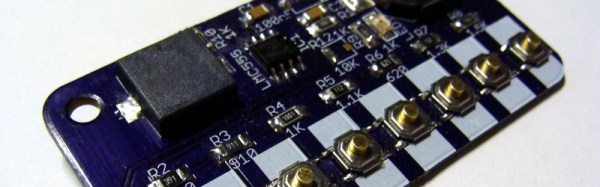
Part of the problem with getting involved in a new hobby is the cost. Whether you’re learning to surf, weld, garden, or program, often the entry cost is several hundred dollars. We’re huge fans of things with low barriers to entry, though, so we were happy to see the latest project from [pappas.chris] which promises to introduce newcomers to the musical hobby of synthesizers for just over $20.

The build revolves around an STM32F7 microcontroller and offers a 6-voice virtual analog synthesizer. The build is expandable, too, so if you want to build on the STM platform with any other add ons the process is relatively simple. This might not be necessary for a while, though; the current iteration offers many features that a typical synthesizer would have. Exhausting the possibilities with this tiny device will take some effort.

Since the synth is built on a common microcontroller platform, it’s easily programmable too, which isn’t often a feature of commercial synthesizers. You can listen to a sample audio file on the project page, and get started building your own as well. If you don’t have your own keyboard to use with it, there are other DIY synths that cover that area as well.