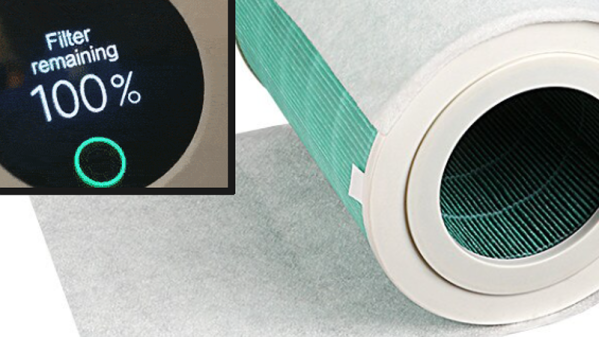
If there’s one thing that can trigger people, it’s the printer racket. Printer manufacturers who put DRM-like features into their consumables are rightly viewed as Satan’s spawn, and while these monsters have been content so far to only put digital rights management features into their ink and toner cartridges, they appear to now have their rapacious gaze set on print media too. At least according to the good folks over at the Electronic Frontier Foundation, who claim that Dymo’s latest generation of label printers will have RFID tags in the label cartridges, apparently to prevent consumers from buying non-Dymo media. The company doesn’t bill it as a way to lock you into their exorbitantly priced consumables, of course; rather, this is an exciting new feature that’s called “Automatic Label Recognition,” which keeps track of what labels are installed and how many are left. Of course, this is just red meat to people like us, and we fully expect to see workarounds in the not-to-distant future.
NFC93 Articles
An NFC Antenna Ring With A Chip As Its Jewel
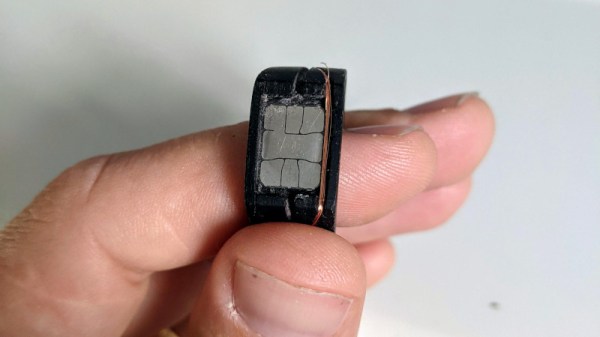
Contactless payment by means of NFC-enabled bank cards has made our everyday transactions far more convenient over the last decade, but there still remains the tedious task of finding the card and waving it over the reader. Maybe embedded chips are a step too far for many of us, but how about a bank card in a wearable such as a ring? [Jonathan Limén] shows us how, by taking the NFC chip module from a bank card and mounting it on a ring with a wire coil antenna embedded within it.
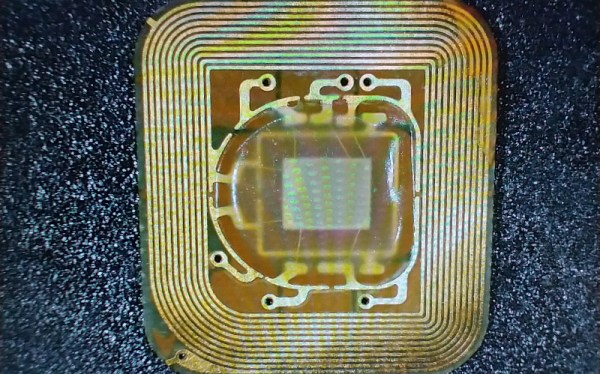
The chip in a bank card comes mounted on a small thin PCB with contacts on one side and a coil on the other that serves as its antenna. It’s not sensitive enough to work reliably with most card readers, so the card incorporates a separate printed circuit layer that forms a large-sized tuned circuit which couples to the chip antenna. After taking us through the removal of the chip from the card with some acetone, he proceeds to create a replacement for the card antenna by winding a wire coil round the ring. This becomes a trial-and-error process, but in the end, the result is a working NFC payment ring.
We quite like this idea, but would be tempted to both take away some of the trial and error with a vector network analyzer, and run a couple of turns of the wire as a closer coupling coil for the chip. This is a subject we’ve looked at before here at Hackaday, and we wouldn’t mind having another go at it.
NFC Performance: It’s All In The Antenna
NFC tags are a frequent target for experimentation, whether simply by using an app on a mobile phone to interrogate or write to tags, by incorporating them in projects by means of an off-the-shelf module, or by designing a project using them from scratch. Yet they’re not always easy to get right, and can often give disappointing results. This article will attempt to demystify what is probably the most likely avenue for an NFC project to have poor performance, the pickup coil antenna in the reader itself.

The tags contain chips that are energised through the RF field that provides enough power for them to start up, at which point they can communicate with a host computer for whatever their purpose is.
“NFC” stands for “Near Field Communication”, in which data can be exchanged between physically proximate devices without their being physically connected. Both reader and tag achieve this through an antenna, which takes the form of a flat coil and a capacitor that together make a resonant tuned circuit. The reader sends out pulses of RF which is maintained once an answer is received from a card, and thus communication can be established until the card is out of the reader’s range. Continue reading “NFC Performance: It’s All In The Antenna”
What’s On Your Bank Card? Hacker Tool Teaches All About NFC And RFID
The Flipper Zero is a multipurpose hacker tool that aims to make the world of hardware hacking more accessible with a slick design, wide array of capabilities, and a fantastic looking UI. They are struggling with manufacturing delays like everyone else right now, but there’s a silver lining: the team’s updates are genuinely informative and in-depth. The latest update is all about RFID and NFC, and how the Flipper Zero can interact with a variety of contactless protocols.

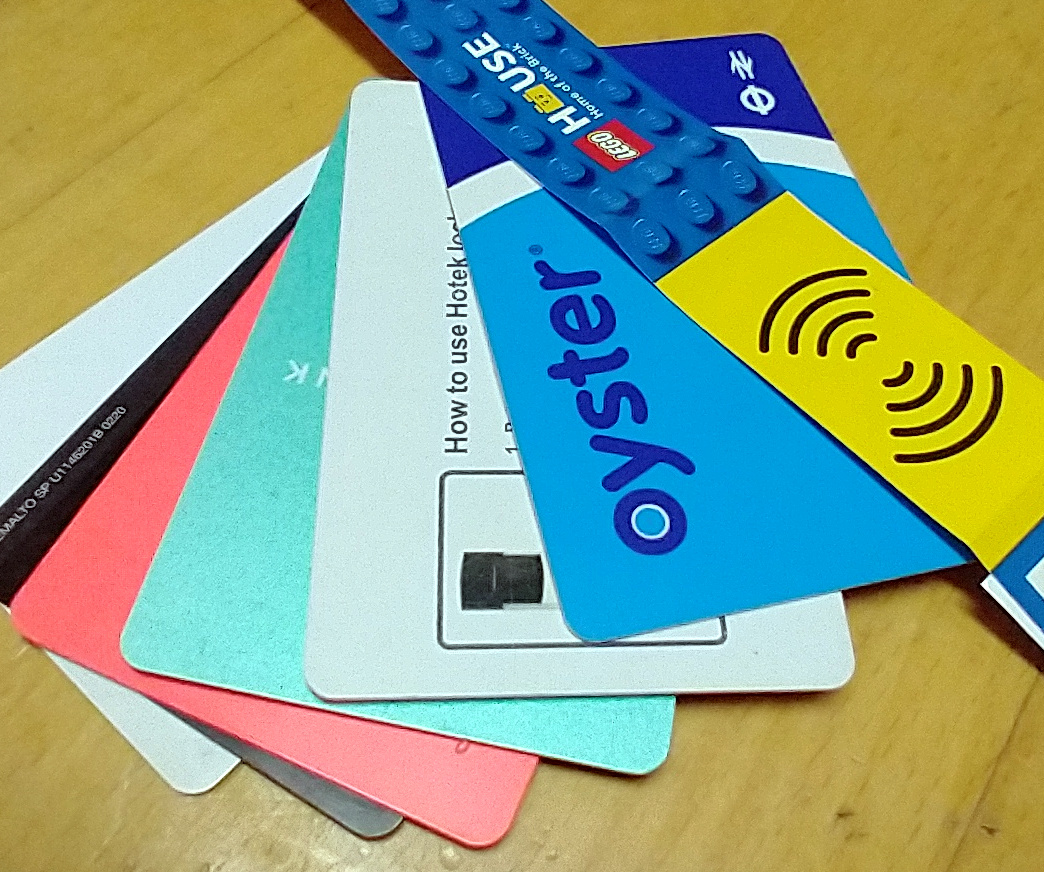
Contactless tags are broadly separated into low-frequency (125 kHz) and high-frequency tags (13.56 MHz), and it’s not really possible to identify which is which just by looking at the outside. Flipper Zero can interface with both, but the update at the link above goes into considerable detail about how these tags are used in the real world, and what they look like from both the outside and inside.
For example, 125 kHz tags have an antenna made from many turns of very fine wire, with no visible space between the loops. High-frequency tags on the other hand will have antennas with fewer loops, and visible space between them. To tell them apart, a bright light is often enough to see the antenna structure through thin plastic.
Low-frequency tags are “dumb” and incapable of encryption or two-way communication, but what about high-frequency (often referred to as NFC) like bank cards and applications like Apple Pay? One thing demonstrated is that mobile payment methods offer up considerably less information on demand than a physical bank or credit card. With a physical contactless card it’s possible to read the full card number, expiry date, and in some cases the name as well as recent transactions. Mobile payment systems (like Apple or Google Pay) don’t do that.
Like many others, we’re looking forward to it becoming available, sadly there is just no getting around component shortages that seem to be affecting everyone.
Download From NFC Datalogger, No App Required
The plethora of wireless technologies has made internet-connected devices the norm, but it’s not always necessary if you don’t need real-time updates. Whether it’s due to battery life, or location and range constraints, downloading data directly from the device whenever possible might be a viable solution. [Malcolm Mackay] demonstrates an elegant solution on the open source cuplTag temperature/humidity logger, using any NFC-enabled smartphone, without requiring a custom app.
The cuplTag utilizes the feature on NFC-enabled smartphones to automatically open a URL provided by the cuplTag. It encodes the sensor data from the sensor unit as a circular buffer in a ~1 kB URL, which automatically uploads to a web frontend that plots the data. (You can use their server or run your own.)
This means that data can be collected by anyone with the appropriate phone with zero setup. The data is displayed on the web app and can be downloaded as a CSV. To deter spoofing, each tag ships with a secret key which is used to generate a unique HMAC every time the circular buffer changes.
Battery life is a priority on the cuplTag, and it’s theoretically capable of running seven years on a single CR1220 coin cell using the current-sipping Texas Instruments MSP430 microcontroller. The hardware, firmware, and server-side frontend and backend code are all open source and available on GitHub.
Earlier this year, we held a data logging contest, and featured submissions that monitored everything from your garden’s moisture levels to your caffeine intake.
NFC Who’s At The Door

[RevK] wanted to learn about NFC readers, and we agree that the best way to do so is to dive in and build one yourself.
There are readers available from multiple sources, but [RevK] found them either compact but with no prototyping space or plenty of prototyping space and a large footprint. High-speed UART (HSU) was selected over I2C for communication with an ESP32 as testing showed it was just as fast and more reliable over long distances at the cost of only one additional wire.
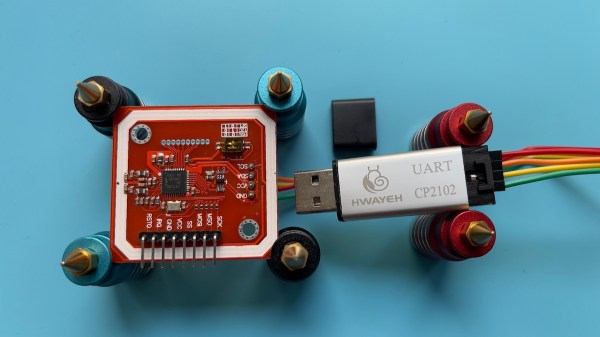
After a few versions, the resulting PN532 based NFC reader has just enough GPIO for a doorbell and tamper switch and three status LEDs, with board files and a 3D-printed case design included in the open source project on GitHub. When looking into the project, we appreciated learning about tamper switches that can include closed or open contact status when an NFC is read, most often used in the packaging of high-value and collectible products. If you have worked with this tamper feature of NFCs, let us know about it.
Thanks for the tip, [Simon]
This Week In Security: Print Nightmare Continues, Ransomware Goes Bigger, And ATM Jackpots!
For the second time, Microsoft has attempted and failed to patch the PrintNightmare vulnerability. Tracked initially as CVE-2021-1675, and the second RCE as CVE-2021-34527. We warned you about this last week, but a few more details are available now. The original reporter, [Yunhai Zhang] confirms our suspicions, stating on Twitter that “it seems that they just test with the test case in my report”.
CVE-2021-1675 is meant to fix PrintNightmare, but it seems that they just test with the test case in my report, which is more elegant and also more restricted. So, the patch is incomplete. : (
— Yunhai Zhang (@_f0rgetting_) July 1, 2021
Microsoft has now shipped an out-of-band patch to address the problem, with the caveat that it’s known not to be a perfect fix, but should eliminate the RCE element of the vulnerability. Except … if the server in question has the point and print feature installed, it’s probably still vulnerable. And to make it even more interesting, Microsoft says they have already seen this vulnerability getting exploited in the wild. Continue reading “This Week In Security: Print Nightmare Continues, Ransomware Goes Bigger, And ATM Jackpots!”