Mercy Me, Thanks For The Heals

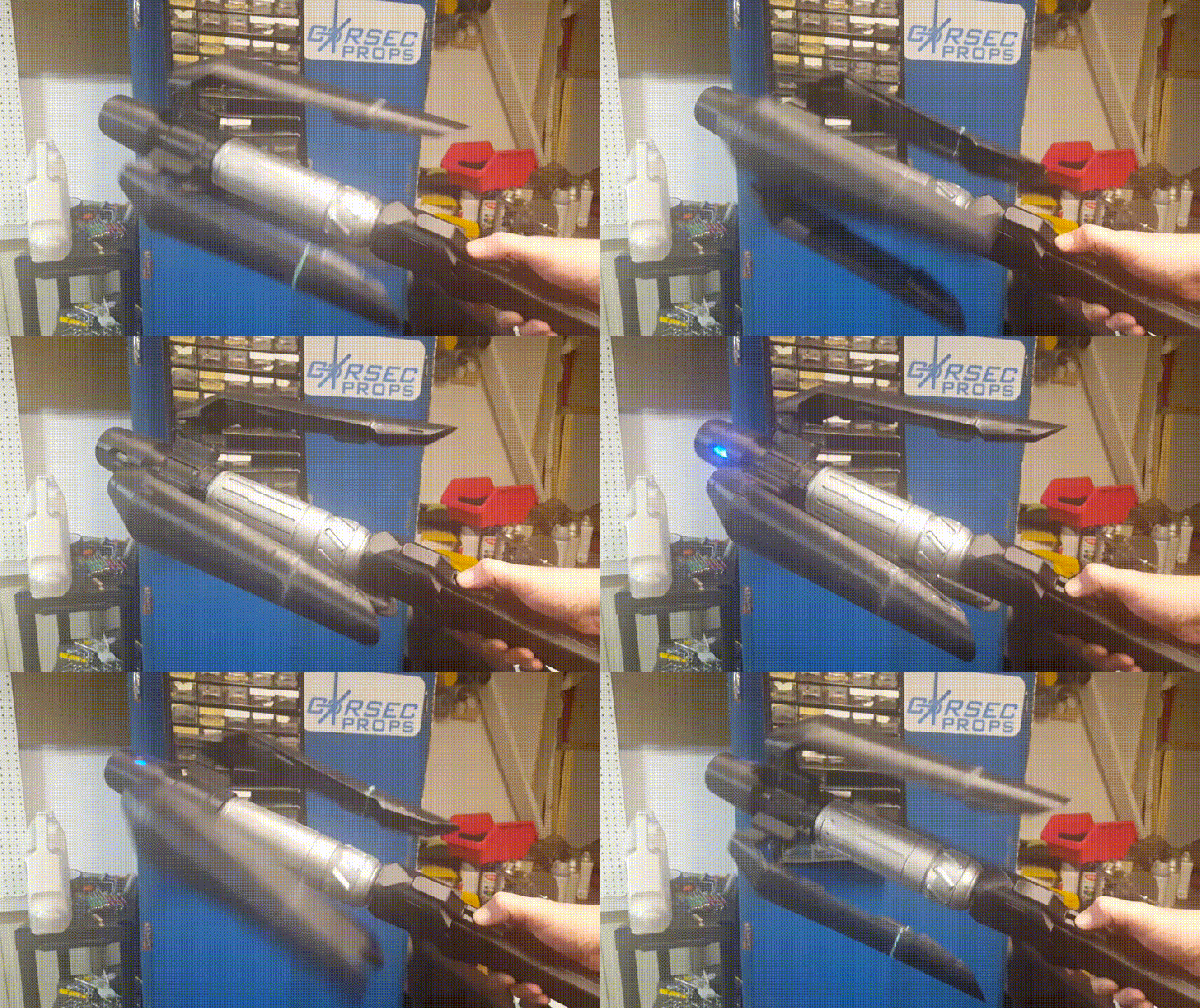
Sometimes, you have to call in the experts. [CorSec Props], builders of fine props, costumes and more, were commissioned to replicate Mercy’s healing staff from the game Overwatch. Sounds simple, but the customer — right as they always are — requested that it spin and light up just like the original.

To get a look at the electronics, the rotating head slides off after removing a screw. Inside, the rechargeable 18650 lithium-ion 3.7V battery — via a DC to DC converter — is bumped up to 5.5V in order to run a 12V, 120rpm motor. At full voltage the staff’s head rotates too fast, and so it’s deliberately under-powered for a more replica-appropriate speed.

A ring of RGB LEDs as well as a pair pointed at the tip of the staff toggle between yellow and blue hues. To switch between these different lighting modes, a double-pole, triple throw switch was modified to function like a more-suited-to-the-task-than-what-we-had-in-the-shop three position, double-pole, double-throw switch.

On the motor shaft, pair of studs slot into a piece of acrylic at the tip of the staff. This stops it from slipping, but also allows the LED glow to diffuse out the top as well as the portholes on the side of the staff. Check out the build after the break!

Continue reading “Mercy Me, Thanks For The Heals”

This Mask Will Make You A Psycho

Videos games are a cornucopia of project ideas well-suited to the talents of makers and hackers, and Halloween is as good a time as any to show them off! Reddit user [Tavarin], a huge fan of the Boderlands video games, whipped up a plaster mask — replete with glowing eyes — of one of the game’s signature enemies: the Psycho.

[Tavarin]’s secret to forming comfortable plaster masks is to open his jaw while the wrap is setting  — that way he’ll be able to talk without breaking the mask off his face. Hot gluing in and modifying a 60mm PC fan and a pair of lenses meant that the only thing standing between him and a lot of sanding to shape the mask’s details was a few layers of thick plaster mix.

Continue reading “This Mask Will Make You A Psycho”

A Lightsaber, With Rave Mode

How often after being exposed to Star Wars did you dream of having your own working lightsaber? These days — well, we don’t quite have the technology to build crystal-based weapons, but tailor-made lightsabers like redditor [interweber]’s are very much real.

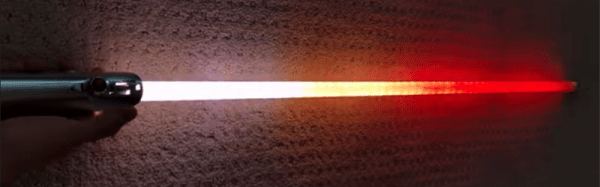
Piggybacking off the Korbanth Graflex 2.0 kit — a sort of bare-bones lightsaber ready to personalize — [interweber] is using a Teensy 3.5 to handle things under the hilt. Instead of taking the easy route and cramming everything into said handle, a 3D printed a cradle for the electronics and speaker keep things secure. The blade is made up of two meters of APA102 LEDs.

As well as all the sound effects appropriate to ‘an elegant weapon for a more civilized age’, a cluster of buttons handle the various functions; , playing and cycling through music(more on that in a second), changing the color of the lightsaber — Jedi today, Sith tomorrow — enabling a flickering effect that mimics Kylo Ren’s lightsaber, color cycling, and a…. rave mode?

Continue reading “A Lightsaber, With Rave Mode”

We Are Now At DEFCON 2

If you had a working DEFCON meter that reported on real data, would it be cool or distressing?

Before we get ahead of ourselves: no, not that DEF CON. Instructables user [ArthurGuy] is a fan of the 1983 movie  War Games, and following a recent viewing –hacker senses a-tingling — he set to work building his own real-time display.

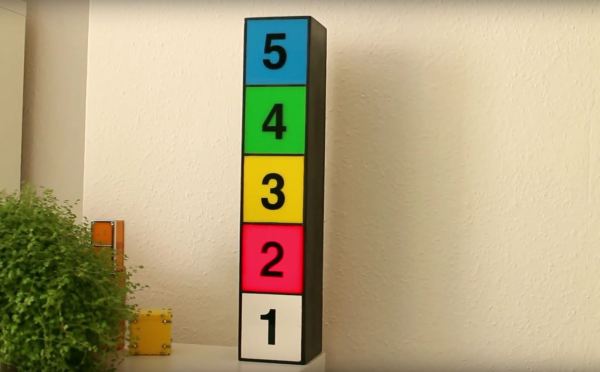
Making use of some spare wood, [ArthurGuy] glued and nailed together a 10x10x50cm box for the sign. Having been painted white already at some point, the paint brilliantly acted as a reflector for the lights inside each section. The five DEF CON level panels were cut from 3mm pieces of coloured acrylic with the numbers slapped on after a bit of work from a vinyl cutter.

Deviating from a proper, screen-accurate replica, [ArthurGuy] cheated a little and used WS2812 NeoPixel LED strips — 12 per level — and used a Particle Photon to control them. A quick bit of code polls the MI5 terrorism RSS feed and displays its current level — sadly, it’s currently at DEFCON 2.

Continue reading “We Are Now At DEFCON 2”

Hacker Maketh Kingsman Umbrella

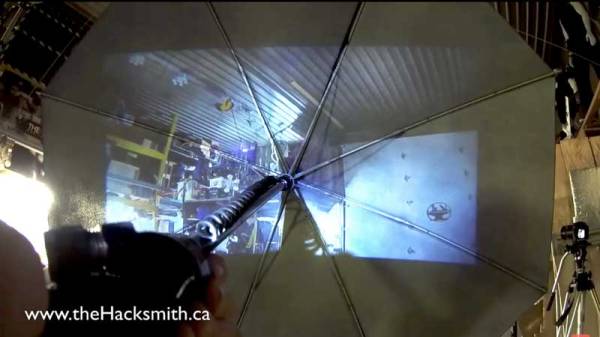
Yes! Someone made the Kingman umbrella and yes it can shoot and yes it has a display on the inside. [James Hobson] just put up a video on YouTube for this excellent project detailing the process that went into creating this live working prop and it is amazing.

The build starts with finding a rugged umbrella and was tested by standing on it as well as decimating a few household objects. Compress CO2 cartridges provide the fuel for propelling blow darts as well as other non-lethal forms of ammunition. The coolest part of the project is the screen inside the portable that allows you to see-through the dome. This is accomplished by a combination of a small camera and a portable mini projector. Simple yet awesome.

The camera is mounted near the muzzle whereas the projector is sliced-up and integrated into the grip. The handle in question is itself 3D printed and includes a custom trigger into the design. Check out the video for a demonstration of the project.

Movie props have a special place in every maker’s heart and this project is an excellent example of imagination meeting ingenuity. After seeing this video, security agencies are going to be giving umbrella owners some suspicious looks though creating own of your own could be a very rewarding experience. If you are looking for a more obvious prop, then check out the PiPBoy Terminal from Fallout which is sure to get everyone’s attention. Continue reading “Hacker Maketh Kingsman Umbrella”

Helix Display Brings Snake Into Three Dimensions

Any time anyone finds a cool way to display in 3D — is there an uncool way? — we’re on board. Instructables user [Gelstronic]’s method involves an array of spinning props to play the game Snake in 3D.

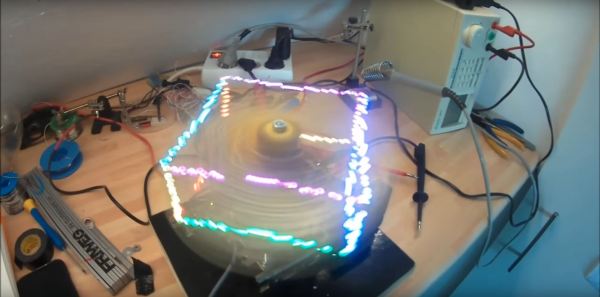
The helix display consists of twelve props, precisely spaced and angled using 3D-printed parts, each with twelve individually addressable LEDs. Four control groups of 36 LEDs are controlled by the P8XBlade2 propeller microcontroller, and the resultant 17280 voxels per rotation are plenty to produce an identifiable image.

In order to power the LEDs, [Gelstronic] used wireless charging coils normally used for cell phones, transferring 10 W of power to the helix array.  A brushless motor keeps things spinning, while an Arduino controls speed and position via an encoder. All the links to the code used are found on the project page, but we have the video of the display in action is after the break.

Continue reading “Helix Display Brings Snake Into Three Dimensions”

Folding Mass Effect Pistol!

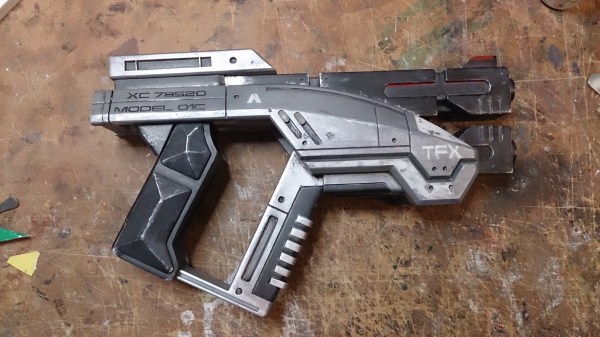
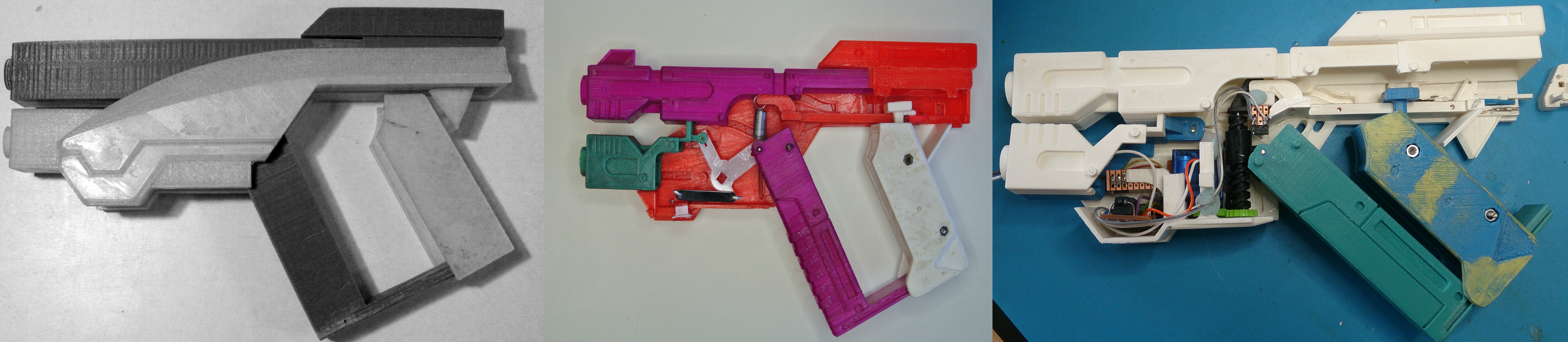
Video game props require a dedicated maker with a repertoire of skills to create. When those props are pulled from the Mass-Effect universe, a little more technological mastery is needed. Bringing those talents to bear,  [Optimistic Geometry] has built a motorized, folding M-3 Predator Pistol!

The gun was modeled in Fusion 360 and 3D printed on an Ultimaker 2 at the  MAKLab Glasgow. [Optimistic Geometry] felt constrained by the laws of our reality, so opted for the smaller firearm thinking it would be an appropriate entry-level challenge. I’m sure you can guess how that went.

There wound up being three main build phases as well as a spring-loaded version to testing purposes. Throughout, [Optimistic Geometry] struggled with getting the parts to latch fully open or closed, as well as working with the small form factor. However, overhauling the motor design — and including some limiters lest it deconstruct itself — a custom latching circuit, and — obviously — a few LEDs for effect, produced a magnificent prop.

Continue reading “Folding Mass Effect Pistol!”