Destroy My Vegetable Garden? Oh Hail No!

Building and maintaining a garden takes a lot of work. And unless you have a greenhouse, you’re forced to leave your hard work outside to fend for itself against the double-edged sword of the elements. Rain and sun are necessary, but hard, pelting hail is never welcome. Just ask [Nick Rogness]. He didn’t go through all the trouble of building a 12’x12′ garden and planting tasty vegetables just to have Mother Nature spew her impurity-filled ice balls on it every other night during the summertime.

[Nick] did what any of us would do: fight back with technology. His solution was to build a retractable roof that covers the garden with a heavy duty tarp. A Raspberry Pi Zero W controls pair of linear actuators via motor controllers, and [Nick] put a limit switch in each of the four corners to report on the roof status. He can run the roof manually, or control it with his phone using MQTT. The whole thing runs on a 12V marine battery that gets charged up by a solar panel, so part of the interface is dedicated to reporting the battery stats.

[Nick] ran out of time to implement all the features he wanted before the season started, but there’s always next year. He has big plans that include soil moisture sensors, rain detection sensors, and an automatic watering system that collects and uses rain water. We planted the bite-size demo video for you after the break — just wash the dirt off and you’re good to go.

Maybe someday [Nick] will create a system that can automate the entire garden, like the FarmBot. Hey, we’re just trying to plant seeds of ideas.

Continue reading “Destroy My Vegetable Garden? Oh Hail No!”

Raspberry Pi 4 And The State Of Video Game Emulation

The modern ideal of pixel art is a fallacy. Videogame art crammed onto cartridges and floppy discs were beholden to the CRT display technology of their day. Transmitting analog video within the confines of dingy yellow-RCA-connector-blur, the images were really just a suggestion of on-screen shapes rather than clearly defined graphics. Even when using the superior RGB-video-over-SCART cables, most consumer grade CRT televisions never generated more than about 400 lines, so the exacting nature of digitized plots became a fuzzy raster when traced by an electron beam. It wasn’t until the late 90s when the confluence of high resolution PC monitors, file sharing, and open source emulation software that the masses saw pixels for the sharp square blocks of color that they are.

More importantly, emulation software is not restricted to any one type of display technology any more than the strata of device it runs on. The open-source nature of videogame emulators always seems to congregate around the Lowest Common Denominator of devices, giving the widest swath of gamers the chance to play. Now, that “L.C.D.” may very well be the Raspberry Pi 4. The single board computer’s mix of tinker-friendly IO at an astonishingly affordable entry price has made it a natural home for emulators, but at fifty bucks what options unlock within the emulation scene?

Continue reading “Raspberry Pi 4 And The State Of Video Game Emulation”

Guitar Hero Controller Gets A New Musical Life

Guitar Hero was a big deal, right up until it wasn’t. The best efforts of the video game industry couldn’t resurrect the once-off rush of enthusiasm for rhythm gaming, and thrift stores around the globe are now littered with little plastic instruments. [Analog Sketchbook] decided to give one of these guitars for the Wii a new life, repurposing it as a synth controller.

The build is a straightforward one, thanks to the prevalence of modern maker solutions to electronic problems. Hooking up to the guitar is a solved problem, with an Adafruit Nunchucky breakout board allowing the Guitar Hero controller to be connected via jumper wires to the Raspberry Pi’s IO pins.

Communication is via I2C, and is easy to work with in Pure Data, running on the Pi. [Analog Sketchbook] created a patch that runs a synthesizer, controlled by the buttons and controls on the guitar itself. With this setup, you could create any number of different routines to allow the guitar to be played differently. We’d love to see a chiptune-esque arpeggio patch, or something that plays fat FM synth tones a la the Genesis, but that’s just our opinion. The sky really is the limit here, with plenty of grunt on the Pi for various forms of synthesis.

It’s a fun build that gives new life to an otherwise forgotten gaming accessory. We’ve seen them repurposed before too, as far back as 2010. Video after the break.

Continue reading “Guitar Hero Controller Gets A New Musical Life”

The Internet Controls This Monster

What’s worse than unleashing a monster on the internet? Allowing the internet to control the monster! But that’s just what [8BitsAndAByte] did, created a monster that anyone on the internet can control. Luckily for us, this monster only talks.

This is a very simple project and most of the parts are off the shelf. Hardware wise the monster’s body is made out of a plastic flowerpot; its mouth is a bit of wood that covers the top of the flowerpot; its eyes, two halves of a plastic sphere painted white with some felt for irises. And then whole thing is covered in some blue fake fur.

Electronics wise, a Raspberry Pi is running the show and handling the text-to-speech is an AIY Voice Hat. A servo fits inside the flowerpot to open and close the monster’s mouth. On the software end of things, a bit of Python has been written that waits for a bit of text, sends it off to the Voice Hat’s text-to-speech module and moves the servo to open and close the mouth. The scary part, connecting the monster to the internet, is done with remo.tv, which is some open-source code hosted on GitHub specifically for allowing control of robots over the internet.

This is a neat little project which is simple enough that kids could build one themselves. The instructions and the python script are up on the Instructables page, and you can see the monster in action at its page on remo.tv. Perhaps [8BitsAndAByte] could add a couple of these internet controlled robot arms to the monster to create a monster that could create some real havoc!

Continue reading “The Internet Controls This Monster”

Parallel Pis For Production Programming; Cutting Minutes And Dollars Off Of Assembly

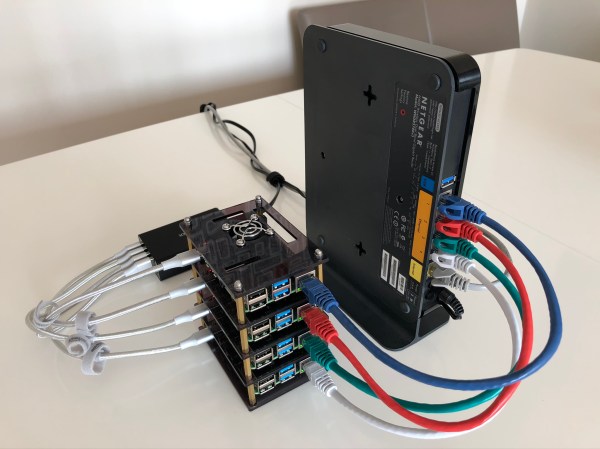
Assembly lines for electronics products are complicated beasts, often composed of many custom tools and fixtures. Typically a microcontroller must be programmed with firmware, and the circuit board tested before assembly into the enclosure, followed by functional testing afterwards before putting it in a box. These test platforms can be very expensive, easily into the tens of thousands of dollars. Instead, this project uses a set of 12 Raspberry Pi Zero Ws in parallel to program, test, and configure up to 12 units at once before moving on to the next stage in assembly.

Continue reading “Parallel Pis For Production Programming; Cutting Minutes And Dollars Off Of Assembly”

Tiny Tree Is A Thermometer For Christmas Fever

Tired of the usual methods for animating all those RGB LEDS for your holiday display? How about using trendiness in a non-trendy way?

[8BitsAndAByte] caved in to increasing holiday madness and bought the cutest little Christmas tree. A special tree deserves special decorations, so they packed it with NeoPixels that turn from red to green and back again one by one. Here’s where the trendiness comes in: the speed at which they change is determined by the popularity of “Christmas” as a search term.

The NeoPixels are controlled by a Raspberry Pi 3B+ that uses PyTrends to grab a value from Google Trends once an hour. The service returns a value between 0 to 100, where 100 means the search term is extremely popular, and 0 means it’s probably the dead of January. Each NeoPixel is wired to the underside of a translucent printed gift box that does a great job of diffusing the light.

You know how Christmas trees have a tendency to stick around well into the new year? This one might last even longer than usual, thanks to the bonus party mode. Press the arcade button on the box cleverly disguised as a present, and the lights change from red to green and back at warp speed while the speaker inside blasts the party anthem of your choice. Be sure to check out the demo/build video waiting for you under after the break.

How could this little tree get any more special? Well, a rotating platform couldn’t hurt.

Continue reading “Tiny Tree Is A Thermometer For Christmas Fever”

Hackaday Links Column Banner

Hackaday Links: December 22, 2019

It’s hard to believe it, but the Raspberry Pi has been on the market for only seven years now. The single-board computer has become so entrenched in the hobby electronics scene that it’s hard to imagine life without it, or what we did before it came along. And with the recent announcement that the 30 millionth Raspberry Pi was recently manufactured, now we have some clarity on the scale of its success. Just roll that number around in your head for a bit – that’s one Pi for every nine or so people in the USA. Some of the other facts and figures in the linked article boggle the mind too, like Eben Upton figured they’d only ever sell about 10,000 units, or that the factory in Wales where most Pis are made can assemble 15,000 units a day.

Speaking of manufacturing, have you ever considered what goes into getting a small-scale manufactured product ready for shipping? The good folks over at Gigatron know all about the joys of kitting, and have put together an interesting un-unboxing video for their flagship TTL-only retro computer. It’s a nice riff on the unboxing videos that are somehow popular on YouTube these days, and shows just how much effort they put into getting a Gigatron out the door. All told, it takes about an hour to ship each unit, and the care put into the process is evident. We especially like the part where all the chips are placed into antistatic foam in the same orientation they’ll be on the completed board. Nice touch.

Last time we checked in on the Lulzbot saga, the open source 3D printer manufacturer had been saved from complete liquidation by a company named FAME 3D. Now we’re getting the first solid details about where things go from here. Not only will thirteen of the remaining Lulzbot employees be staying on, but FAME 3D plans to hire 50 new employees to get operations back up as quickly as possible. The catch? The “F” in FAME 3D stands for Fargo, North Dakota, where Fargo Additive Manufacturing Equipment 3D is based. So Lulzbot will be moving north from Loveland, Colorado in the coming months.

For the last few years, adventure travelers making the pilgrimage to Shenzhen to scour the electronics markets have stuffed a copy of Andrew “Bunnie” Huang’s The Essential Guide to Electronics in Shenzhen into their soon-to-be-overflowing backpacks. The book is a goldmine of insider information, stuffed with maps and translation tables critical for navigating a different culture with no local language skills. Bunnie’s book has only been available in dead-tree format and now that all but the last few copies have been sold, he decided to make a web version available for free. We’d have to think a tablet or phone would be a bit harder to use in the heat of negotiation than the nice spiral-bound design of the print copy, but the fact that the insider information will now be widely available probably makes this a net positive.

And finally, if you’ve ever nearly been run over by an EV or hybrid silently backing out of a parking space, you’ll no doubt appreciate attempts to legislate some sort of audible presence to these vehicles. But what exactly should an electric vehicle be made to sound like? Volkswagen has begun to address that question, and while you can certainly read through the fluff in their press release, all you really need to do is listen to the sample. We’ve got to say that they pretty much nailed what a car of the future should sound like. Although they might have missed a real opportunity here.