Way to rub it in, guys. As it turns out, due to family and work obligations we won’t be able to see the next Great American Eclipse, at least not from anywhere near the path of totality, when it sweeps from Mexico into Canada on April 8. And that’s too bad, because compared to the eclipse back in 2017, “Eclipse 2: Solar Boogaloo” is occurring during a much more active phase in the solar cycle, with the potential for some pretty exciting viewing. The sun regularly belches out gigatons of plasma during coronal mass ejections (CMEs), most of which we can’t see with the naked eye because not only is staring at the sun not a great idea, but most of that activity occurs across the disk of the sun, obscuring the view in the background light. But during the eclipse, we — oops, you — might just get lucky enough to have a solar prominence erupt along the limb of the sun that will be visible during totality. The sun has been quite active lately, as reflected by the relatively high sunspot number, so even though it’s an outside chance, it’s certainly more likely than it was in 2017. Good luck out there. Continue reading “Hackaday Links: March 24, 2024”
satellite194 Articles
Measuring Trees Via Satellite Actually Takes A Great Deal Of Field Work
Figuring out what the Earth’s climate is going to do at any given point is a difficult task. To know how it will react to given events, you need to know what you’re working with. This requires an accurate model of everything from ocean currents to atmospheric heat absorption and the chemical and literal behavior of everything from cattle to humans to trees.
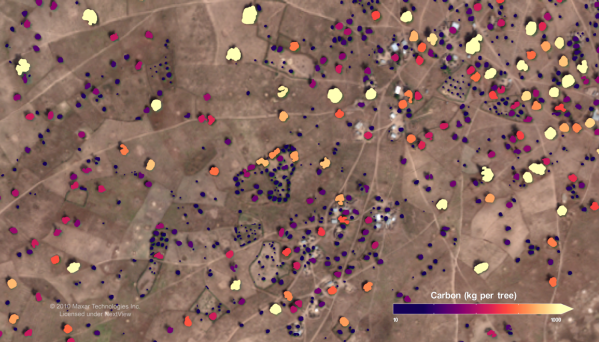
In the latter regard, scientists need to know how many trees we have to properly model the climate. This is key, as trees play a major role in the carbon cycle by turning carbon dioxide into oxygen plus wood. But how do you count trees at a continental scale? You’ll probably want to get yourself a nice satellite to do the job.
Continue reading “Measuring Trees Via Satellite Actually Takes A Great Deal Of Field Work”
Umbrella Antenna Protects You From Rain, But Not The Way You Think
You never know when you’ll be called upon to [MacGyver] your way out of an emergency. We can’t imagine what kind of situation would call for whipping up a satellite ground station for NOAA weather satellites from junk, but hey, it could happen.
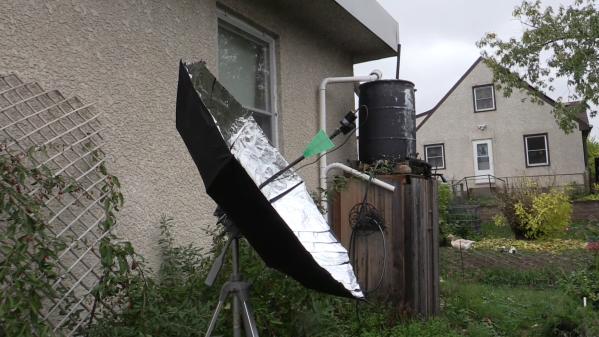
And when it does, you’ll be ready — as long as you have an umbrella, some foil tape, and various bits and bobs like wire and an RTL-SDR dongle. That’s what [saveitforparts] used for his field-expedient build, at least in the first instance; as you can imagine, builds like this take a lot of tweaking to get right. The umbrella and foil tape form the main reflector for the antenna, with a pie tin, a scrap of wire, and some random twigs being used to build the antenna’s helical feed. Attached to a SAWbird LNA/filter and an RTL-SDR plugged into a dodgy second-hand phone, he was able to get at least some kind of data from one of the GOES satellites, but it wasn’t great.
Switching the feed to a commercially available log periodic antenna worked much better, with some partial decodes of weather map data. Actually, getting anything at all with a setup like this is impressive enough for us to call it a win. It shows that the umbrella approach to antennas is valid; but then again, we already knew that.
Continue reading “Umbrella Antenna Protects You From Rain, But Not The Way You Think”
Hackaday Links: November 12, 2023
Somebody must really have it in for Cruise, because the bad press just keeps piling up for the robo-taxi company. We’ve highlighted many of the company’s woes in this space, from unscheduled rendezvous with various vehicles to random acts of vandalism and stupid AI pranks. The hits kept coming as California regulators pulled the plug on testing, which finally convinced parent company General Motors to put a halt to the whole Cruise testing program nationwide. You’d think that would be enough, but no — now we learn that Cruise cars had a problem recognizing children, to the point that there was concern that one of their autonomous cars could clobber a kid under the right conditions. The fact that they apparently knew this and kept sending cars out for IRL testing is a pretty bad look, to say the least. Sadly but predictably, Cruise has announced layoffs, starting with the employees who supported the now-mothballed robo-taxi fleet, including those who had the unenviable job of cleaning the cars after, err, being enjoyed by customers. It seems a bit wrongheaded to sack people who had no hand in engineering the cars, but then again, there seems to be a lot of wrongheadedness to go around.
Junk Bin Cyberdish Turns You Into The Satellite Tracker
The good thing about listening in on satellites is that they tend to beam down all kinds of juicy information from their lofty perches. The bad thing about satellites is that to stay in those orbits, they’ve got to be moving really fast, and that means that you’ve got to track them if you want to keep a nice consistent signal during a pass. And that can lead to all sorts of complexity, with motorized two-axis mounts and fancy tracking software.
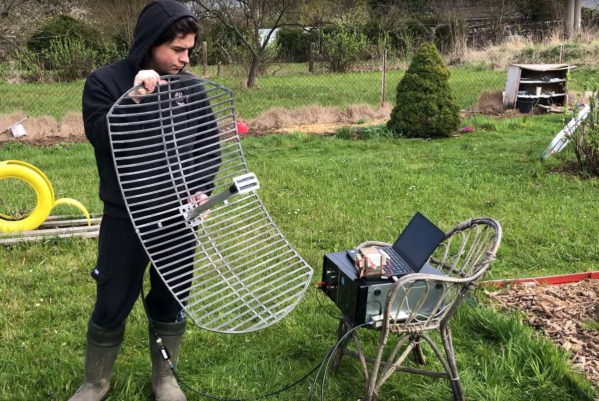
Or does it? Not if you’re willing to act as the antenna mount, which is the boat [Gabe] from the saveitforparts channel on YouTube recently found himself in when searching for L-band signals from the GOES satellite. His GOES setup uses a 30″ (0.8 m) dish repurposed from a long-range wireless networking rig. Unfortunately, the old security camera pan-tilt unit it was mounted on wasn’t quite up to satellite tracking duty, so [Gabe] pulled the dish off and converted it to manual tracking.
With a freshly wound helical antenna and a SAWbird LNA at the focal point, the dish proved to be pretty easy to keep on track manually, while providing quite the isometric workout. Aiming was aided by an app called Stellarium which uses augmented reality to point out objects in the night sky, and a cheap tablet computer was tasked with running SDR++ and capturing data. Sadly, neither of these additions brought much to the party, with the latter quickly breaking and the former geared more toward stargazing than satellite snooping. But with some patience — and some upper-body strength — [Gabe] was able to track GOES well enough with the all-in-one “cyberdish” to get some usable images. The whole saga is documented in the video after the break.
Kudos to [Gabe] for showing us what can be accomplished with a little bit of junk and a lot of sticktoitiveness. He promises that a legit two-axis mount is in the works, so we’ll be on the lookout for that. We’ve seen a few of those before, and [Chris Lott] did a great overview of satellite tracking gear a while back, too.
Continue reading “Junk Bin Cyberdish Turns You Into The Satellite Tracker”
Listening In On A Deep-Space Satellite As It Returns Home
We’ve covered dozens of projects about getting images of Earth’s weather straight from the source. It’s not too much of a trick to download images straight from our constellation of weather satellites, but what about space weather? We’ve got satellites for that too, of course, but to get a good look at the Sun, they’re out of reach of most homebrew ground stations.
That’s about to change, though, as STEREO-A returns to our neighborhood after a 17-year absence, making citizen science a reasonable proposition. The STEREO mission — Solar Terrestrial Relations Observatory — was launched in 2006 with a pair of satellites in heliocentric orbits. STEREO-B was lost in 2014 due to a navigational glitch, but STEREO-A has spent a lot of the intervening years watching the backside of the Sun relative to the Earth. As [Scott Tilley] explains, the satellite is now approaching inferior conjunction, where it will pass between the Earth and the Sun.
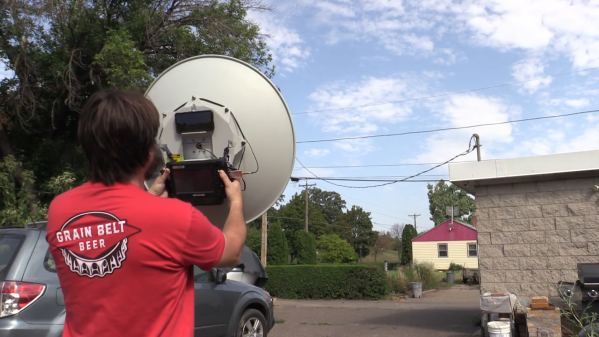
This close pass makes STEREO-A’s X-band deep-space beacon readily available to hobbyist-scale equipment, like [Scott]’s 66-cm dish antenna. The dish is mounted on an alt-az telescope mount for tracking, and sports a host of gear at the focus, like LNAs, filters, mixers, and an Ettus B200 SDR. It’s not a cheap setup, but compared to what’s usually needed to listen to STEREO-A, it’s a bargain. The process of demodulating and decoding the signals was a bit more involved, though, requiring not only SatDump and some custom code but also a lot of patience. The images are worth the wait, though; [Scott] shares some amazing shots of our increasingly active Sun as well as animations of recent sunspot activity.
If you’re interested in getting in on the STEREO-A action, you’d better get hopping — the satellite will only be in the neighborhood for a few more months before heading off for another pass around the back of the Sun.
Using An Old Satellite To See The Earth In A New Light
Snooping in on satellites is getting to be quite popular, enough so that the number of people advancing the state of the art — not to mention the wealth of satellites transmitting signals in the clear — has almost made the hobby too easy. An SDR, a homebrew antenna, and some off-the-shelf software, and you too can see weather satellite images on your screen in real time.
But where’s the challenge? That seems to be the question [dereksgc] asked and answered by tapping into S-band telemetry from an obsolete satellite. Most satellite hunters focus on downlinks in the L-band or even the VHF portion of the spectrum, which are within easy reach of most RTL-SDR dongles. However, the Coriolis satellite, which was launched in 2003, has a downlink firmly in the S-band, which at 2.2-GHz puts it just outside the high end of an RTL-SDR. To work around this, [dereksgc] bought a knock-off HackRF SDR and couple it with a wideband low-noise amplifier (LNA) of his own design. The dish antenna is also homebrewed from a used 1.8-m dish and a custom helical antenna for the right-hand circular polarized downlink signal.
As the video below shows, receiving downlink signals from Coriolis with the rig wasn’t all that difficult. Even with manually steering the dish, [dereksgc] was able to record a couple of decent passes with SDR#. Making sense of the data from WINDSAT, a passive microwave polarimetric radiometer that’s the main instrument that’s still working on the satellite, was another matter. Decoded with SatDump and massaged with Gimp, the microwave images of Europe are at least recognizable, mostly due to Italy’s distinctive shape.
Despite the distortion, seeing the planet’s surface via the microwaves emitted by water vapor is still pretty cool. If more traditional weather satellite images are what you’re looking for, those are pretty cool too.
Continue reading “Using An Old Satellite To See The Earth In A New Light”