An ADS-B Antenna Built From Actual Garbage

With the advent of low-cost software defined radio (SDR), anyone who’s interested can surf the airwaves from the FM band all the way up to the gigahertz frequencies used by geosynchronous satellites for about $20 USD. It’s difficult to overstate the impact this has had on the world of radio hacking. It used to be only the Wizened Ham Graybeards could command the airwaves from the front panels of their $1K+ radios, but now even those who identify as software hackers can get their foot in the door for a little more than the cost of a pizza.

But as many new SDR explorers find out, having a receiver is only half the battle: you need an antenna as well. A length of wire stuck in the antenna jack of your SDR will let you pick up some low hanging fruit, but if you’re looking to extend your range or get into the higher frequencies, your antenna needs to be carefully designed and constructed. But as [Akos Czermann] shows on his blog, that doesn’t mean it has to be expensive. He shows how you can construct a very capable ADS-B antenna out of little more than an empty soda can and a bit of wire.
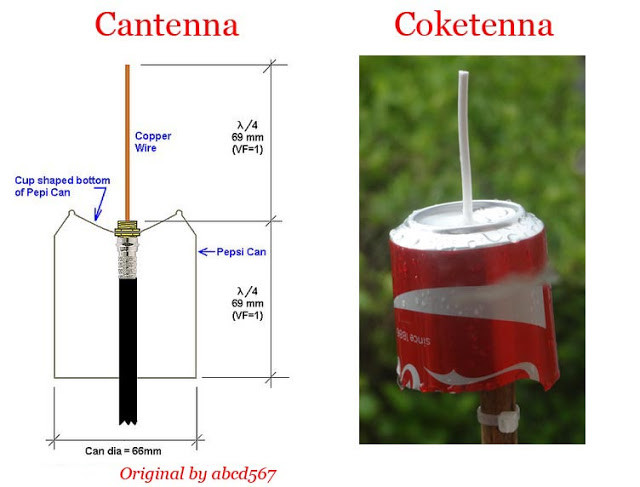
He makes it clear that the idea of using an old soda can as an antenna is not new, another radio hacker who goes by the handle [abcd567] popularized their own version of the “cantenna” some time ago. But [Akos] has made some tweaks to the design to drive the bar even lower, which he has dubbed the “coketenna”.

The primary advantages of his design is that you no longer need to solder anything or even use any special connectors. In fact, you can assemble this antenna with nothing more than a pocket knife.

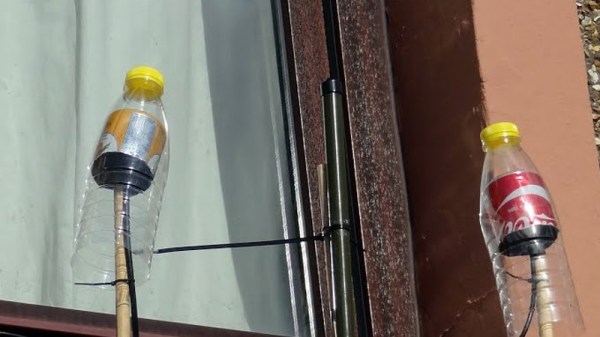
You start by cutting the can down to around 68 mm in length, and cutting an “X” into the bottom. Then strip a piece of coax, and push it through the X. The plastic-coated center conductor of the coax should emerge through the bottom of the can, while the braided copper insulation will bunch up on the other side. If you want to make it really fancy, [Akos] suggests cutting a plastic drink bottle in half and using that as a cover to keep water out of the “coketenna”.

How well does it work? He reports performance being very similar to his commercial ADS-B antenna which set him back $45 USD. Not bad for some parts of out the trash.

We’ve covered the math of creating an ADS-B antenna in the past if you’d like to know more about the science of how it all works. But if you just want an easy way of picking up some signals, this “coketenna” and an RTL-SDR dongle will get you started in no time.

Shmoocon: Delightful Doppler Direction Finding With Software Defined Radio

When it comes to finding what direction a radio signal is coming from, the best and cheapest way to accomplish the task is usually a Yagi and getting dizzy. There are other methods, and at Shmoocon this last weekend, [Michael Ossmann] and [Schuyler St. Leger] demonstrated pseudo-doppler direction finding using cheap, off-the-shelf software defined radio hardware.

The hardware for this build is, of course, the HackRF, but this pseudo-doppler requires antenna switching. That means length-matched antennas, and switching antennas without interrupts or other CPU delays. This required an add-on board for the HackRF dubbed the Opera Cake. This board is effectively an eight-input antenna switcher using the state configurable timer found in the LPC43xx found on the HackRF.

The key technique for pseudo-doppler is basically switching between an array of antennas mounted in a circle. By switching through these antennas very, very quickly — on the order of hundreds of thousands of times per second — you can measure the Doppler shift of a transmitter.

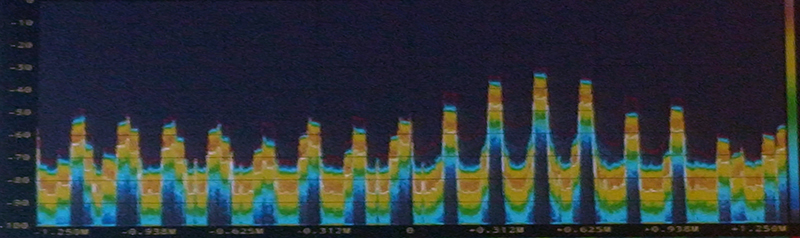
However, teasing out a distinct signal from a bunch of antennas virtually whizzing about isn’t exactly easy. If you look at what the HackRF an Opera Cake receive on a waterfall display, you’ll find a big peak around where you expect, and copies of that signal trailing off, separated by whatever your antenna switching frequency is. This was initially a problem for [Schuyler] and [Ossmann]’s experiments. Spinning the antennas at 20 kHz meant there was only 20 kHz difference in these copies, resulting in a mess that can’t be decoded. The solution was to virtually spin these antennas much faster, resulting in more separation, and a clean signal.

There are significant challenges when it comes to finding the direction of modern radio targets. Internet of Things things sometimes have very short packet duration, modulation interferes with antenna rotation, and packet detection must maintain the phase. That said, is this technique actually able to find the direction of IoT garbage devices? Yes, the demo on stage was simply finding the direction of one of the wireless microphones for the talk. It mostly worked, but the guys have some ideas for the future that would make this technique work a little better. They’re going to try phase demodulation instead of only frequency-based demodulation. They’re also going to try asymmetric antenna arrays and pseudorandom antenna switching. With any luck, this is going to become an easy and cheap way to do pseudo-doppler direction finding, all enabled by a few dollars in hardware and a laser-cut jig to hold a few antennas.

Spite, Thrift, And The Virtues Of An Affordable Logic Analyzer

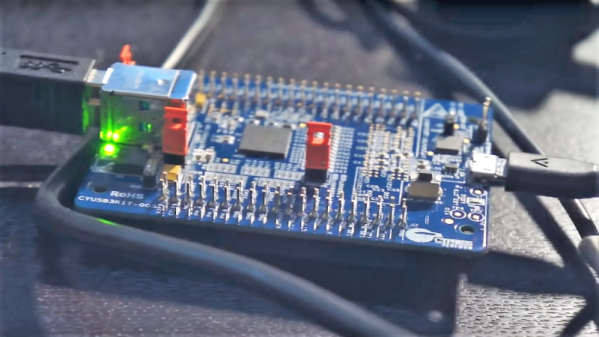
[Larry Wall], the father of Perl, lists the three great virtues of all programmers: Laziness, Impatience, and Hubris. After seeing that Saleae jacked up the prices on their popular logic analyzers to ludicrous levels, [CNLohr] added a fourth virtue: Spite. And since his tests with a Cypress FX3 over the last few days may lead to a dirt-cheap DIY logic analyzer, we may soon be able to add another virtue: Thrift.

The story begins a year or two ago when [CNLohr] got a Cypress FX3 development board for $45. The board sat unused for want of a Windows machine, but after seeing our recent article on a minimalist logic analyzer based on an FX2, he started playing with the board to see if it could fan the flames of his Saleae hatred. The FX3 is a neat little chip that has a 100-MHz General Programmable Interface (GPIF) bus that basically lets it act like an easy to use FPGA.

Prepared to spend months on the project, he was surprised to make significant progress on his mission of spiteful thrift within a few days, reading 16 bits off the GPIF at over 200 megabytes per second and dumping it over the USB 3.0 port. [Charles]’ libraries for the FX3 lay the foundation for a lot of cool stuff, from logic analyzers to SDRs and beyond — now someone just has to build them.

The search for a cheap but capable logic analyzer is nothing new, of course. Last year, both [Jenny List] and [Bil Herd] looked at the $22 iCEstick as a potential Saleae beater.

Continue reading “Spite, Thrift, And The Virtues Of An Affordable Logic Analyzer”

Image Source: Brannon Dorsey

Art Eavesdrops On Life And Pagers

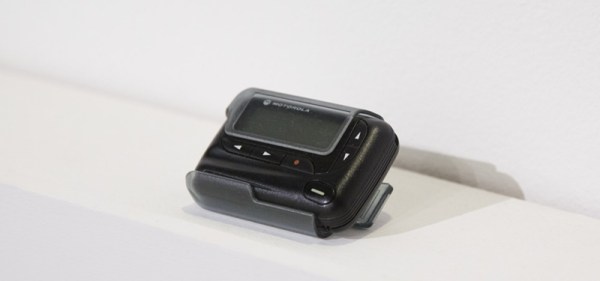
Before cell phones, pagers were the way to communicate on the go. At first, they were almost a status symbol. Eventually, they became the mark of someone who couldn’t or wouldn’t carry a cell phone. However, apparently, there are still some users that clutch their pagers with a death grip, including medical professionals. In an art project called HolyPager, [Brannon Dorsey] intercepted all the pager messages in a city and printed them on a few old-style roll printers. The results were a little surprising. You can check out the video below.

Almost all the pages were medical and many of them had sensitive information. From a technical standpoint, [Brannon’s] page doesn’t shed much light, but an article about the project says that it and other art projects that show the hidden world or radio waves are using our old friend the RTL-SDR dongle.

Pagers use a protocol — POCSAG — that predates our modern (and well-founded) obsession with privacy and security. That isn’t surprising although the idea that private medical data is flying through the air like this is. Decoding POCSAG isn’t hard. GNU Radio, for example, can easily handle the task.

We’ve looked at pager hacking in the past. You can even run your own pager network, but don’t blame us if you get fined.

Continue reading “Art Eavesdrops On Life And Pagers”

Neural Network Learns SDR Ham Radio

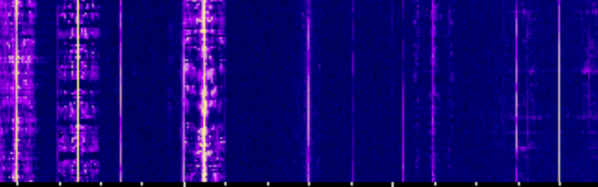
Identifying ham radio signals used to be easy. Beeps were Morse code, voice was AM unless it sounded like Donald Duck in which case it was sideband. But there are dozens of modes in common use now including TV, digital data, digital voice, FM, and more coming on line every day. [Randaller] used CUDA to build a neural network that could interface with an RTL-SDR dongle and can classify the signals it hears. Since it is a neural network, it isn’t so much programmed to do it as it is trained. The proof of concept has training to distinguish FM, SECAM, and tetra. However, you can train it to recognize other modulation schemes if you want to invest the time into it.

Continue reading “Neural Network Learns SDR Ham Radio”

Tapping Into A Ham Radio’s Potential With SDRPlay

Software-defined radios are great tools for the amateur radio operator, allowing visualization of large swaths of spectrum and letting hams quickly home in on faint signals with the click of a mouse. High-end ham radios often have this function built in, but by tapping into the RF stage of a transceiver with an SDR, even budget-conscious hams can enjoy high-end features.

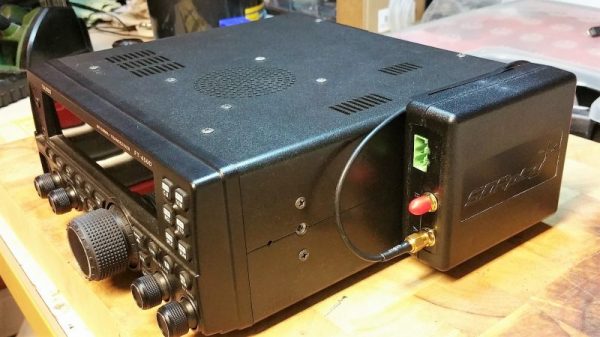
With both a rugged and reliable Yaesu FT-450D and the versatile SDRPlay in his shack, UK ham [Dave (G7IYK)] looked for the best way to link the two devices. Using two separate antennas was possible but inelegant, and switching the RF path between the two devices seemed clumsy. So he settled on tapping into the RF stage of the transceiver with a high-impedance low-noise amplifier (LNA) and feeding the output to the SDRPlay. The simple LNA was built on a milled PCB. A little sleuthing with the Yaesu manual — ham radio gear almost always includes schematics — led him to the right tap point in the RF path, just before the bandpass filter network. This lets the SDRPlay see the signal before the IF stage. He also identified likely points to source power for the LNA only when the radio is not transmitting. With the LNA inside the radio and the SDRPlay outside, he now has a waterfall display and thanks to Omni-Rig remote control software, he can tune the Yaesu at the click of a mouse.

If you need to learn more about SDRPlay, [Al Williams]’ guide to GNU Radio and SDRPlay is a great place to start.

Continue reading “Tapping Into A Ham Radio’s Potential With SDRPlay”

Measuring HF Signal Speeds In A DIY Coaxial Collinear Antenna

Air Traffic Controllers use Automatic Dependent Surveillance-Broadcast (ADS-B) as an alternative to secondary radar to track aircraft. The ADS-B is transmitted by the aircraft and contains information such as GPS position, pressure, altitude, and callsign among other things at a 1090 MHz frequency, which can be decoded using any of a number of software tools.

[Mike Field] lives near an airport, and decided he wanted to peek into the tracking signals for fun. He turned to an RTL-based TV Dongle. Since the stock antenna was not cutting it, he decided to make one specifically for the 1090 MHz signal. His design is based on Coaxial Collinear Antenna for ADS-B Receiver by [Dusan Balara] which uses pieces of the coaxial cable cut to the right length. There are a number of calculations involved in determining the size of the cable, however, the hack in this design is the way he uses a USB based oscilloscope to measure the speed of RF waves inside the line in question.

We reached out to [Mike], and this is what he had to say. The idea is to use a cable of half the size of the wavelength which is calculated as

lambda = c/f

For the best reception, the sections of coax need to be half a wavelength long – but the wavelength of the signal inside the coax, which is shorter than the wavelength in free space. As this was a generic cable he had no idea of the dielectric that separates the core from the shield, so the ‘velocity factor’ could be anything depending on the exact composition.

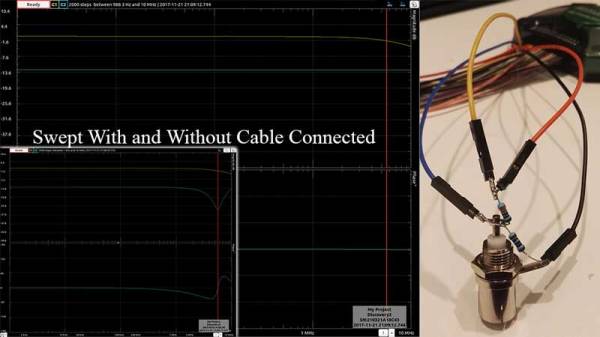
To determine the speed of the signal in the cable, his approach omits the more expensive equipment. A length of coax acts as a stub – any energy that is sent into the cable reaches the far end of the transmission line and is then reflected back to the source. When the cable is 1/4th of the wavelength long, the reflected signal arrives back at the start of the signal 180 degrees out of phase – in a perfect world it would completely null out the input signal. Continue reading “Measuring HF Signal Speeds In A DIY Coaxial Collinear Antenna”