Hacker’s Discovery Changes Understanding Of The Antikythera Mechanism

With all the trained academics who have pored over the Antikythera mechanism in the 120 years since it was pulled from the Mediterranean Sea, you’d think all of the features of the ancient analog computer would have been discovered by now. But the mechanism still holds secrets, some of which can only be appreciated by someone in tune with the original maker of the device. At least that what appears to have happened with the recent discovery of a hitherto unknown lunar calendar in the Antikythera mechanism. (Video, embedded below.)

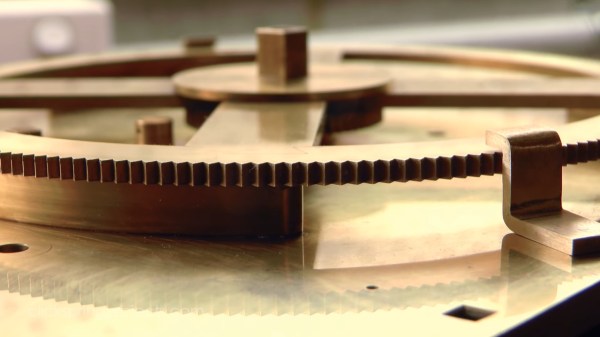
The Antikythera mechanism is fascinating in its own right, but the real treat here is that this discovery comes from one of our own community — [Chris] at Clickspring, maker of amazing clocks and other mechanical works of art. When he undertook a reproduction of the Antikythera mechanism using nothing but period-correct materials and tools four years ago, he had no idea that the effort would take the direction it has. The video below — also on Vimeo — sums up the serendipitous discovery, which is based on the unusual number of divisions etched into one of the rings of the mechanisms. Scholars had dismissed this as a mistake, but having walked a mile in the shoes of the mechanism’s creator, [Chris] knew better.

The craftsmanship and ingenuity evidenced in the original led [Chris] and his collaborators to the conclusion that the calendar ring is actually a 354-day calendar that reflects a lunar cycle rather than a solar cycle. The findings are summarized in a scholarly paper in the Horological Journal. Getting a paper accepted in a peer-reviewed journal is no mean feat, so hats off to the authors for not only finding this long-lost feature of the Antikythera mechanism and figuring out its significance, but also for persisting through the writing and publication process while putting other projects on hold. Clickspring fans have extra reason to rejoice, too — more videos are now on the way!

Continue reading “Hacker’s Discovery Changes Understanding Of The Antikythera Mechanism”

Gathering Eclipse Data Via Ham Radio

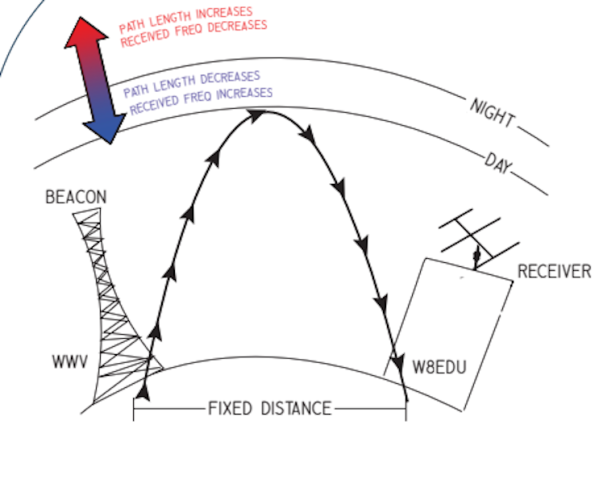
A solar eclipse is coming up in just a few weeks, and although with its path of totality near the southern tip of South America means that not many people will be able to see it first-hand, there is an opportunity to get involved with it even at an extreme distance. PhD candidate [Kristina] and the organization HamSCI are trying to learn a little bit more about the effects of an eclipse on radio communications, and all that is required to help is a receiver capable of listening in the 10 MHz range during the time of the eclipse.

It’s well-known that certain radio waves can propagate further depending on the time of day due to changes in many factors such as the state of the ionosphere and the amount of solar activity. What is not known is specifically how the paths can vary over the course of the day. During the eclipse the sun’s interference is minimized, and its impact can be more directly measured in a more controlled experiment. By tuning into particular time stations and recording data during the eclipse, it’s possible to see how exactly the eclipse impacts propagation of these signals. [Kristina] hopes to take all of the data gathered during the event to observe the doppler effect that is expected to occur.

The project requires a large amount of volunteers to listen in to the time stations during the eclipse (even if it is not visible to them) and there are only a few more days before this eclipse happens. If you have the required hardware, which is essentially just a receiver capable of receiving upper-sideband signals in 10 MHz range, it may be worthwhile to give this a shot. If not, there may be some time to cobble together an SDR that can listen in (even an RTL-SDR set up for 10 MHz will work) provided you can use it to record the required samples. It’s definitely a time that ham radio could embrace the hacker community.

Let The Solar Free

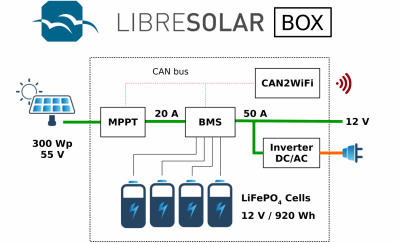
Anyone tackling solar power for the first time will quickly find there’s a truly dizzying amount of information to understand and digest. You might think you just need to buy some solar panels, wire them together, and just sort of plug them in. But there are a hundred and one different questions about how they’ll be connected, the voltage of the panels, and the hardware for driving a load. [Michel], [case06], and [Martin Jäger] have set out to create a simpler and easier to understand charge controller named LibreSolar.

a diagram showing how the libre solar is wired up

A charge controller is fundamentally a simple idea. The goal is to charge a battery with solar panels, which means it’s essentially just a heavy-duty DC/DC buck converter. What makes this project different is that it is an open platform built for extensibility.

There are UEXT connectors included for adding extra peripherals, and with some tweaks to the STM32 firmware, it would be easy to handle small wind turbines (with some rectification to convert to DC, of course). LibreSolar seems to be designed with an eye towards creating a nano-scale localized networked grid. For example, they’ve developed a Raspberry Pi Zero module that uses WiFi to create a CAN bus allowing the boxes to communicate their maximum voltage to each other. This makes the system as plug-and-play as possible, as the bus doesn’t require a master controller to communicate.

With features such as MPPT (Maximum Power Point Tracking), 20 amp peak charging, a USB interface for updating, and several built-in protection mechanisms, it’s clearly a well thought through project. We look forward to seeing it deployed in the real world!

CNC On The Desktop Hack Chat

Join us on Wednesday, August 26 at noon Pacific for the CNC on the Desktop Hack Chat with Matt Hertel and John Allwine!

Once limited to multi-million dollar machines on the floors of cavernous factories, CNC technology has moved so far downscale in terms of machine size that it’s often easy to lose track of where it pops up. Everything from 3D-printers to laser engravers use computer numeric control to move a tool to some point in three-dimensional space, and do it with unmatched precision and reproducibility.

CNC has gotten so pervasive that chances are pretty good that there’s a CNC machine of some sort pretty close to everyone reading this, with many of those machines being homebrew designs. That’s the backstory of Pocket NC, a company that was literally started in a one-bedroom apartment in 2011 by Matt and Michelle Hertel. After a successful Kickstarter that delivered 100 of their flagship five-axis desktop CNC mills to backers, they geared up for production and now turn out affordable machine tools for the masses. We’ve even seen some very complex parts made on these mills show up in projects we’ve featured.

For this Hack Chat, we’ll be joined by Pocket NC CTO and co-founder Matt Hertel and John Allwine, who recently joined the company as Principal Software Engineer. We’ll discuss not only Pocket NC’s success and future plans, but the desktop CNC landscape in general. Drop by with your questions regarding both the hardware and the software side of CNC, about turning an idea into a business, and where the CNC world and next-generation manufacturing will be heading in the future.

join-hack-chatOur Hack Chats are live community events in the Hackaday.io Hack Chat group messaging. This week we’ll be sitting down on Wednesday, August 26 at 12:00 PM Pacific time. If time zones baffle you as much as us, we have a handy time zone converter.

Click that speech bubble to the right, and you’ll be taken directly to the Hack Chat group on Hackaday.io. You don’t have to wait until Wednesday; join whenever you want and you can see what the community is talking about.

Building The Ultimate Raspberry Pi Automation Controller

At this point, we’ve lost count of how many automation projects we’ve seen with some variant of a Raspberry Pi at the helm. Which is hardly surprising, as the boards are cheap, powerful, and well documented. The list of reasons not to use one has never been very long, but with the PiCon One that [Frank] has been working on, it’s about to get even shorter.

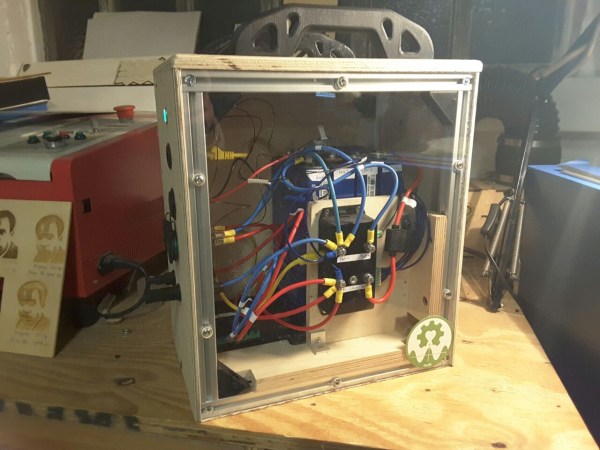
The project takes the form of an IP65 industrial enclosure and support electronics that the Raspberry Pi Zero W plugs into. While expandable in nature, [Frank] has a core set of features he’s aiming for as a baseline such as additional serial ports, integrated uninterruptible power supply, a battery-backed Real Time Clock (RTC), an array of programmable status LEDs, and support for XBee and GPS plug-in modules. Feedback is provided through a pair of four digit seven-segment displays and a color 320×480 TFT screen running a custom user interface.

[Frank] envisions the PiCon One for use as a rugged solar power controller, eventually able to measure array output, energy consumption, and even operate motorized mounts to keep the panels pointed at the sun. To that end, he’s recently been experimenting with running JPL’s Horizon software on the Pi to determine the sun’s position in real-time. But the device is capable of so much more, and would make an ideal controller for many home and potentially even industrial applications.

Continue reading “Building The Ultimate Raspberry Pi Automation Controller”

Open And Sustainable Engineering Hack Chat

Join us on Wednesday, August 19 at noon Pacific for the Open and Sustainable Engineering Hack Chat with Joshua Pearce!

Since the first of our hominid ancestors learned to pick up a rock and make it into a tool, we humans have been using our engineering skills to change the world. For most of the 2 million or so years since that first technological leap, natural materials like stone and wood were the focus of our engineering projects, and except for a few tantalizing remnants, most of what was built has returned to the Earth whence it came.

Then we discovered other materials; we learned to free metals from rocks and how to harvest the fossilized hydrocarbon remains of ancient plants. Iron, aluminum, plastic, and silicon became our stock in trade, and the planet is now layered so thick with these materials and the byproducts of harvesting them that a new geological epoch, the Anthropocene Epoch, has been proposed to cover this time of human activity and its impact on the geological record.

But if we humans are clever enough to make such an impact, we should be clever enough to think our way out of the mess, and wise enough to see the need. That’s where the efforts of Dr. Pearce’s research at the Michigan Tech Open Sustainability Technology (MOST) lab are focused. Dr. Pearce envisions a sustainable future powered by pervasive solar photovoltaic systems and using open-source technologies like 3D printing to drive new models for manufacturing. We’ve recently seen interesting work from his lab, like this grinder that makes custom compression screws for plastic recycling. The MOST page on Hackaday.io is filled with other great examples of the technology that supports their mission, from low-cost environmental testing instruments to 3D-printable microfluidics.

Dr. Pearce will join us on the Hack Chat to talk about open and sustainable engineering. Be sure to stop by with your questions and to find out what you can do to engineer a brighter future, starting right in your own shop.

join-hack-chatOur Hack Chats are live community events in the Hackaday.io Hack Chat group messaging. This week we’ll be sitting down on Wednesday, August 19 at 12:00 PM Pacific time. If time zones baffle you as much as us, we have a handy time zone converter.

Click that speech bubble to the right, and you’ll be taken directly to the Hack Chat group on Hackaday.io. You don’t have to wait until Wednesday; join whenever you want and you can see what the community is talking about.

Continue reading “Open And Sustainable Engineering Hack Chat”

Drone Buoy Drifts Along The Gulf Stream For Citizen Science

It may be named after the most famous volleyball in history, but “Wilson” isn’t just a great conversationalist. [Hayden Brophy] built the free-drifting satellite buoy to see if useful science can be done with off-the-shelf hardware and on a shoestring budget. And from the look of the data so far, Wilson is doing pretty well.

Wilson belongs to a class of autonomous vessels known as drifters, designed to float along passively in the currents of the world’s ocean. The hull of [Hayden]’s drifter is a small Pelican watertight case, which contains all the electronics: Arduino Pro Trinket, GPS receiver, a satellite modem, and a charger for the LiPo battery. The lid of the case is dominated by a 9 W solar panel, plus the needed antennas for GPS and the Iridium uplink and a couple of sensors, like a hygrometer and a thermometer. To keep Wilson bobbing along with his solar panel up, there’s a keel mounted to the bottom of the case, weighted with chains and rocks, and containing a temperature sensor for the water.

Wilson is programmed to wake up every 12 hours and uplink position and environmental data as he drifts along. The drifter was launched into the heart of the Gulf Stream on August 8, about 15 nautical miles off Marathon Key in Florida, by [Captain Jim] and the very happy crew of the “Raw Deal”. As of this writing, the tracking data shows that Wilson is just off the coast of Miami, 113 nautical miles from launch, and drifting along at a stately pace of 2.5 knots. Where the buoy ends up is anyone’s guess, but we’ve seen similar buoys make it all the way across the Atlantic, so here’s hoping that hurricane season is kind to Wilson.

We think this is great, and congratulations to [Hayden] for organizing a useful and interesting project.

Continue reading “Drone Buoy Drifts Along The Gulf Stream For Citizen Science”