Magic Pyramids Blink Eternal With The Power Of The Sun

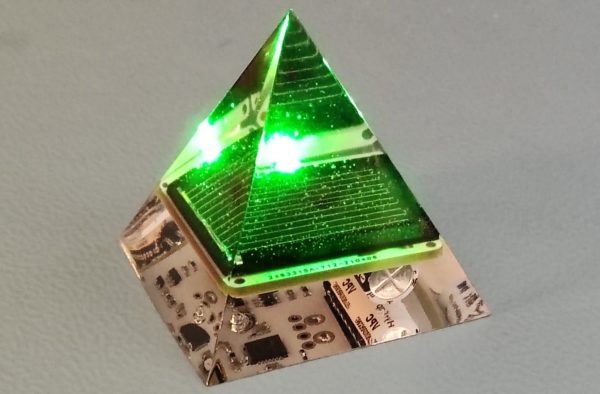
Without knowing it, we’ve spent years watching [Jasper Sikken] piece together an empire of energy harvesting equipment, and now he’s putting the pieces together into wonderful creations. His recently finished solar harvesting pyramids are mesmerizing objects of geometric perfection we’d love to see glinting in the sun.

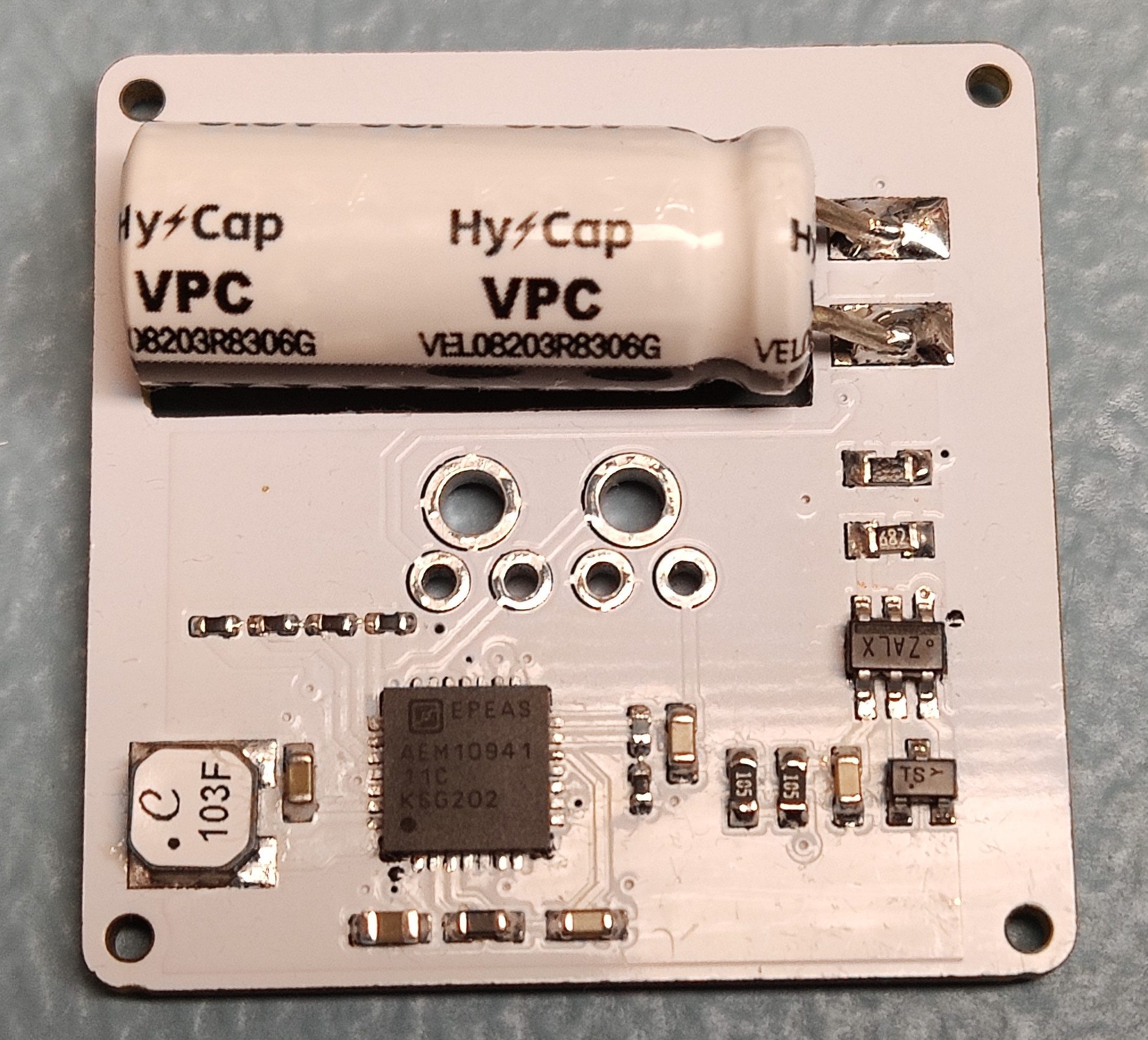
These solar harvesting pyramids are well described by their name. Each one contains a PCBA around 30mm on a side with a solar energy harvester built around the dedicated AEM10941 IC, a single solar cell, and a very bright green LED. [Jasper] calculates that the solar cell will charge the super capacitor at 20uA at with just 200 lux of light (a level typical for casual indoor spaces) letting it run indefinitely when placed indoors. Amazingly with the LED blinking for 15ms every 2 seconds it will run for 21 days in complete darkness. And that’s it! This is a software-free piece of hardware which requires no input besides dim light and blinks an LED indefinitely.

Small PCBA, large capacitor

What about that super capacitor? It’s called a Lithium Ion Capacitor (LIC) and is a hybrid between a typical rechargeable lithium battery and an electrolytic capacitor, offering extremely high capacity in a convenient two leg through hole form factor. This one is a whopping 30 Farad at 3.8 V, and we first saw it when [Jasper] won the Hackaday Earth Day contest last month. Check out that link if you want to know more about their uses and how to integrate them.

For more detail about all of the components of the solar pyramid we need only turn to the Hackaday archives. In December 2019 [Tom Nardi] wrote about building a cheap degassing system for making some very familiar looking resin pyramids. And before that [Donald Papp] brought us another familiar piece of the pyramid when he wrote up a different 1″ x 1″ solar harvesting system that [Jasper] designed.

Check out the video after the break to see what one of these gems looks like from all sides. And for many more experiments leading up the final pyramid check out the logs on the Hackaday.io page.

Continue reading “Magic Pyramids Blink Eternal With The Power Of The Sun”

Heating A Home With Sunlight… And Water

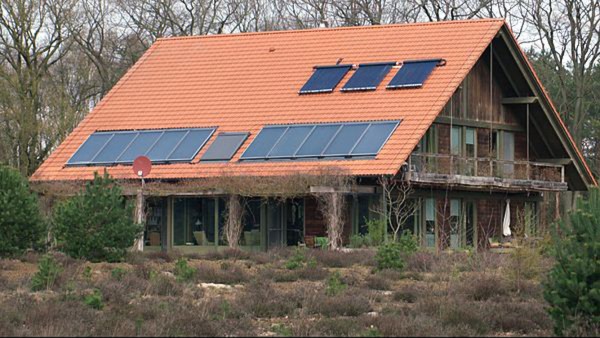
The sun is a tremendous source of energy, and while photovoltaic panels are an easy way to harvest some of that energy especially now that prices for them are incredibly low, there are plenty of other ways to tap into that free energy as well. [Engelbert] was looking for alternative ways to heat his house since traditional methods were prohibitively expensive, and ended up building a heat exchanger using solar-heated water to cover his home heating needs. (Google Translate from Dutch)

The system uses several large roof-mounted hot water heating panels. The heat captured by them is then pumped into an underground pipe network which is able to warm up a large area of earth in the summer. In the winter, that heat is able to be extracted back out of the earth and used to heat his home. The system includes almost three kilometers of pipe which are buried two meters below grade, so this will probably not be a weekend project, but it still cost much less than the €80,000 to install gas heating in his home.

[Engelbert] is able to use this self-built system to keep his home and another smaller building at a constant 23°C all year. He actually overbuilt the system slightly and has since disconnected almost half of the pipes, but we certainly understand the desire to over-engineer things around here. The only problem he has had is with various government entities that are slow to adopt energy-efficient systems like these. Perhaps the Dutch government can take some notes from the Swiss when it comes to installing geothermal systems like these.

Thanks to [Jero] for the tip!

Antique Map Of Paris With Modern Tech

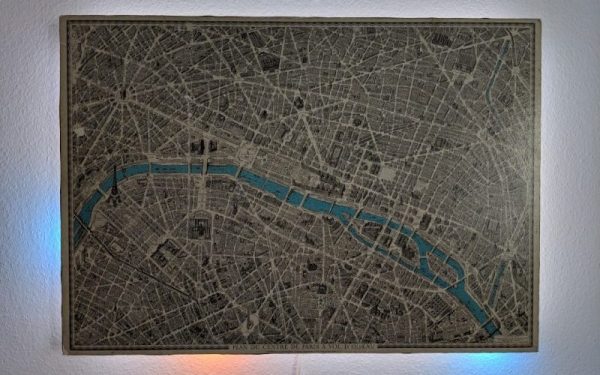
There’s plenty to love about antiques, from cars, furniture, to art. While it might be a little bit of survivorship bias, it’s easy to appreciate these older things for superior quality materials, craftsmanship, or even simplicity. They are missing out on all of our modern technology, though, so performing “restomods” on classics is a popular activity nowadays. This antique map of Paris, for example, is made of a beautiful hardwood but has been enhanced by some modern amenities as well.

At first the creator of this project, [Marc], just wanted to give it some ambient lighting, but it eventually progressed over the course of two years to have a series of Neopixels hidden behind it that illuminate according to the current sun and moon positions. The Neopixels get their instructions from an ESP8266 which calculates these positions using code [Marc] wrote himself based on the current date. Due to the limitations of the ESP8266 it’s not particularly precise, but it gets the job done to great effect.

To improve on the accuracy, [Marc] notes that an ESP32 could be used instead, but we can give the ESP8266 a pass for now since the whole project is an excellent art installation even if it is slightly off on its calculations. If you need higher accuracy for tracking celestial objects, you can always grab a Raspberry Pi too.

Increasing The Resolution Of The Electrical Grid

As a society in the USA and other parts of the world, we don’t give much thought to the twisting vines of civilization that entangle our skies and snake beneath our streets. The humming electrical lines on long poles that string our nations together are simply just there. Ever-present and immutable. We expect to flick the switch and power to come on. We only notice the electrical grid when something goes wrong and there is a seemingly myriad number of ways for things to go wrong. Lighting strikes, trees falling on lines, fires, or even too many people trying to crank on the A/C can all cause rolling blackouts. Or as we found out this month, cold weather can take down generation systems that have not been weatherized.

We often hear the electrical grid described as aging and strained. As we look to the future and at the ever-growing pressure on the infrastructure we take for granted, what does the future of the electrical grid look like? Can we move past blackouts and high voltage lines that criss-cross the country?

Continue reading “Increasing The Resolution Of The Electrical Grid”

Solar Safety Bag Lights Up The Night, Charges Your Phone

Spend enough time riding a bike, and chances are good that you’ll start carrying a few tools with you. Even if you don’t, you’re probably going to use a bag to carry something along, so why not make that bag do triple duty? This convertible backpack/tote bag can charge your phone and provide safety lighting for nighttime rides. The design lends itself nicely to turn signals, too.

This bag was designed to show off the capabilities of Loomia, a line of prototyping parts made with e-textiles and other flexible applications in mind. It can be sewn, fused, or adhered to various substrates including fabric and wood. [AmpedAtelier] is using a Beetle microcontroller to control RGB LED strips using an illuminated Loomia soft switch on the strap. The switch is wired to the microcontroller through Loomia busses running through the strap.

Although Loomia’s site has a deep dive into the capabilities of their technology, it isn’t exactly open source. If that’s what you’re after, take a look at PolySense, which uses piezoresistive dye to create textile sensors.

World Solar Challenge: How Far In A Solar Car?

Solar power is a great source of renewable energy, but has always had its limitations. At best, there’s only 1,000 Watts/m2 available at the Earth’s surface on a sunny day, and the limited efficiency of solar panels cuts this down further. It’s such a low amount that solar panels on passenger cars have been limited to menial tasks such as battery tending and running low-power ventilation fans.

However, where some might see an impossibility, others see opportunity. The World Solar Challenge is a competition that has aimed to show the true potential of solar powered transport. Now 30 years since its inception, what used to be impossible is in fact achieved by multiple teams in under one tenth of the original time. To keep competitors on their toes, the rules have been evolving over time, always pushing the boundaries of what’s possible simply with sunlight. This isn’t mainstream transportation; this is an engineering challenge. How far can you go in a solar car?

Continue reading “World Solar Challenge: How Far In A Solar Car?”

Hackaday Links Column Banner

Hackaday Links: December 13, 2020

Our Sun is getting a bit frisky these days, and has rewarded us with perhaps the best screensaver image ever taken. The incredibly detailed photo of a sunspot was actually taken back in January by the Daniel K. Inouye Solar Telescope, a 4-meter instrument with adaptive optics that can image the sun from the near-infrared to visible wavelengths and resolve surface details down to 20 km. The photo, with a distinct “Eye of Sauron” look, shows the massive convection cells surrounding the dark sunspot; an accompanying animation shows the movement of plasmas along the tortured lines of magnetic flux that cause the sunspot to form. It’s fascinating to watch, and even more interesting to mull over the technology that went into capturing it.

With the dustup surrounding the youtube-dl DCMA takedown by GitHub fresh on the open-source community’s minds, GitHub Universe 2020 had an interesting discussion about maintaining open-source software projects that’s worth watching. They focused on the challenges that youtube-dl maintainers face in keeping the tool working, and the impact their effort has on the people and groups that rely on them. To underscore that point, they featured a researcher with Human Rights Watch who depends on youtube-dl in her work, and made it quite clear that keeping up with all the API changes that constantly break open source tools like youtube-dl make the role of the maintainers that much more critical.

Speaking of GitHub, here’s a frightening and fascinating new tool: Depix, the password de-pixelizer. Developer Sipke Mellema noticed that his company often used pixelization to obscure passwords in documentation, and wondered if he could undo the process. He wrote up an article describing the pixelization process using a linear box filter and his method for attacking it, which involves generating a De Bruijn sequence in the same font, text size, and colors as the original document and feeding a screenshot of that and the pixellated password into the tool. We suspect it’ll only work for a subset of obfuscated passwords, but it’s still pretty clever.

‘Tis the season for Advent calendars, and the folks at QEMU have posted theirs. Open each of 24 doors on the calendar and you’re rewarded with a downloadable QEMU disk image that implements something fun. Minesweeper, a ray tracer that fits into a boot loader, and of course Conway’s Game of Life. The GW-BASIC image on Day 3 caught our eye — brings back some memories.

For anyone who has ever watched a Pixar film and wondered how all that animation actually works, here’s a great lesson in making art with math. The video is by Inigo Quilez and goes through the basics of rendering images using raymarching SDFs, or signed distance functions. In the beginning, it seemed like it was going to be a little bit like drawing an owl, but his descriptions of the math involved and how each element of the animation is just another formula is fascinating. What’s more, there’s a real-time rendering tool where you can inspect the code and edit it. Alas, my changes only made things worse, but it was still fun and instructive to play with. Check out the video after the break!

Continue reading “Hackaday Links: December 13, 2020”