Blue Pill As A Nerdy Swiss Army Knife

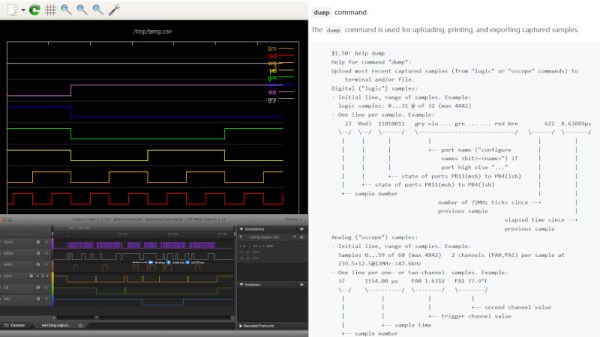
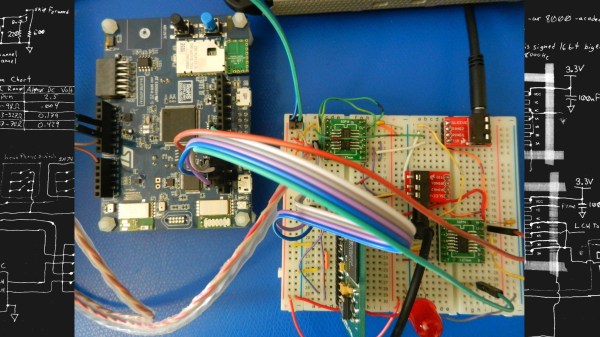
Not everyone can afford an oscilloscope, and some of us can’t find a USB logic analyzer half the time. But we can usually get our hands on a microcontroller kit, which can be turned into a makeshift instrument if given the appropriate code. A perfect example is buck50 developed by [Mark Rubin], an open source firmware to turn a STM32 “Blue Pill” into a multi-purpose test and measurement instrument.

buck50 comes with a plethora of functionality built in which includes an oscilloscope, logic analyzer, and bus monitor. The device is a two way street and also comes with GPIO control as well as PWM output. There’s really a remarkable amount of functionality crammed into the project. [Mark] provides a Python application that exposes a text based UI for configuring and using the device though commands and lots of commands which makes this really nerdy. There are a number of options to visualize the data captured which includes gnuplot, gtk wave and PulseView to name a few.

[Mark] does a fantastic job not only with the firmware but also with the documentation, and we really think this makes the project stand out. Commands are well documented and everything is available on [GitHub] for your hacking pleasure. And if you are about to order a Blue Pill online, you might want to check out the nitty-gritty of the clones that are floating around.

Thanks [JohnU] for the tip!

Bare-Metal STM32: From Power-Up To Hello World

Some may ask why you’d want to program a Cortex-M microcontroller like the STM32 series using nothing but the ARM toolchain and the ST Microelectronics-provided datasheet and reference manual. If your first response to that question wasn’t a panicked dive towards the nearest emergency exit, then it might be that that question has piqued your interest. Why, indeed?

Definitely, one could use any of the existing frameworks to program an STM32 MCU, whether the ST HAL framework, plain CMSIS, or even something more Arduino-flavored. Yet where is the fun in that, when at the end of the day one is still fully dependent on that framework’s documentation and its developers? More succinctly, if the contents of the STM32 reference manuals still look like so much gibberish, does one really understand the platform?

Let’s take a look at how bare-metal STM32 programming works, and make the most basic example run, shall we? Continue reading “Bare-Metal STM32: From Power-Up To Hello World”

STM32 Gets Up Close And Personal With Mandelbrot

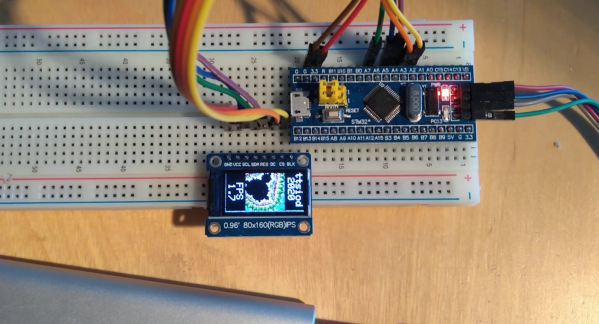
The Mandelbrot set is a curious mathematical oddity that, while interesting in its own right, is also a useful tool for benchmarking various types of computers. Its constant computing requirement when zooming in and out on the function, combined with the fact that it can be zoomed indefinitely, means that it takes some quality hardware and software to display it properly. [Thanassis] has made this a pet project of his, running Mandelbrot set visualizations in different ways on many different hardware platforms.

This particular one is based on an STM32 board called the Blue Pill, which [Thanassis] chose because he hadn’t yet done a continuous Mandelbrot zoom on a microcontroller yet. The display is handled by a tiny 16K IPS color screen, and some clever memory tricks had to come into play in order to get smooth video output since the STM has only 20 kB available. The integer multiplication is also tricky on a platform this small while keeping the continuous zoom function, so it’s limited to fixed point multiplication.

Even with the limitations of the platform, he is still able to achieve nearly double-digit FPS rates with this one. If you want to play around with graphics like this on an STM platform, [Thanassis] has released all of the source code on his GitHub page, but if you’d like to see more Mandelbrot manipulation you can check out one of his older projects where he built a similar project on an FPGA.

Continue reading “STM32 Gets Up Close And Personal With Mandelbrot”

STM32 Clones: The Good, The Bad And The Ugly

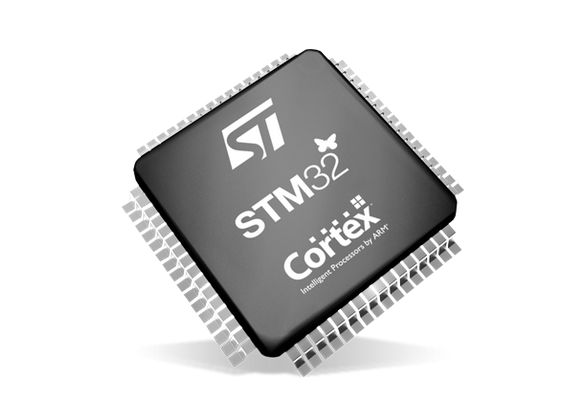
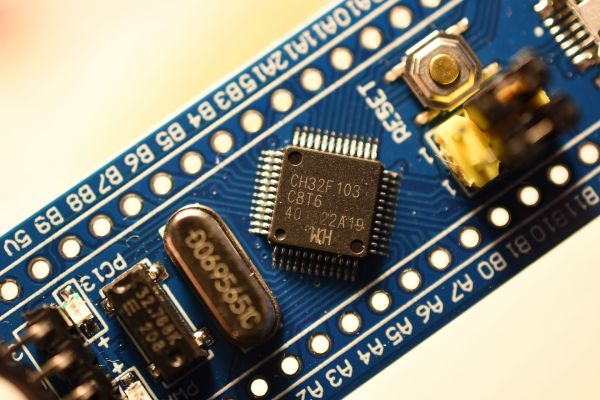
Whenever a product becomes popular, it’s only a matter of time before other companies start feeling the urge to hitch a ride on this popularity. This phenomenon is the primary reason why so many terrible toys and video games have been produced over the years. Yet it also drives the world of electronics. Hence it should come as no surprise that ST’s highly successful ARM-based series of microcontrollers (MCUs) has seen its share of imitations, clones and outright fakes.

The fakes are probably the most problematic, as those chips pretend to be genuine STM32 parts down to the markings on the IC package, while compatibility with the part they are pretending to be can differ wildly. For the imitations and clones that carry their own markings, things are a bit more fuzzy, as one could reasonably pretend that those companies just so happened to have designed MCUs that purely by coincidence happen to be fully pin- and register compatible with those highly popular competing MCU designs. That would be the sincerest form of flattery.

Let’s take a look at which fakes and imitations are around, and what it means if you end up with one. Continue reading “STM32 Clones: The Good, The Bad And The Ugly”

Pause Your Tunes When It Is Time To Listen Up!

“Sorry. I had music playing. Would you say that again?” If we had a money-unit every time someone tried talking to us while we were wearing headphones, we could afford a super-nice pair. For an Embedded C class, [extremerockets] built Listen Up!, a cutoff switch that pauses your music when someone wants your attention.

The idea was born while sheltering in place with his daughter, who likes loud music, but he does not want to holler to get her attention. Rather than deny her some auditory privacy, Listen Up! samples the ambient noise level, listens for a sustained rise in amplitude, like speech, and sends a pause signal to the phone. Someday, there may be an option to route the microphone’s audio into the headphones, but for now there is a text-to-speech module for verbalizing character strings. It might be a bit jarring to hear a call to dinner in the middle of a guitar riff, but we don’t like missing dinner either, so we’re with [extremerockets] on this one.

We don’t really need lots of money to get fun headphones, and we are not afraid of making our own.

Teardown: Orthofix SpinalStim

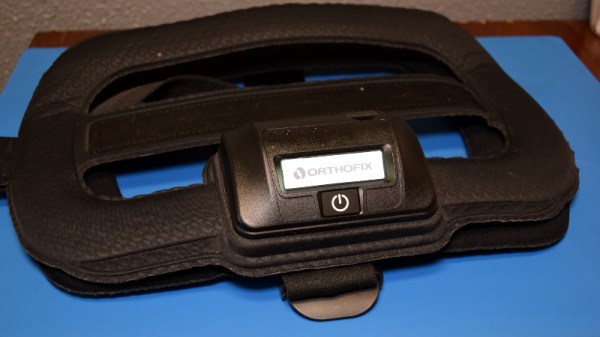
If you’ve ever had a particularly nasty fracture, your doctor may have prescribed the use of an electronic bone growth stimulator. These wearable devices produce a pulsed electromagnetic field (PEMF) around the bone, which has been shown to speed up the natural healing process in a statistically significant number of patients. That’s not to say there isn’t a debate about how effective they actually are, but studies haven’t shown any downsides to the therapy, so it’s worth trying at least.

Image from SpinalStim manual.

When you receive one of these devices, it will be programmed to only operate for a certain amount of time or number of sessions. Once you’ve “used up” the bone stimulator, it’s functionally worthless. As you might imagine, there’s no technical reason this has to be the case. The cynic would say the only reason these devices have an expiration date on them is because the manufacturer wants to keep them from hitting the second hand market, but such a debate is perhaps outside the scope of these pages.

The Orthofix SpinalStim you’re seeing here was given to me by a friend after their doctor said the therapy could be cut short. This provided a somewhat rare opportunity to observe the device before it deactivated itself, which I’d hoped would let me take a closer look at how it actually operated.

As you’ll soon see, things unfortunately didn’t work out that way. But that doesn’t mean the effort was fruitless, and there may yet be hope for hacking these devices should anyone feel like taking up the challenge.

Continue reading “Teardown: Orthofix SpinalStim”

Bluepill Copies Code So You Don’t Have To

You really should learn to read Morse code. But if you can’t — or even if you can, and just want a break — you can always get a computer to do it. For example, [jmharvey1] has a decoder that runs on a cheap Bluepill dev board.

The device uses a touchscreen and a few common components. The whole thing cost about $16. You can see it at work along with a description of the project in the video below.

Continue reading “Bluepill Copies Code So You Don’t Have To”