Great Beginnings For Vintage Computing In Seattle; VCF PNW

The pitch to my wife was simple: “Feel like spending the weekend in Seattle?” That’s how I ended up at the inaugural Vintage Computer Festival Pacific Northwest last weekend, and I’m glad we made the five-hour drive into The Big City to check it out. Hackaday is a VCF sponsor, after all, so it seemed like a great excuse to make the trip. That it ended up being two consecutive days of great Seattle weather was only icing on the cake of being able to spend time with fellow retro computer aficionados and their dearest bits of old hardware, in a great museum dedicated to keeping computer history alive and accessible.

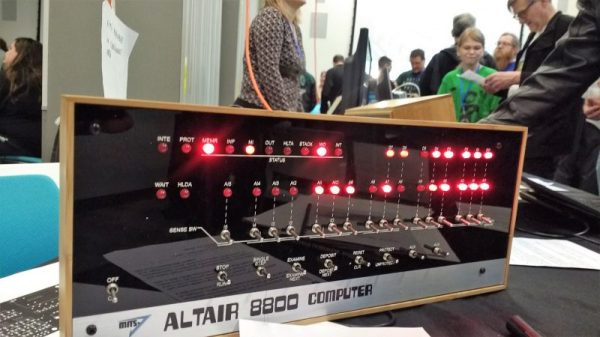
The fact that Seattle, home of Microsoft, Amazon, and dozens of other tech companies, has until now been left out of the loop in favor of VCF East in New Jersey and VCF West in Mountain View seems strange, but judging by the reception, VCF PNW is here to stay and poised to grow. There were 20 exhibitors for this go around, showing off everything from reanimated PDP-11 and Altair 8800 control panels to TRS-80s from Model 1 through to the CoCo. Almost every class of reasonably transportable retro hardware was represented, as well as some that pushed the portability envelope, like a working PDP-8 and a huge Symbolics 3640 LISP workstation.

Continue reading “Great Beginnings For Vintage Computing In Seattle; VCF PNW”

Next Week: Vintage Computer Festival Pacific Northwest

Next week something magical is happening. Seattle is getting a Vintage Computer Festival. It’s the Vintage Computer Festival Pacific Northwest, and it’s happening Saturday, February 10th and Sunday, February 11th at the Living Computers Museum and Labs.

As with all Vintage Computer Festivals, this is one with plenty of exhibits, speakers, and the ever-popular consignment shop. A few of the more interesting exhibits include a demonstration of the Syntauri alphaSyntauri, a synthesizer card and controller designed for the Apple II. When it was released in 1980, this was the first affordable digital synthesizer that competed against the Synclavier and Fairlight CMI. The difference? Synclaviers cost as much as a house, where the alphaSyntauri cost as much as a car. Also on deck is the dis-integrated MOnSter6502, a complete NMOS 6502 constructed out of individual, surface mount transistors. The Digi-Comp II from Evil Mad Scientist will be there, there will be BlinkenBones, and for anyone who wants to assemble their own front panel for a vintage minicomputer, [Oscar Vermeulen] will be there with the Pi-DP/8. This isn’t an event to miss.

As an aside, we’d really like to commend the Vintage Computer Federation for their incredible work in putting these shows together. The VCF West at the Computer History Museum in Mountain View is an incredible show, VCF Southeast has some amazing displays, and VCF East in New Jersey is a pretty incredible gathering going down May 18th through the 20th this year. The people working behind the scenes to make these shows happen are doing a service for all vintage computers and performing digital archeology that benefits us all.

Hackaday is proud to be a sponsor of VCF Pacific Northwest.

Homemade LED Clock Stands Test Of Time

In an era when you might get chastised if your mobile phone is more than two years old, it’s easy to forget that hardware was not always meant to be a temporary commodity. We acknowledge a few standout examples of classic hardware still surviving into the modern era, such as vintage computers, but they’re usually considered to be more of a novelty than an engineering goal. In a disposable society, many have forgotten that quality components and a well thought out design should give you a service life measured in decades, not months.

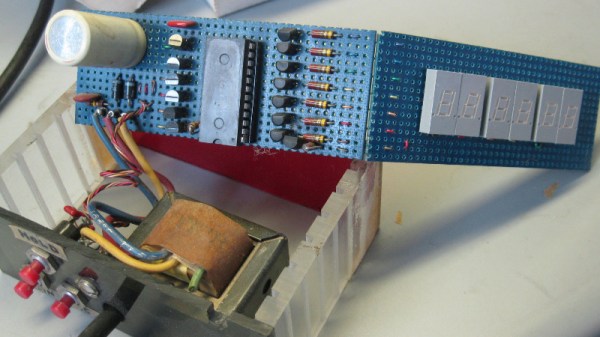
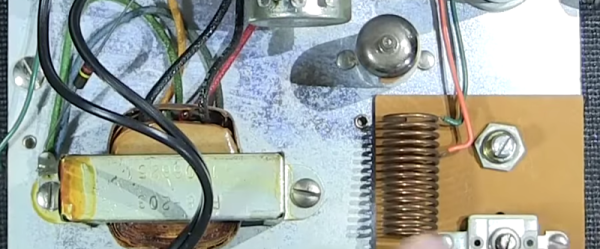
A perfect example of this principle is the beautiful LED clock built 40 years ago by [Davide Andrea]. A teenager at the time, [Davide] built this clock to be used by the local radio station, as clocks that showed seconds were important for timing radio shows. Finding it in storage recently, [Davide] took to the /r/electronics subreddit to report that it still works fine after all these years.

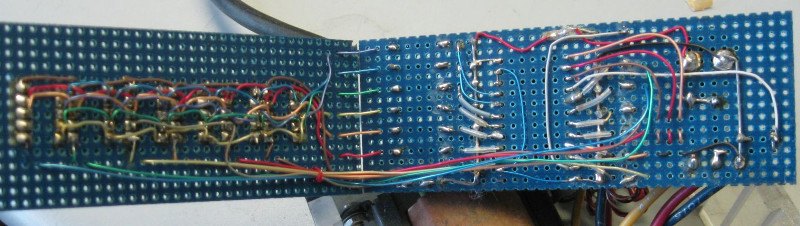
Cracking open the case shows a unique and highly functional construction style. Notches cut into the side panels of the case accept individual protoboards in a “blade” type configuration, with the blades connected by a handful of individual wires. No digging through the parts bin for a “worthless” old IDE cable to tear up back in the 1970’s.

Continue reading “Homemade LED Clock Stands Test Of Time”

Yellowing: The Plastic Equivalent Of A Sunburn

Your fancy white electronic brick of consumer electronics started off white, but after some time it yellowed and became brittle. This shouldn’t have happened; plastic is supposed to last forever. It turns out that plastic enclosures are vulnerable to the same things as skin, and the effects are similar. When they are stared at by the sun, the damage is done even though it might not be visible to you for quite some time.

Continue reading “Yellowing: The Plastic Equivalent Of A Sunburn”

CRT Cataract Surgery

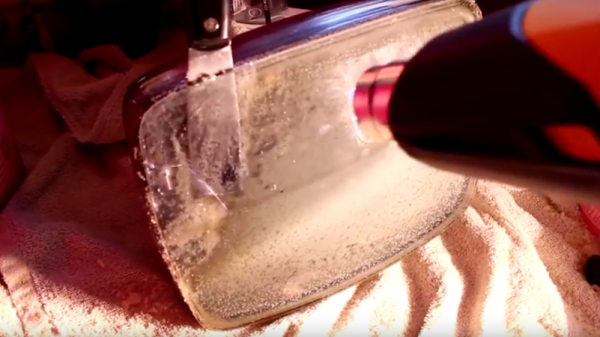
Back in the good old days, people got their information by staring into particle accelerators that could implode at any moment, and we liked it that way, by gum! To protect against disaster, CRT monitors were equipped with a safety screen laminated to the front of the tube. Decades of use often resulted in degradation of the glue used to hold the safety glass on, leading to the dread disease of “CRT cataracts.”

Luckily for aficionados of vintage terminals, [John Sutley] has come up with a cure for CRT cataracts. The video below shows the straightforward but still somewhat fussy process from start to finish. You’ll want to follow [John]’s advice on discharging the high-voltage flyback section of any stored charge; we speak from painful experience on this. With the CRT removed from the case, removing the safety screen is as simple as melting the glue with a hot air gun and applying gentle leverage with a putty knife. We’d think a plastic tool would be less likely to scratch the glass, but [John] managed to get them apart without incident. Acetone and elbow grease cleaned off the old glue, and the restored CRT looks great when reassembled.

With its cataracts cured, [John] says his next step is to restore the wonky keyboard on his Lear Siegler ADM-3A terminal. Perhaps he should look over this VT220 keyboard repair for ideas.

Continue reading “CRT Cataract Surgery”

Eye Tube Tests Capacitors

Most component testers require removal of a component to test it. [Mr Carlson] recently restored an old Paco C-25 in-circuit capacitor tester. He does a very complete video tearing it down and showing how it works and why.

The tester uses an eye tube (sometimes called a magic eye tube) as an indicator. A 40 MHz oscillator produces a signal that finds open and shorted capacitors. You can also measure resistance, although you have to wonder how accurate it would be in circuit. If you want to read the original manual, there are a few copies online.

Continue reading “Eye Tube Tests Capacitors”

Dual Trace Scope 1939 Style

If you buy a serious scope these days, it is a good bet it will have at least two channels. There is a lot of value to being able to see two signals in relation to one another at one time. Even though the dual-trace oscilloscope goes back to 1938, they were uncommon and expensive for many years. [Mr. Carlson] found a device from 1939 that would turn a single channel scope into a dual trace scope. In 1939, that was quite the engineering feat.

Today, a dual trace scope is very likely to be digital. But some analog scopes used CRTs with multiple beams to actually draw two traces on the same screen. Most, however, would draw either one trace followed by the other (alternate mode) or rapidly switch between channels (chopper mode). This Sylvania type 104 electronic switch looks like it takes the alternate approach, switching between signals on each sweep using vacuum tubes. You can see the device in action in the video, below.

The inputs and outputs of the device are just simple binding posts, but the unit looked to be in good shape except for the power cord. [Mr. Carlson] does a teardown and he even traced out a hand-drawn schematic. Fair warning. The video is pretty long. If you want to get right to the switch actually driving a scope, that’s at about one hour and seven minutes in.

We doubt we’ll see a tube-based Quake game anytime soon. If you want to get into restoring old tube-based gear yourself, you could do worse than read about radio restoration.

Continue reading “Dual Trace Scope 1939 Style”