Retro-Styled Raspberry Pi Radio

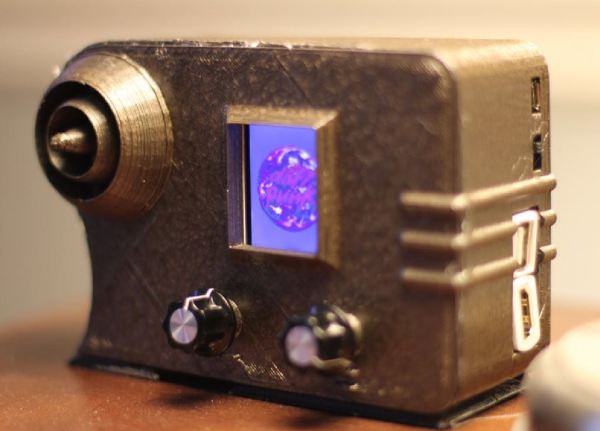
Ok, so you want a radio — but not just any radio. It has to be wireless, access a variety of music services, and must have a vintage aesthetic that belies its modern innards. Oh, and a tiny screen that displays album art, because that’s always awesome. This 1938 Emerson AX212-inspired radio delivers.

Building on the backbone of a Raspberry Pi Zero W and an Adafruit MAX 98357 mono amp chip, the crux of this single-speaker radio is the program Mopidy. Mopidy is a music player that enables streaming from multiple services, with the stipulation that you have a premium Spotify account. Once signed up, [Tinkernut] helpfully outlines how to set up Mopidy to run automatically once the Pi boots up. The addition of a screen to display album art adds flair to the design,  and Adafruit’s 1.8″ TFT LCD screen is small enough to fit the bill.

But wait — there’s more!

Continue reading “Retro-Styled Raspberry Pi Radio”

Adding Character To The C64

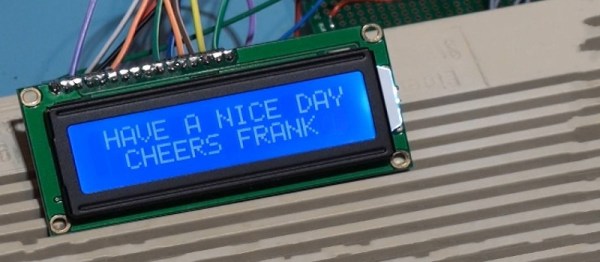
The venerable Commodore 64, is there anything it can’t do? Like many 1980s computer platforms, direct access to memory and peripherals makes hacking easy and fun. In particular, you’ll find serial & parallel ports are ripe for experimentation, but the Commodore has its expansion/cartridge port, too, and [Frank Buss] decided to hook it up to a two-line character LCD.

Using the expansion port for this duty is a little unconventional. Unlike the parallel port, the expansion port doesn’t have a stable output, as such. The port contains the data lines of the 6510 CPU and thus updates whenever RAM is read or written to, rather then updating in a controlled fashion like a parallel port does. However, [Frank] found a way around this – the IO1 and IO2 lines go low when certain areas of memory are written to. By combining these with latch circuitry, it’s possible to gain up to 16 parallel output lines – more than enough to drive a simple HD44780 display! It’s a testament to the flexibility of 74-series logic.
It’s all built on a C64 cartridge proto-board of [Frank]’s own design, and effort was made to ensure the LCD works with BASIC for easy experimentation. It’s a tidy mod that could easily be built into a nice enclosure and perhaps used as the basis for an 8-bit automation project. Someone’s gotta top that Amiga 2000 running the school district HVAC, after all!

Restoring A Japanese Oscilloscope

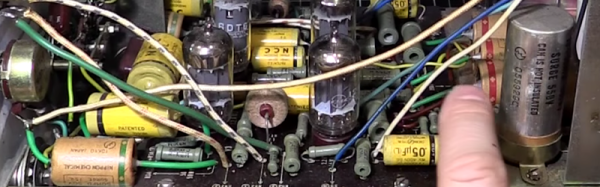
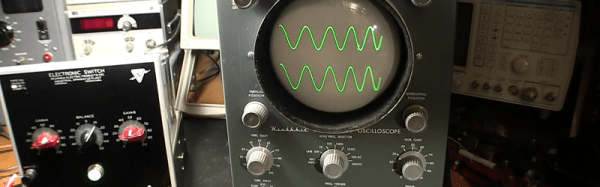
Oscilloscopes have come a long way. Today’s scope is more likely to look like a tablet than an old tube-based instrument. Still, there’s something about looking into a glowing green tube, especially if you’ve done the work to resurrect that old hollow state device. [NFM] picked up a Kikusui OP-31C–a vintage Japanese scope at a second-hand store. He made a video of his restoration efforts that you can see below.

The scope actually powered up and worked the first time. Of course, unlike a modern scope, the OP-31C has to warm up before it will show up. However, the pots needed cleaning and as a precaution, he replaced the old oil and electrolytic capacitors.

The big transformer and the coarse-looking single sided circuit board certainly will bring back memories if you are old enough. [NFM] had a schematic of the scope and takes you on a tour of the innards, although his schematic had some subtle differences from the actual unit, possibly due to some repair work.

He was going to rebuild one of the large electrolytic “can” capacitors to keep the outer shell with newer (and smaller) modern capacitors. However, he found a very similar modern capacitor and used that, instead.

We think it would have been more fun if the scope didn’t work. However, it was still a great tear down of the old tube-based device. This is a bigger device than the last old scope tear down we looked at. Not that we haven’t seen smaller ones (although, the link in the post has moved).

Continue reading “Restoring A Japanese Oscilloscope”

Command Alexa With A Completely Mechanical Vintage Remote Control

Anyone with grandparents already knows that in ye olden days, televisions did not have remote control. Your parents probably still complain about how, as children, they were forced to physically walk over to the TV in order to switch between the three available channels. In these modern times of technological wonder, we have voice control, programmable touch screen remotes, and streaming services that will automatically play an entire season of the show you’re binge watching. However, before these, and before the ubiquitous infrared remote, television manufacturers were experimenting with ways to keep kids from having to run across the living room every time the channel needed to be changed.

Early remote controls were simply wired affairs — nothing too surprising there. But, it wasn’t long before methods of wireless control were being introduced. One early effort called the Flashmatic would shine light onto a photoelectric cell on the television set to control it. Of course, it might also be controlled by unintended light sources, and users had to have good aim to hit the sensor. These issues soon led to the introduction of the Zenith Space Command remote control, which used ultrasonic frequencies to control the TV.

Continue reading “Command Alexa With A Completely Mechanical Vintage Remote Control”

Walter Is The Slickest Retro-Futuristic Robot Arm

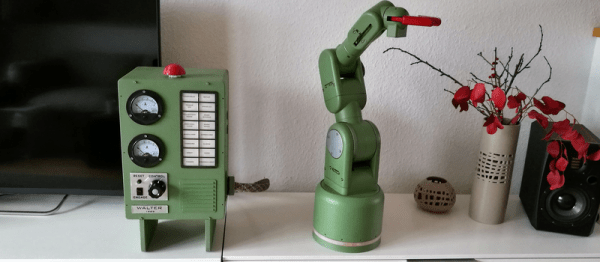
[Jochen Alt] is on a roll. We just covered his ball-balancing robot, Paul, only to find his phenomenal six-DOF robot arm in full retro style. Its name is “Walter” and it’s done up in DDR style (the former East Germany), in painted, 3D-printed plastic. The full design and build documents are an absolutely amazing resource if you’re into robot arm or legs.

In particular, the sections on trajectory planning and kinematics are fantastic. If you’re interested in robot motion planning by Bezier curves, you know where to go. (We’ve always wanted a Bezier-curve 3D printer slicer, but that’s another story.) The construction is also top-notch here, and the attention to detail that went into this arm is phenomenal. It’s all done with stepper motors and geared belts, which allow each of Walter’s joints to be driven by a motor that’s one joint further upstream than would be the case if it were designed with servos. [Jochen] even went so far as to expose the belt in some places to show off the gearing. Walter is worth checking out.

Even if you’ll never build such a fancy robot arm, you should read through the docs just to appreciate all of the thought and work that went into this very refined and simple-from-the-outside design. If you’d like to start out on the simple side of the spectrum, check out these robot arms made of office supplies or a desk lamp. Once you’re ready for your second arm project this short list, some of which [Jochen] mention in his writeup, should get you up and grasping. And do check out his balancing bot, Paul.

Looking Back At QRP Transmitters

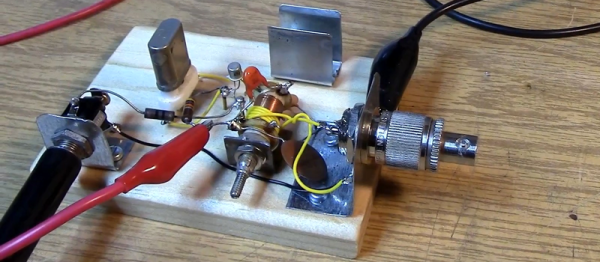
When you get to a certain age, you get unsettled by people calling “your” music oldies. That’s how a few of us felt when we saw [Mikrowave1’s] video about Retro QRP – Solid Gold Years (see below). “QRP” is the ham radio term for low power operation, and the “solid gold” years in question are the 1960s to 1980. The videox has some good stuff, including some old books and some analysis of a popular one-transistor design from that time. He even tries a few different period transistors to see which works best.

[Mikrowave1] talks about the construction techniques used in that time frame, old transistors, and some vintage test equipment. You can even see an old ARC-5 command receiver in use to listen to the transmitter. These were made for use in military aircraft and were very common as surplus.

Continue reading “Looking Back At QRP Transmitters”

Decimal Oscilloclock Harks Back To 1927 Movie

Metropolis is a classic, silent film produced in 1927 and was one of the very first full length feature films of the science fiction genre, and very influential. (C-3PO was inspired by Maria, the “Machine human” in Metropolis.) Within the first couple of minutes in the film, we get to see two clocks — one with a 24-hour dial and another larger one with a 10-hour dial. The human overlords of Metropolis lived a utopian 24 hour day, while the worker scum who were forced to live and work underground, were subjected to work in two ten-hour shifts during the same period.

[Aaron]’s client was setting up a Metropolis themed man-cave and commissioned him to build a Metropolis Oscilloclock which would not only show the 24 hour and 10 hour clocks from the film, but also accurately reproduce the clock movements and its fonts. [Aaron]’s Oscilloclock is his latest project in the series of bespoke CRT clocks which he has been building since he was a teen.

The clock is built around a Toshiba ST-1248D vintage oscilloscope that has been beautifully restored. There are some modern additions – such as LED glow indicators for the various valves and an external X-Y input to allow rendering Lissajous figures on the CRT. He’s also added some animations derived from the original poster of the film. Doing a project of this magnitude is not trivial and its taken him almost eight months to bring it from concept to reality. We recommend looking through some of his other blog posts too, where he describes how oscilloclocks work, how he builds the HV power supplies needed to drive the CRT’s, and how he ensures vibration and noise damping for the cooling fans used for the HV power supplies. It’s this attention to detail which results in such well-built clocks. Check out some of [Aaron]’s other awesome Oscilloclock builds that we have featured over the years.

The film itself has undergone several restoration attempts, with most of it being recovered from prints which were discovered in old archives. If you wish to go down that rabbit hole, check out Wikipedia for more details and then head over to YouTube where several versions appear to be hosted.

Continue reading “Decimal Oscilloclock Harks Back To 1927 Movie”