Stop Buying Expensive Circular Saw Blades, Use Paper Instead

[John Heisz] was contemplating the secrets of the universe when an errant thought led him to wonder, could I use a sheet of paper as the blade in my table saw?

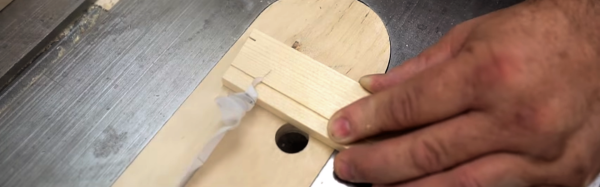
He takes a sheet of regular printer paper, draws a circle on it the same diameter as his regular blades, and cuts it out. He then bolts it into place on the spindle, slots in the table saw insert for really really thin kerf blades, and fires it up.

The blade is surprisingly dangerous. One would maybe expect a paper blade to be minimally damaging to a finger at best, but it quickly shows itself to be capable of tearing through paper and cutting through wood at a reasonable clip. Since the paper is minimally conductive, a SawStop couldn’t save someone from a lack of caution.

The blade finally meets its match half way through a half-inch thick piece of wood scrap. Wood and paper dust explode outward as the experiment ends. Video after the break.

Continue reading “Stop Buying Expensive Circular Saw Blades, Use Paper Instead”

Mechanized One-Man Sawmill

The title of ‘maker’ is conventionally applied to the young-adult age group. In the case of 84 year-old Ralph Affleck, a lifelong sawmiller, ‘maker’ perhaps undersells the accomplishment of building a fully functioning sawmill that can be operated by a single individual.

Starting in the trade at the age of 16 under his father’s tutelage, fifty years of working in sawmills saw him still loving what he did as retirement loomed. So, with pen, paper, and a simple school ruler he designed the entire shop from scratch. Decades of expertise working with wood allowed him to design the machines to account for warping and abnormalities in the timber resulting in incredibly accurate cuts.

With no other examples to guide his design — aside from perhaps old style steam-powered sawmills, and newer portable ones that he feels are inadequate for the job — much of the shop is built from scratch with scavenged parts. And, that list is impressive: four hydraulic cylinders from a Canberra bomber, levers from an old locomotive, differentials and gearboxes from a MAC and 1912 Republic trucks, a Leyland engine that operated for 13 years without the need for maintenance, and an assortment of old military and air force vehicle parts. This is complimented by his log skidder — also custom — that would look at home in a post-apocalyptic wasteland. Built from two tractors, it combines three gearboxes for 12 forward and 8 reverse gears(what!?), and can hit 42mph in reverse!

Continue reading “Mechanized One-Man Sawmill”

Make Your Own Transparent Wood

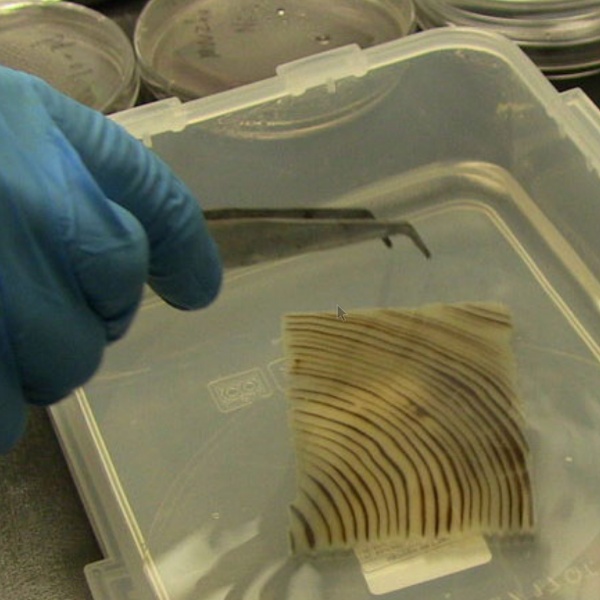
Want to bring your fine antique furniture into the 21st century? Make it clear with transparent wood. That’s what [blorggg] is doing over on Hackaday.io, and it looks cool enough to have a some interesting and novel applications besides small, clear test pieces.

The recipe for transparent wood is surprisingly simple, and all the ingredients are readily available from a drug store or home supply store. First, the wood is soaked in a bath containing lye and sodium sulfite for several hours. The wood is then bleached in a bath of hydrogen peroxide. After this, the wood is transparent, but very weak. Infusing the wood with epoxy resin strengthens the wood.

We first heard about this process back in May when the the paper [blorggg] based his recipe on came to light. the lye and sodium sulfite are frequently used in the paper industry to dissolve the lignin in wood. By removing the lignin, the microscopic structure of a piece of wood becomes just a series of tubes and thin cell walls. After bleaching, adding the epoxy shores up the now exceptionally weak structure of a block of wood.

While the original researchers only made two pieces of transparent wood – end grain and cross grain basswood, inexplicably referred to as R-wood and L-wood – [blorggg] is taking this much further. He’s using plywood to great effect, and the process is simple enough to expand to woods a bit weirder than basswood. If you have some scrap walnut, burl, or some exotic wood, this might be something to try out.

Walnut Windfall Winds Up In Custom Keyboard

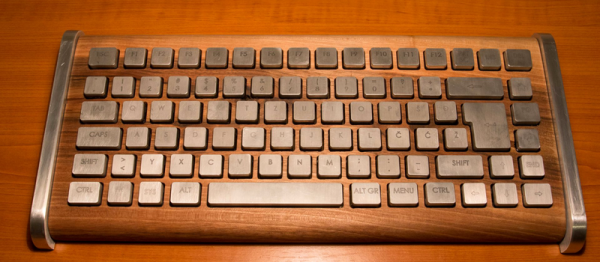
When a neighbor decided to cut down a walnut tree, [voluhar] decided to make something of the wood. The result was this custom keyboard that combines wood and metal in a lovely and functional package.

Walnut is a wood with a rich heritage in consumer electronics. Back in the early days of TV, huge console sets were built into solid walnut cabinets and proudly displayed along with the other fine furnishings in a home. [voluhar]’s keyboard captures a little of that spirit while retaining all the functionality you’d expect. From the custom PCB to the engraved aluminum key caps, it looks like every part was machined with a CNC router. The keyboard sports satisfyingly clicky Cherry MX switches, and a few cleverly positioned LEDs provide subtle feedback on the state of the locking keys. As for the imperfections in the walnut case, we think it just adds to the charm and warmth of the finished product, which would look great on any desktop.

Wood has appeared in a couple of custom keyboards that we’ve featured before, like this all-wood version. But if you want the retro look without the wood, you could always try a keyboard built out of a typewriter.

Continue reading “Walnut Windfall Winds Up In Custom Keyboard”

Star Trek Material Science Is Finally Real: Transparent Wood

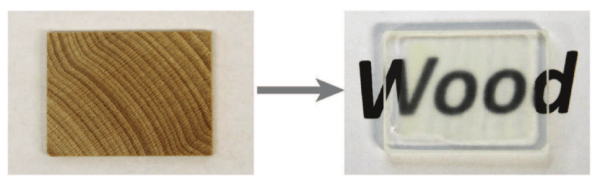
It’s not transparent aluminum, exactly, but it might be even better: transparent wood. Scientists at the University of Maryland have devised a way to remove all of its coloring, leaving behind an essentially clear piece of wood.

IMG_20160518_110605By boiling the block of wood in a NaOH and Na2SO chemical bath for a few hours the wood loses its lignin, which is gives wood its color. The major caveat here is that the lignin also gives wood strength; the colorless cellulose structure that remains is itself very fragile. The solution is to impregnate the transparent wood with an epoxy using about three vacuum cycles, which results in a composite that is stronger than the original wood.

There are some really interesting applications for this material. It does exhibit some haze so it is not as optimally transparent as glass but in cases where light and not vision is the goal — like architectural glass block — this is a winner. Anything traditionally build out of wood for its mechanical properties will be able to add an alpha color channel to the available options.

The next step is finding a way to scale up the process. At this point the process has only been successful on samples up to 1 centimeter thick. If you’re looking to build a starship out of this stuff in the meantime, your best bet is still transparent aluminum. We do still wonder if there’s a way to eliminate the need for epoxy, too.

Gear Clock Uses Stepper Motor

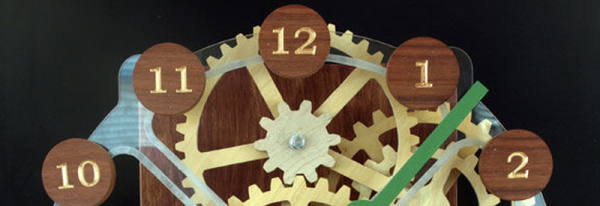
[Rjeuch] liked a wooden clock he saw on the Internet, but the gears were produced with a proprietary software tool. So he built his own version. Unlike the original, however, he chose to use a stepper motor to drive the hands.

The clock’s gears aren’t just for show, and the post does a good job explaining how the gears work, how you might customize them, and how they fit together. The clock’s electronics rely on an Arduino.

Continue reading “Gear Clock Uses Stepper Motor”

White Oak Illuminated Bluetooth Speaker

Besides being common tools available to most hackers and makers out there, 3D printing, CNC machines, and cheap Chinese electronics have one more things in common: they were all used by [Nick] to build a bluetooth speaker system that has some interesting LED effects built into the case.

This is fresh on the heels of another hack that used similar construction methods to build a “magic” wood lamp. [Nick] takes it a step further, though. His case is precisely machined in white oak and stuffed with the latest China has to offer: a bank of lithium-ion batteries, a DC-DC converter to power the amplifier, and a Bluetooth module. After some sanding, the speakers look professional alongside the blue light features hiding behind the polycarbonate rings.

Of course you’ll want to visit the project site for all the details of how [Nick] built his speaker case. He does admit, however, that the electronics are fairly inefficient and need a little work. All in all though, it’s a very refined set of speakers that’ll look great on a bookshelf or on a beach, workshop bench, or anyplace else that you could take them.

Continue reading “White Oak Illuminated Bluetooth Speaker”