Transistors That Grow On Trees

Modern technology is riddled with innovations that were initially inspired by the natural world. Velcro, bullet trains, airplanes, solar panels, and many other technologies took inspiration from nature to become what they are today. While some of these examples might seem like obvious places to look, scientists are peering into more unconventional locations for this transistor design which is both inspired by and made out of wood.

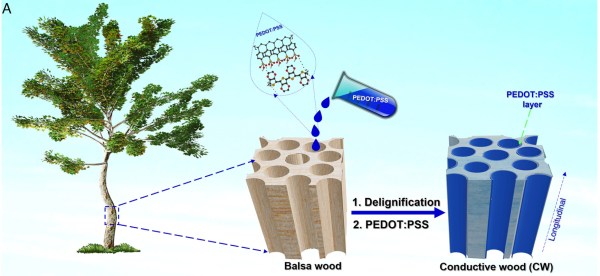
The first obvious hurdle to overcome with any electronics made out of wood is that wood isn’t particularly conductive, but then again a block of silicon needs some work before it reliably conducts electricity too. First, the lignin is removed from the wood by dissolving it in acetate, leaving behind mostly the cellulose structure. Then a conductive polymer is added to create a lattice structure of sorts using the wood cellulose as the structure. Within this structure, transistors can be constructed that function mostly the same as a conventional transistor might.

It might seem counterintuitive to use wood to build electronics like transistors, but this method might offer a number of advantages including sustainability, lower cost, recyclability, and physical flexibility. Wood can be worked in a number of ways once the lignin is removed, most notably when making paper, but removing the lignin can also make the wood relatively transparent as well which has a number of other potential uses.

Thanks to [Adrian] for the tip!

Automating The Most Analog Of HVAC Equipment

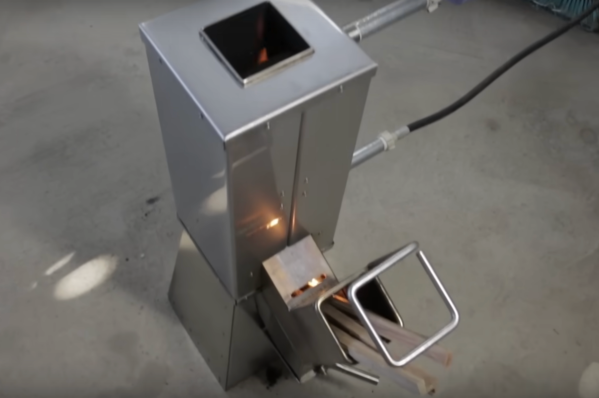
Burning wood, while not a perfect heating solution, has a number of advantages over more modern heating appliances. It’s a renewable resource, doesn’t add carbon to the atmosphere over geologic time scales like fossil fuels do, can be harvested locally using simple tools, and it doesn’t require any modern infrastructure to support it. That being said, wood stoves aren’t something that are very high-tech and don’t lend themselves particularly well to automation as a result, at least with the exception of this wood stove from [jotulf45v2].

While this doesn’t automate the loading or direct control of a modern pellet stove, it does help [jotulf45v2] know when the best times are for loading more wood into the stove and helps keep the stove in the right temperature range to avoid the dangerous formation of creosote on the inside of his chimney caused by low temperature burns. Two temperature sensors, one on the stovetop and the other on the stove pipe, monitor the stove exhaust temperature. They feed data to a Node-RED system running on a Raspberry Pi which automatically notifies the user by text message when certain stove temperatures are reached.

For anyone heating with wood, tools like this are indispensable to help avoid spending an otherwise unnecessary amount of time getting a fire up to temperature quickly without over-firing the stove. Modern pellet stoves have some more modern conveniences like this built in, but many of the perks of using cord wood are lost with these devices. There are plenty of other ways to heat with wood too; take a look at this custom wood boiler which serves as a hot water heater.

Custom Enclosure For 3D Printer

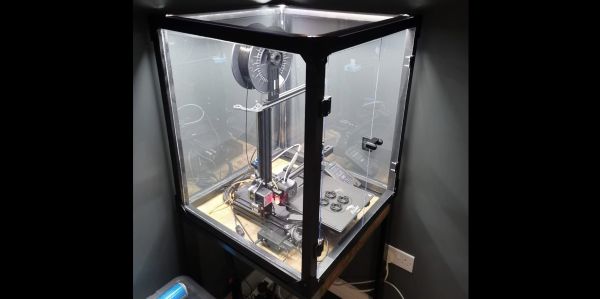
Having an enclosure around an FDM 3D printer is generally a good idea, even when printing only with PLA, as it keeps the noise in, and the heat (and smell, with ABS) inside. With all the available options for enclosures out there, however, [David McDaid] figured that it should be possible to make an enclosure that does not look like a grow tent and is not overly expensive. He also shared the design files on GitHub.

The essential idea is very simple and straightforward: the structural part is cut out of pine beams that are cut to size and joined into a cube by (3D-printed) corner brackets, with acrylic (Perspex) sheets filling in the space between the wooden beams. A door is formed using (also 3D-printed) hinges and door handles. The whole enclosure is rounded off with a lick of paint on the wooden elements, and a diffused set of LED lights for internal illumination.

It definitely has to be admitted that it makes for a very stylish enclosure, with a lot of modding potential. It can also easily be adapted to differently sized printers and filament material demands.

DIY Macro Keyboard Wood Be Nice

Editing video tends to involve a lot of keyboard shortcuts, and while this might be fine for the occasional edit, those who regularly deal with video often reach for a macro pad to streamline their workflow. There are plenty of macro keyboards available specifically meant to meet the needs of those who edit a lot of video, but if you want something tailored for your personal workflow you may want to design your own keyboard like this wooden macro pad from [SS4H].

The keyboard itself is built around an STM32 microcontroller, which gives it plenty of power to drive and read the keyboard matrix. It also handles an encoder that is typically included on macro keyboards for video editing, but rather than using a potentiometer-type encoder this one uses a magnetic rotary encoder for accuracy and reliability. There’s a display built into the keyboard as well with its own on-board microcontroller that needs to be programmed separately, but with everything assembled it looks like a professional offering.

[SS4H] built a prototype using 3D printed parts, but for the final version he created one with a wooden case and laser etched keys to add a bit of uniqueness to the build. He also open-sourced all of the PCB schematics and other files needed to recreate this build so anyone can make it if they’d like. It’s not the only macro keyboard we’ve seen before, either, so if you’re looking for something even more esoteric take a look at this keyboard designed to be operated by foot.

Continue reading “DIY Macro Keyboard Wood Be Nice”

Self-Propelled Chainsaw Reduces Injuries

[Advoko] is an expert at milling logs into various sizes of boards. He typically uses nothing but a chainsaw to enable him to mill on-site without needing to bring any large or expensive equipment. The only problem is that sometimes he gets a little carried away running his mill non-stop until he has enough lumber for whatever project he is building, which has led to some repetitive strain injuries. To enable him to continue to run his mill, he’s created this self-propelled chainsaw jig.

The creation of the self-propelled chainsaw was a little serendipitous. [Advoko] needed to mill a tree which had fallen on a slope, and he couldn’t move the large trunk before starting to mill. To avoid fatigue while pulling his chainsaw upwards, he devised a system of rubber belts that would help pull the weight of the chainsaw up the hill. Noticing that if the chainsaw could have been operated downhill, it would essentially pull itself along the cut, he set about building a carriage for the mill to hold the chainsaw in place while it semi-autonomously milled lumber for him.

The chainsaw jig isn’t fully autonomous; [Advoko] still needs to start and stop the chainsaw and set up the jig. It does have a number of safety features to prevent damage to the jig, the chainsaw, and himself too, and over a number of iterations of this device he has perfected it to the point where he can start it on a cut and then do other tasks such as move boards or set up other logs for cutting while it is running, saving him both time and reducing his risk of other repetitive strain injuries. If you don’t fully trust the automatic chainsaw jig, take a look at this one which requires a little more human effort but still significantly reduces the strain of milling a large log.

Continue reading “Self-Propelled Chainsaw Reduces Injuries”

I’ve Got Two Turntables And A Laser Engraver

Digital media provides us with a lot of advantages. For something like recording and playing back music, digital copies don’t degrade, they can have arbitrarily high quality, and they can be played in a number of different ways including through digital streaming services. That being said, a number of people don’t feel like the digital experience is as faithful to the original sound as it could be and opt for analog methods instead. Creating analog copies of music is a much tougher matter though, as [Marco] demonstrates by using a laser engraver to produce vinyl records.

[Marco] started this month-long project by assembling and calibrating the laser engraver. It has fine enough resolution to encode analog data onto a piece of vinyl, but he had to create the software. The first step was to generate the audio sample, then process it through a filter to remove some of the unwanted frequencies. From there, the waveform gets made into a spiral, accounting for the changing speed of the needle on the record as it moves to the center. Then the data is finally ready to be sent to the laser engraver.

[Marco] did practice a few times using wood with excellent success before moving on to vinyl, and after some calibration of the laser engraver he has a nearly flawless 45 rpm record ready to hit the turntable. It’s an excellent watch if not for anything than seeing a working wood record. We’ve actually seen a similar project before (without the wood prototyping), and one to play records from an image, but it’s been quite a while.

Thanks to [ZioTibia81] for the tip!

Continue reading “I’ve Got Two Turntables And A Laser Engraver”

A Simple Stove, Built For Beans

Sitting around a campfire or fireplace is an aesthetically pleasing experience in most situations, and can even provide some warmth. But unless you have a modern wood-burning appliance, it’s likely that most of the energy available in the biomass is escaping as un-burned vapors. Surprisingly, solving this problem is almost as easy as buying a can of beans at the store, and the result is a very efficient stove which can be used for heat in a pinch.

[Robert] is demonstrating this gasifier stove, not with beans but using both a can of peas and a larger can of potatoes. Various holes are drilled in each can in a specific pattern, and then the smaller pea can is fitted inside the larger potato can. Once a fire is going, the holes allow for air to flow in a way which traps the escaping un-burned vapors from the fuel and burns them as they flow through the contraption. No moving parts are required; this is all powered by the natural airflow that’s produced by the heat of the fire.

The result of a build like this is not only a stove which can extract a much higher percentage of the available fuel, but also quires much less fuel for a given amount of heat, and produces a much cleaner, less smokey fire. [Robert] also added a screen mantle which allows for this to be used more as a heat source, but similar builds can also be used just as effectively for cooking, too.

Continue reading “A Simple Stove, Built For Beans”