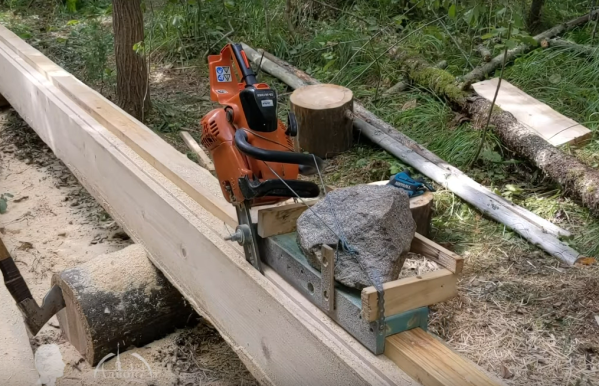
[Advoko] is an expert at milling logs into various sizes of boards. He typically uses nothing but a chainsaw to enable him to mill on-site without needing to bring any large or expensive equipment. The only problem is that sometimes he gets a little carried away running his mill non-stop until he has enough lumber for whatever project he is building, which has led to some repetitive strain injuries. To enable him to continue to run his mill, he’s created this self-propelled chainsaw jig.
The creation of the self-propelled chainsaw was a little serendipitous. [Advoko] needed to mill a tree which had fallen on a slope, and he couldn’t move the large trunk before starting to mill. To avoid fatigue while pulling his chainsaw upwards, he devised a system of rubber belts that would help pull the weight of the chainsaw up the hill. Noticing that if the chainsaw could have been operated downhill, it would essentially pull itself along the cut, he set about building a carriage for the mill to hold the chainsaw in place while it semi-autonomously milled lumber for him.
The chainsaw jig isn’t fully autonomous; [Advoko] still needs to start and stop the chainsaw and set up the jig. It does have a number of safety features to prevent damage to the jig, the chainsaw, and himself too, and over a number of iterations of this device he has perfected it to the point where he can start it on a cut and then do other tasks such as move boards or set up other logs for cutting while it is running, saving him both time and reducing his risk of other repetitive strain injuries. If you don’t fully trust the automatic chainsaw jig, take a look at this one which requires a little more human effort but still significantly reduces the strain of milling a large log.




 But ironically, this homage features a critical piece that’s actually not made of wood. The 77’s pickup pattern was cardioid, making for a directional mic that picked up sound best from the front, thanks to an acoustic labyrinth that increased the path length for incoming sound waves. [Frank]’s labyrinth was made from epoxy resin poured into a mold made from heavy paper, creating a cylinder with multiple parallel tunnels. The tops and bottoms of adjacent tunnels were connected together, creating an acoustic path over a meter long. The ribbon motor, as close to a duplicate of the original as possible using wood, sits atop the labyrinth block’s output underneath a wood veneer shell that does its best to imitate the classic pill-shaped windscreen of the original. The video below, which of course was narrated using the mic, shows its construction in detail.