This bit of nostalgia really caught our attention. A german hacker or “inventor” as we were called back then, came up with this interesting concept. He would project an image on to the moving blades of an Autogiro, relying on the POV effect to make it appear complete. While this is not the same system of utilizing POV that we currently use, it relies on the same principles. It looks like he’s hanging the projector or “magic lantern” from below the Autogiro, using the length of the rope to hang it as a focusing system. Were this to have actually gone into production, it probably would have really freaked people out. If only he had had access to something along the lines of the ceiling fan POV system.
[thanks itay]
[update: Why didn't we look around for this earlier. It was brought up in the comments, there is in fact a POV system for R/C helis. http://www.nightgraphix.de (translated)]
We’ve all seen those little toy helicopters appearing everywhere. They’re getting cheaper and cheaper with some models getting down to roughly $30. The JRL team wanted to be able to control them with a PC, and figured the best way to do it was to build somewhat of a universal remote for them. The HeliControl module currently has several different types of copters programmed in, and they plan on adding more. Its not surprising to see the rise in popularity of these mini choppers, we’ve even seen some pretty extensive mods to the bodies and even mechanicals. Click around this forum to see what some people are doing to them.
[Kiethrobot] built this six legged little helicopter. You can see that it is fairly mobile. You can also see that it doesn’t really make it off the ground really well. He must have gotten more power out of it though because he destroyed it in a crash the day after filming this. It is surprising how much character those six little legs add to the RC helicopter. This thing is almost as cute as something from crabfu.
Have you ever wondered how they inspect high voltage cables without taking them out of service? Check out this video which offers a glimpse into the life of a professional high voltage cable inspector. There are parts of the job you’d expect—namely perching on the cable like a bird, trying to not fall off—but the part of the job you wouldn’t expect is the suit. This suit is made of 75% Nomex, to prevent it from catching fire, and 25% stainless steel thread, turning the suit into a wearable Faraday cage. Of course, because he’s got a Faraday cage mere millimeters from his skin, the cable inspector spends his workday surrounded by half a million volts. To avoid electric shock, he equalizes the voltage potential between himself and the line before touching the cable.
Depending on your specific phobias, this video might make your job seem really dull… or really really safe.
We welcome the swarm of autonomous hovering robot overlords being made by students at Humboldt University. The goal of this project is to build an autonomous hovering platform that is controlled via adapted insect behavior. Navigation comes from monitoring real time inputs, such as air pressure and optical sensors, not by predefined paths and GPS coordinates. Some examples of this adapted behavior are: navigation via polarized sun light like African ants, and optical flow similar to bees.
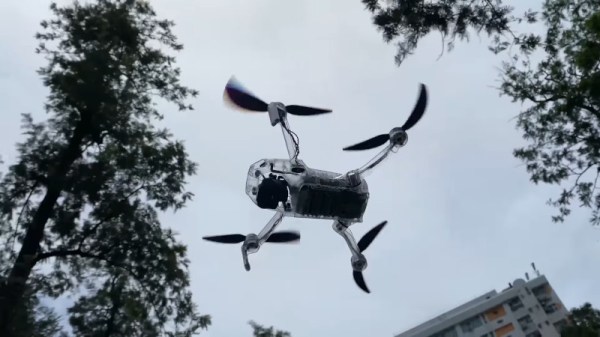
If any of this seems familiar, it’s because we covered CCCamp 2007, which was near Berlin and had some very similar quadcopters. While the large quadcopter platforms have been around for a while and are steadily coming down in price, there are some new alternatives out there that are quite tempting. Anyone want to build some autonomy into this little baby?
Stanford’s autonomous helicopter group has made some impressive advancements in the field of autonomous helicopter control, including inverted hovering and performing aerobatic stunts. The group uses reinforcement learning to teach its control system various maneuvers and has been very successful in doing so. One of their latest achievements was teaching the bot the emergency landing technique autorotation. Autorotation is used when a helicopter’s engine fails or is disengaged and works by changing the collective pitch to use the airflow from descent to rotate the blades. The group has more flight demonstrations on their YouTube channel.
I guess we’re on a UAV kick – I ran across this one when I was looking for interesting propeller projects. [Glenn]’s building this one based on a R/C helicopter he picked up. Both the controller and the heli recieved a propeller chip, along with a pretty standard array of navigation sensors for the heli. It’s a work in progress, but sometimes those are the most inspiring.
R/C quad-copters have been quite popular at CCCamp. Our friend, Dan Kaminsky shot this video of two different models in flight. The first is a 10K Euro commercial version, but the second one is a 500 Euro home built one. The commercial unit has a head mounted display so you can fly it from the onboard camera. There is a second video after the break that shows the maneuverability.